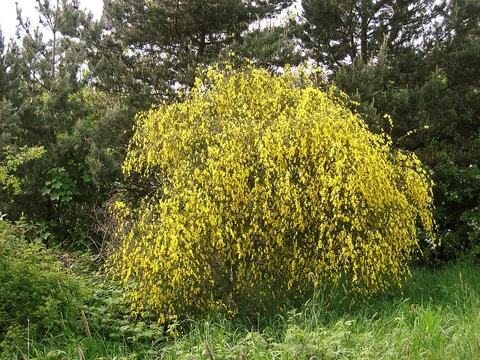
Corylus maxima
A Eurasian hazel species producing edible nuts in tubular husks.
Last updated

Hladac · CC BY-SA 4.0
Corylus maxima is a plant species, not an animal, classified in the family Betulaceae.[1] Its edible nut, called the filbert, is very similar to the hazelnut and is used as a large filler in mixed nuts in the United States.[2] The natural distribution of this plant covers the Balkan region and extends eastward to Ordu in Turkey, placing it in southeastern Europe and southwestern Asia.[3]
Scientific classification
- CladeTracheophytes
- CladeAngiosperms
- CladeEudicots
- CladeRosids
- OrderFagales
- FamilyBetulaceae
- GenusCorylus
- SpeciesCorylus maxima
Named by Mill.
Sources: Wikipedia taxobox: Corylus maxima (CC BY-SA 4.0)
Conservation status
Data Deficient (DD)
Data Deficient: there is not enough information to place this species on the risk scale.
Source: IUCN Red List assessment · GBIF copy of the Red List category
Where the corylus maxima has been recorded
Each dot is a place where the species has been observed and reported (2,283 records, half-degree grid) — not a modelled range. 353 inland records left out (institution coordinates).
Map: drawn by Codexery. Data: GBIF occurrence search (records CC0 / CC BY) · Natural Earth basemap (public domain)
Quick Facts
- Species
- maxima
Facts from the source article.
Biology and range
Pale yellow male catkins measure 5–10 cm, while the bright red female ones are just 1–3 mm long.[2] Nuts grow in groups of one to five.[2] Each nut, 1.5–2.5 cm in length, sits completely inside a tubular husk that is 3–5 cm long.[2] This species occurs naturally from the Balkans to Ordu in Turkey, covering parts of southeastern Europe and southwestern Asia.[3]
What the specialist sources record
GBIF Backbone Taxonomy accepts Corylus maxima Mill. as a species in the order Fagales, family Betulaceae.[1] GBIF holds 2,730 occurrence records for this taxon as of 7 October 2026.[1] According to the Oxford English Dictionary, the word 'filbert' may come from Norman French.[4] In Oregon, the term "filbert" refers to all commercial hazelnuts, as stated by the Oregon Hazelnut Marketing Board.[5]
References
- GBIF Backbone Taxonomy and occurrence index, Corylus maxima (taxon key 2876049). CC BY 4.0 (backbone); counts are facts. gbif.org
- Wikipedia, "Corylus maxima" (CC BY-SA 4.0), which cites: Rushforth, K. (1999). Trees of Britain and Europe. Collins .; Flora of NW Europe: Corylus maxima (original not read by us) en.wikipedia.org
- Wikipedia, "Corylus maxima" (CC BY-SA 4.0), which cites: Rushforth, K. (1999). Trees of Britain and Europe. Collins . (original not read by us) en.wikipedia.org
- Wikipedia, "Corylus maxima" (CC BY-SA 4.0), which cites: Oxford English Dictionary. (original not read by us) en.wikipedia.org
- Wikipedia, "Corylus maxima" (CC BY-SA 4.0), which cites: Oregon Hazelnut Marketing Board; "Agriculture Quarterly - Oregon Department of Agriculture", www.oda.state.or.us (original not read by us) en.wikipedia.org
Each numbered sentence above was checked against the source it cites before publication. Sentences citing Wikipedia adapt text from the English Wikipedia article Corylus maxima (contributors), used under CC BY-SA 4.0; this entry is available under the same licence. Other sources were used for facts only; no text or images are copied from them.
More in Trees & Shrubs
Sources
Compiled from Wikipedia and the sources listed below. Text from Wikipedia is available under CC BY-SA 4.0; this entry is adapted from it.
- Wikipedia: Corylus maxima (CC BY-SA 4.0).
- Conservation status: IUCN Red List assessment.
- Occurrence records: GBIF (CC0 / CC BY). Basemap: Natural Earth (public domain).
- Word definitions: the Codexery glossary, each quoted from its Wikipedia article.
Spotted an error? Know more?
Reader corrections go straight into our review queue. Suggest an edit · How this site is sourced