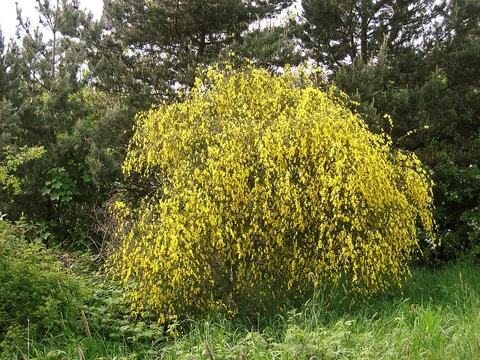
Cupressus sempervirens
A long-lived evergreen tree central to Mediterranean culture and ecology.
Last updated

Al*from*Lig · CC BY-SA 4.0
Cupressus sempervirens is a coniferous evergreen tree native to the eastern Mediterranean region and Iran.[1] It is known for its long lifespan, with some individuals exceeding 1,000 years.[2]
Scientific classification
- CladeTracheophytes
- CladeGymnosperms
- ClassPinopsida
- OrderCupressales
- FamilyCupressaceae
- GenusCupressus
- SpeciesCupressus sempervirens
Named by L.
Sources: Wikipedia taxobox: Cupressus sempervirens (CC BY-SA 4.0) · order, family and genus agree with WoRMS AphiaID 1492691 (CC BY 4.0)
Conservation status
Least Concern (LC)
- LC▲ this species
- NT
- VU
- EN
- CR
- EW
- EX
Source: IUCN Red List assessment · GBIF copy of the Red List category
Where the cupressus sempervirens has been recorded
Each dot is a place where the species has been observed and reported (14,749 records, half-degree grid) — not a modelled range. 376 inland records left out (institution coordinates). 2 isolated far-off records not drawn.
Map: drawn by Codexery. Data: GBIF occurrence search (records CC0 / CC BY) · Natural Earth basemap (public domain)
Biology and range
The seed cones are ovoid or oblong, 25-40 mm long, with 10-14 scales that mature to brown after 20-24 months.[3] The cones display serotiny, remaining sealed for years until fire induces seed release.[4][3] The species grows primarily in places with wet winters and hot summers.[5] It is tolerant to temperatures as low as -20°C.[4]
According to the conifers.org source, Cupressus sempervirens typically grows to a height of 20-30 m, while Wikipedia's description section (citing multiple sources) reports it reaches up to 35 m tall with a conic crown and dense, dark green foliage in sprays.[4][2][6] Wikipedia's lead section (citing an EFSA report) states that this species is found throughout the Mediterranean basin and can survive in both acidic and alkaline soils.[7]
What the specialist sources record
The Conifers.org account notes that native stands have big trees around 20-25 m tall and 50 cm dbh.[4] The Sarv-e Abarku in Iran, a multi-trunked tree, was approximately 573 cm dbh and 25 m tall in 2016.[4] The cones are composed of 8 to 14 opposite scales with a small central umbo.[4] After shedding seeds, the cone persists on the tree for several years.[4]
GBIF holds 20,442 occurrence records for this taxon.[8] The WoRMS database lists its environment as terrestrial.[9]
References
- Wikipedia, "Cupressus sempervirens" (CC BY-SA 4.0), which cites: "The IUCN Red List of Threatened Species", IUCN Red List of Threatened Species, 2011-07-15; (original not read by us) en.wikipedia.org
- Wikipedia, "Cupressus sempervirens" (CC BY-SA 4.0), which cites: See also Uses section for the differing cultivated variants; Mauri, "EU-Trees4F, a dataset on the future distribution of European tree species", Scientific Data, 2022-02-03, p. 37 (original not read by us) en.wikipedia.org
- Wikipedia, "Cupressus sempervirens" (CC BY-SA 4.0), which cites: "Cupressus sempervirens (Mediterranean cypress) description", www.conifers.org (we also read that source) en.wikipedia.org
- "Cupressus sempervirens (Mediterranean cypress) description", www.conifers.org. facts only, no text reused. conifers.org
- Wikipedia, "Cupressus sempervirens" (CC BY-SA 4.0), which cites: "Supporting EFSA assessment of the EU environmental suitability for exotic forestry pests: Final Report", EFSA Supporting Publications, March 2014; Mauri, "EU-Trees4F, a dataset on the future distribution of European tree species", Scientific Data, 2022-02-03, p. 37; "Supporting EFSA assessment of the EU environmental suitability for exotic forestry pests: Final Report", EFSA Supporting Publications, March 2014; Selim, "Chemical composition, antimicrobial and antibiofilm activity of the essential oil and methanol extract of the M en.wikipedia.org
- Wikipedia, "Cupressus sempervirens" (CC BY-SA 4.0), which cites: Weick, "The Ethnobotanical Evolution of the Mediterranean Cypress (Cupressus sempervirens)", Economic Botany, June 2023, p. 203–221 (original not read by us) en.wikipedia.org
- Wikipedia, "Cupressus sempervirens" (CC BY-SA 4.0), which cites: "Supporting EFSA assessment of the EU environmental suitability for exotic forestry pests: Final Report", EFSA Supporting Publications, March 2014 (original not read by us) en.wikipedia.org
- GBIF Backbone Taxonomy and occurrence index, Cupressus sempervirens (taxon key 2684030). CC BY 4.0 (backbone); counts are facts. gbif.org
- World Register of Marine Species, Cupressus sempervirens (AphiaID 1492691). CC BY 4.0. marinespecies.org
Each numbered sentence above was checked against the source it cites before publication. Sentences citing Wikipedia adapt text from the English Wikipedia article Cupressus sempervirens (contributors), used under CC BY-SA 4.0; this entry is available under the same licence. Other sources were used for facts only; no text or images are copied from them.
More in Trees & Shrubs
Sources
Compiled from Wikipedia and the sources listed below. Text from Wikipedia is available under CC BY-SA 4.0; this entry is adapted from it.
- Wikipedia: Cupressus sempervirens (CC BY-SA 4.0).
- Classification: the source article's taxobox; order, family and genus checked against WoRMS, the World Register of Marine Species (CC BY 4.0).
- Conservation status: IUCN Red List assessment.
- Occurrence records: GBIF (CC0 / CC BY). Basemap: Natural Earth (public domain).
Spotted an error? Know more?
Reader corrections go straight into our review queue. Suggest an edit · How this site is sourced