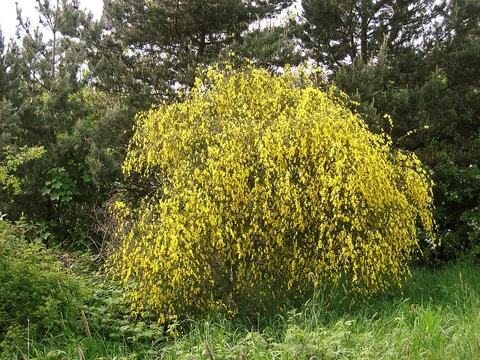
Larch
Deciduous conifers, the most abundant tree genus on Earth.
Last updated
Larches are deciduous coniferous trees native to the cooler temperate northern hemisphere, growing 20 to 45 m tall.[1] Philip Miller, an English botanist, provided the initial description of the genus Larix in 1754.[1][2] Unlike most conifers, which are evergreen, larches shed their foliage each autumn.[3][1]
Scientific classification
- CladeTracheophytes
- CladeGymnosperms
- ClassPinopsida
- OrderPinales
- FamilyPinaceae
- GenusLarix
Named by Mill.
Sources: Wikipedia taxobox: Larch (CC BY-SA 4.0)
Quick Facts
- Type species
- Larix decidua
Facts from the source article.
Biology and range
Male pollen cones are small and die after pollination, while female seed cones are erect and take 4–7 months to mature.[4] Seed cones are 1 to 9 cm long, green or purple when young, ripening brown 5 to 8 months after pollination.[1] Larches require a cool and fairly humid climate, growing in mountains of temperate zones and in plains of northern boreal zones.[5] The branch structure of larch trees is dimorphic: on long shoots, needles are arranged singly and spirally, while on short shoots, they form dense bundles of 20 to 50.[6][1]
Young larch trees have a smooth bark surface, which becomes thick and develops scales as the tree matures.[3] Across the Northern Hemisphere, from North America through Europe and mountainous China to northern Siberia, the genus Larix occupies all temperate-cold zones.[5] Larix occidentalis* is the tallest larch species, with a potential height of 50 to 60 meters.[6]
What the specialist sources record
The International Dendrology Society account notes that larches are the archetypal deciduous conifer, with leaves turning gold, yellow and orange before falling in autumn.[7] The same source states that larch timber is extremely strong and durable, far more so than that of firs, spruces and pines.[7] The American Conifer Society database reports that in the past, cone bract length was used to divide larches into two sections, but genetic evidence does not support this division.[1] The UK Moths account describes the larch pug caterpillar feeding on larch needles and being well-camouflaged.[8]
The Forestry and Land Scotland account states that hybrid larch arose from accidental cross-pollination of Japanese and European larch.[9] The same source notes that unlike other conifers, larch changes crown colour in spring, autumn and winter.[9]
References
- "Larix Genus (larch)", American Conifer Society. facts only, no text reused. conifersociety.org
- Wikipedia, "Larch" (CC BY-SA 4.0), which cites: "Larix Genus (larch)", American Conifer Society; Miller, "The Gardeners Dictionary", Philip Miller, 1754 (we also read that source) en.wikipedia.org
- Wikipedia, "Larch" (CC BY-SA 4.0), which cites: "Larix Mill.", International Dendrology Society (we also read that source) en.wikipedia.org
- Wikipedia, "Larch" (CC BY-SA 4.0), which cites: "Larix Mill.", International Dendrology Society; "Larix Mill.", International Dendrology Society; "Larix Mill.", International Dendrology Society; "Larix Mill.", International Dendrology Society (we also read that source) en.wikipedia.org
- Wikipedia, "Larch" (CC BY-SA 4.0), which cites: Tsepliaev, "The Forests of the U.S.S.R.", Israel Program for Scientific Translations, 1965, p. 289 (Table 86); Farjon, "Introduction to the Conifers", Curtis's Botanical Magazine, 1999, p. 158–172 (original not read by us) en.wikipedia.org
- Wikipedia, "Larch" (CC BY-SA 4.0), which cites: Stace, "New Flora of the British Isles", Cambridge University Press, 2010 (we also read that source) en.wikipedia.org
- "Larix Mill.", International Dendrology Society. facts only, no text reused. treesandshrubsonline.org
- "Larch Pug Eupithecia lariciata", UK Moths. facts only, no text reused. ukmoths.org.uk
- "Hybrid larch", Forestry and Land Scotland. facts only, no text reused. forestryandland.gov.scot
Each numbered sentence above was checked against the source it cites before publication. Sentences citing Wikipedia adapt text from the English Wikipedia article Larch (contributors), used under CC BY-SA 4.0; this entry is available under the same licence. Other sources were used for facts only; no text or images are copied from them.
More in Trees & Shrubs
Sources
Compiled from Wikipedia and the sources listed below. Text from Wikipedia is available under CC BY-SA 4.0; this entry is adapted from it.
- Wikipedia: Larch (CC BY-SA 4.0).
- Word definitions: the Codexery glossary, each quoted from its Wikipedia article.
Spotted an error? Know more?
Reader corrections go straight into our review queue. Suggest an edit · How this site is sourced