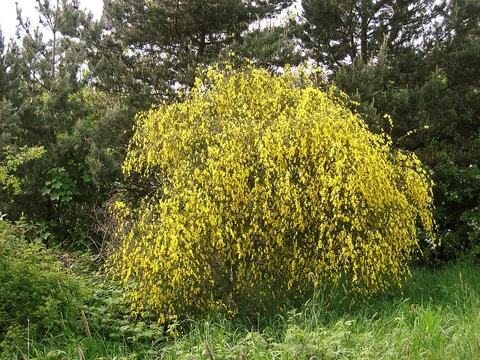
Cupressaceae
Last updated
Cupressaceae is a family of conifers with a near-global distribution, found on all continents except Antarctica.[1] The family includes important timber species and many plants used in horticulture.[2][3] Its pollen is a major cause of hay fever in regions where these trees are abundant.[4]
Scientific classification
- CladeTracheophytes
- CladeGymnosperms
- ClassPinopsida
- OrderCupressales
- FamilyCupressaceae
Named by Bartlett
Sources: Wikipedia taxobox: Cupressaceae (CC BY-SA 4.0)
Biology and range
Cupressaceae leaves are arranged spirally, in decussate pairs, or in whorls of three or four.[5] Old leaves are usually shed in small sprays of foliage rather than individually.[5] The family ranges from 70°N in Norway to 55°S in Chile, further south than any other conifer.[1] Most land habitats are occupied except polar tundra and tropical lowland rainforest.[1]
Only a few species tolerate severe drought, such as Cupressus dupreziana in the central Sahara.[1] In many Cupressaceae genera, the foliage transitions from needle-like on immature specimens to scale-like on older ones.[5] Within Tibet, Juniperus indica has been documented growing at elevations reaching 4930 meters.[1] Phylogenetic analyses indicate that Cupressaceae and the yew family (Taxaceae) are sister clades.[6]
What the specialist sources record
The World Register of Marine Species lists Cupressaceae as a family in the order Cupressales, class Pinopsida, with a freshwater and terrestrial environment.[7] GBIF records 2,026,038 occurrence records for Cupressaceae as of October 2026.[8] The California State Capitol Museum notes that coast redwood and giant sequoia jointly share the designation of California's state tree.[9] A 2005 book titled "Carving Cypress Knees" discusses the use of bald cypress knees for souvenirs and folk art.[10][11]
A 2015 book titled "The Allergy-Fighting Garden" provides OPALS allergy scale ratings for Cupressaceae species.[12][4]
References
- Wikipedia, "Cupressaceae" (CC BY-SA 4.0), which cites: Tumajer, "Growing faster, longer, or both? Modelling plastic response of Juniperus communis growth to climate change", Global Ecology and Biogeography, 18 August 2021; Holz, "Radial growth response to climate change along the latitudinal range of the world's southernmost conifer in southern South America", Journal of Biogeography, 25 March 2018, p. 1140–1152; Miehe, "Highest Treeline in the Northern Hemisphere Found in Southern Tibet", Mountain Research and Development, 1 May 2007, p. 169 173 (original not read by us) en.wikipedia.org
- Wikipedia, "Cupressaceae" (CC BY-SA 4.0), which cites: McDonald, "Incense-Cedar: an American wood", US Forest Service, October 1973; Evarts, "C. L. Ma Collection: Traditional Chinese Furniture from the Greater Shanxi Region", C.L. Ma Furniture, 1999; Evarts, "C. L. Ma Collection: Traditional Chinese Furniture from the Greater Shanxi Region", C.L. Ma Furniture, 1999; Thomas, P., "Fokienia hodginsii", 2013; (we also read that source) en.wikipedia.org
- Wikipedia, "Cupressaceae" (CC BY-SA 4.0), which cites: "Junipers", Chicago Botanic Garden; Westerfield, "Junipers", University of Georgia Extension, 6 October 2022 (original not read by us) en.wikipedia.org
- Wikipedia, "Cupressaceae" (CC BY-SA 4.0), which cites: Charpin, "Cypress pollen allergy", Revue des Maladies Respiratoires, 2013, p. 868–878; Krihara (Kurihashi), "Physiochemical and immunological characterization of major allergens of Japanese cedar pollen and false cypress pollen", Allergology, 1997, p. 203–211; Ogren, "The Allergy-Fighting Garden: Stop Asthma and Allergies with Smart Landscaping", Ten Speed Press, 2015; Ogren, "The Allergy-Fighting Garden: Stop Asthma and Allergies with Smart Landscaping", Ten Speed Press, 2015 (we also read that source) en.wikipedia.org
- Wikipedia, "Cupressaceae" (CC BY-SA 4.0), which cites: ; (original not read by us) en.wikipedia.org
- Wikipedia, "Cupressaceae" (CC BY-SA 4.0), which cites: Stull, "Gene duplications and phylogenomic conflict underlie major pulses of phenotypic evolution in gymnosperms", Nature Plants, 19 July 2021, p. 1015–1025; Escapa, "A new genus of the Cupressaceae (sensu lato) from the Jurassic of Patagonia: Implications for conifer megasporangiate cone homologies", Review of Palaeobotany and Palynology, September 2008, p. 110–122 (original not read by us) en.wikipedia.org
- World Register of Marine Species, Cupressaceae (AphiaID 1492688). CC BY 4.0. marinespecies.org
- GBIF Backbone Taxonomy and occurrence index, Cupressaceae (taxon key 8144). CC BY 4.0 (backbone); counts are facts. gbif.org
- "State Tree – California Redwood", California State Capitol Museum, 20 October 2021. capitolmuseum.ca.gov
- Open Library record, ISBN 9781565232716 ("Carving Cypress Knees"). CC0 (metadata); book content not read. openlibrary.org
- Wikipedia, "Cupressaceae" (CC BY-SA 4.0), which cites: Williams, "Carving Cypress Knees: Creating Whimsical Characters from One of Nature's Most Unique Woods", Fox Chapel Publishing, 1 September 2005; Reynolds, "Standing Before the Lone Cypress", Los Angeles Times, 19 May 2013 (we also read that source) en.wikipedia.org
- Open Library record, ISBN 9781607744917 ("The allergy-fighting garden"). CC0 (metadata); book content not read. openlibrary.org
Each numbered sentence above was checked against the source it cites before publication. Sentences citing Wikipedia adapt text from the English Wikipedia article Cupressaceae (contributors), used under CC BY-SA 4.0; this entry is available under the same licence. Other sources were used for facts only.
More in Trees & Shrubs
Sources
Compiled from Wikipedia and the sources listed below. Text from Wikipedia is available under CC BY-SA 4.0; this entry is adapted from it.
- Wikipedia: Cupressaceae (CC BY-SA 4.0).
- Word definitions: the Codexery glossary, each quoted from its Wikipedia article.
Spotted an error? Know more?
Reader corrections go straight into our review queue. Suggest an edit · How this site is sourced