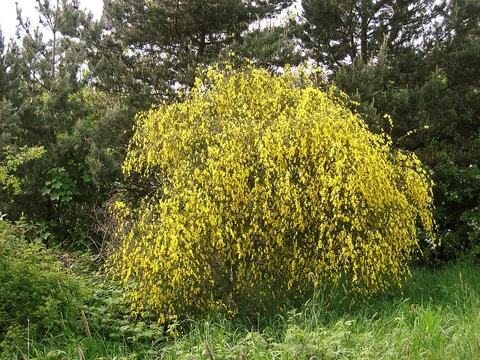
Conifer
Last updated
They produce separate male and female cones on the same tree and are pollinated by wind.[1][2] Narrow, often needle-shaped leaves are a characteristic feature of the woody plants known as conifers, the majority of which are trees.[1] Within the conifer group are found the planet's tallest and most ancient living tree specimens.[1]
Scientific classification
- CladeTracheophytes
- CladeGymnosperms
- ClassPinopsida
Sources: Wikipedia taxobox: Conifer (CC BY-SA 4.0)
Biology and range
In many species, leaves are long, thin, and needle-like; in others, they are flat, triangular, and scale-like.[3][4] The seeds are mostly winged samaras dispersed by wind.[1] Around 200 conifer species live only in the tropics.[5] Throughout the entire year, most conifers keep their functional leaves, making them evergreen.[3]
The length of conifer leaves can be as short as 2 mm for species with scale-like leaves, or reach up to 600 mm in certain pine species.[6] A strobilus, or protective cone, is the structure inside which conifers develop their seeds.[2] Larches, pines, and spruces are the primary tree types that make up the taiga forest.[7]
What the specialist sources record
The Tree Guide UK account notes that conifers do not have flowers or fruit, unlike broadleaf trees.[8] The same source states that some conifers, such as the Stone Pine, have large seeds dispersed by birds or animals.[8] Worrall's "Foliage Diseases" account explains that conifers cannot refoliate like hardwoods, so foliage diseases are often more damaging to them.[9] That source adds that most genera of conifers serve as hosts to needle casts.[9]
The World Register of Marine Species lists Pinopsida as an accepted class with a freshwater and terrestrial environment.[10] According to the GBIF database, the class Pinopsida has 9,083,114 occurrence records.[11]
References
- Wikipedia, "Conifer" (CC BY-SA 4.0), which cites: Mitchell, "Conifers: Forestry Commission Booklet No. 15", HMSO, 1985, p. 4–5 (we also read that source) en.wikipedia.org
- Wikipedia, "Conifer" (CC BY-SA 4.0), which cites: "Conifer Life Cycle", Tree Guide UK; Owens, "Pollination in conifers", Trends in Plant Science, December 1998, p. 479–485 (we also read that source) en.wikipedia.org
- Wikipedia, "Conifer" (CC BY-SA 4.0), which cites: Campbell, "Biology", 2005, p. 595 (original not read by us) en.wikipedia.org
- Wikipedia, "Conifer" (CC BY-SA 4.0), which cites: "Conifer Tree ID by Leaf and Needle Shape", Treeguide (original not read by us) en.wikipedia.org
- Wikipedia, "Conifer" (CC BY-SA 4.0), which cites: "Conifers of the World: Resources for Conifer Research", Oxford University Herbaria; Farjon, "Introduction to the Conifers", Curtis's Botanical Magazine, 1999, p. 158–172 (original not read by us) en.wikipedia.org
- Wikipedia, "Conifer" (CC BY-SA 4.0), which cites: Campbell, "Biology", 2005, p. 595; "Royal Horticultural Society Dictionary of Gardening", Macmillan Press; Stockton Press, 1992, p. 582–594 (we also read that source) en.wikipedia.org
- Wikipedia, "Conifer" (CC BY-SA 4.0), which cites: "The forest biome", University of California Museum of Paleontology; Tsepliaev, "The Forests of the U.S.S.R.", Israel Program for Scientific Translations, 1965, p. 289 (Table 86); Farjon, "Introduction to the Conifers", Curtis's Botanical Magazine, 1999, p. 158–172 (original not read by us) en.wikipedia.org
- "Conifer Life Cycle", Tree Guide UK. treeguideuk.co.uk
- Worrall, "Foliage Diseases", Forest Pathology. forestpathology.org
- World Register of Marine Species, Pinopsida (AphiaID 886453). CC BY 4.0. marinespecies.org
- GBIF Backbone Taxonomy and occurrence index, Pinopsida (taxon key 194). CC BY 4.0 (backbone); counts are facts. gbif.org
Each numbered sentence above was checked against the source it cites before publication. Sentences citing Wikipedia adapt text from the English Wikipedia article Conifer (contributors), used under CC BY-SA 4.0; this entry is available under the same licence. Other sources were used for facts only.
More in Trees & Shrubs
Sources
Compiled from Wikipedia and the sources listed below. Text from Wikipedia is available under CC BY-SA 4.0; this entry is adapted from it.
- Wikipedia: Conifer (CC BY-SA 4.0).
Spotted an error? Know more?
Reader corrections go straight into our review queue. Suggest an edit · How this site is sourced