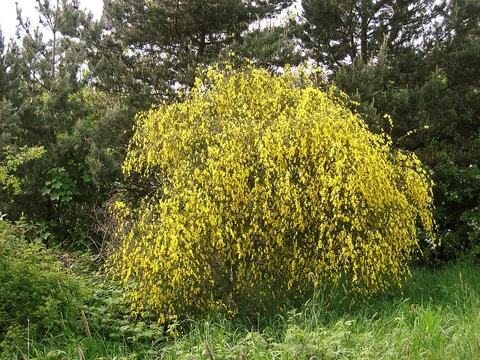
Diospyros
Last updated
The generic name Diospyros comes from a Greek term meaning 'divine food' or 'divine fruit'.[1]
Scientific classification
- CladeTracheophytes
- CladeAngiosperms
- CladeEudicots
- CladeAsterids
- OrderEricales
- FamilyEbenaceae
- GenusDiospyros
Named by L.
Sources: Wikipedia taxobox: Diospyros (CC BY-SA 4.0)
Biology and range
Most Diospyros species occur naturally in tropical regions; only a small number are found in temperate zones.[2] Plants in this genus typically have separate male and female individuals, making them dioecious.[2] Fossil evidence places the earliest known Diospyros remains in the Eocene epoch, showing that the genus already had a broad presence across the Northern Hemisphere at that time.[3] A number of Diospyros species have applications in herbal medicine, and betulinic acid is obtained from D. leucomelas.[4]
When grown in plantations, Diospyros may be of some use as honey plants, though bees are not major pollinators for the genus.[4]
What the specialist sources record
GBIF holds 302,164 occurrence records for this taxon as of 7 October 2026.[5] The isolated amyrin mixture has demonstrated both anti-inflammatory and analgesic properties.[6]
References
- Wikipedia, "Diospyros" (CC BY-SA 4.0), which cites: Jaeger, Edmund Carroll, "A source-book of biological names and terms", Thomas, 1959; Tice, John. H. "Essay on the Diospyros virginiana" Annual report / Missouri State Horticultural Society 1864. (we also read that source) en.wikipedia.org
- Wikipedia, "Diospyros" (CC BY-SA 4.0), which cites: Akagi, "Development of Molecular Markers Associated with Sexuality in Diospyros lotus L. and Their Application in D. kaki Thunb.", Journal of the Japanese Society for Horticultural Science, 2013, p. 214–221 (original not read by us) en.wikipedia.org
- Wikipedia, "Diospyros" (CC BY-SA 4.0), which cites: Denk, "Dispersed pollen and calyx remains of Diospyros (Ebenaceae) from the middle Miocene "Plant beds" of Søby, Denmark", GFF, 2021-07-03, p. 292–304 (original not read by us) en.wikipedia.org
- Wikipedia, "Diospyros" (CC BY-SA 4.0), which cites: "Antiviral Agent and Antiviral Composition" (original not read by us) en.wikipedia.org
- GBIF Backbone Taxonomy and occurrence index, Diospyros (taxon key 3030169). CC BY 4.0 (backbone); counts are facts. gbif.org
- Wikipedia, "Diospyros" (CC BY-SA 4.0), which cites: Ragasa, CY, Puno, MR, Sengson, JMA, Shen, CC, Rideout, JA, Raga, DD, "Bioactive triterpenes from Diospyros blancoi", Natural Product Research, November 2009, p. 1252–58; Ragasa, CY, Puno, MR, Sengson, JMA, Shen, CC, Rideout, JA, Raga, DD, "Bioactive triterpenes from Diospyros blancoi", Natural Product Research, November 2009, p. 1252–58; Ragasa, CY, Puno, MR, Sengson, JMA, Shen, CC, Rideout, JA, Raga, DD, "Bioactive triterpenes from Diospyros blancoi", Natural Product Research, November 2009, p. 1252–58 (original not read by us) en.wikipedia.org
Each numbered sentence above was checked against the source it cites before publication. Sentences citing Wikipedia adapt text from the English Wikipedia article Diospyros (contributors), used under CC BY-SA 4.0; this entry is available under the same licence. Other sources were used for facts only.
More in Trees & Shrubs
Sources
Compiled from Wikipedia and the sources listed below. Text from Wikipedia is available under CC BY-SA 4.0; this entry is adapted from it.
- Wikipedia: Diospyros (CC BY-SA 4.0).
- Word definitions: the Codexery glossary, each quoted from its Wikipedia article.
Spotted an error? Know more?
Reader corrections go straight into our review queue. Suggest an edit · How this site is sourced