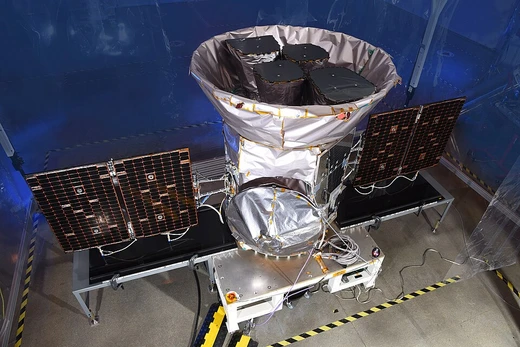
TOI-849 b
A candidate chthonian planet, the exposed core of a gas giant.
TOI-849 b is an exoplanet that orbits a late-G type star called TOI-849, about 700 light-years from Earth. It is a candidate chthonian planet, meaning it may be the leftover core of a gas giant whose atmosphere was largely stripped away.
This planet is unusually dense and massive for its size. It has roughly 40 times Earth’s mass but only about 3.4 times Earth’s radius, making it more massive than Neptune. It orbits extremely close to its star, completing one orbit in less than a day, which places it inside the Neptunian desert—a region where few Neptune-sized planets are found.
Because of its high density, any hydrogen-helium envelope can account for at most a small fraction of the planet’s total mass. Even so, its density is still too low for a purely rocky composition. A planet this massive would normally have gathered a thick gas envelope from the protoplanetary disk during formation, turning it into a gas giant. Instead, TOI-849 b is thought to be the stripped core of such a giant. A 2021 modeling study suggested that the intense stellar radiation it receives could have removed its entire gaseous envelope, even if the planet originally had as much mass as Jupiter.
Quick Facts
- Discovery Method
- Transit
- Discovered
- 2020
- Discoverer
- TESS
- Eccentricity
- 0
- Star
- TOI-849
Facts from the source article.
Lore & Background
TOI-849 b is a high-density planet more massive than Neptune, with a mass about forty times that of Earth. It orbits extremely close to its host star, completing an orbit in less than one day, placing it within the Neptunian desert—a region where few Neptune-sized planets are found. Compared to other Neptune-sized exoplanets, this planet is unusually massive and dense: it is about 40 times Earth's mass but only about 3.4 times Earth's radius. This implies that any gaseous envelope of hydrogen and helium makes up at most a small fraction of the planet's mass. However, given its size, its density is still too low for a purely rocky composition.
The gravity of such a massive planet would normally be expected to accrete large amounts of gas from the protoplanetary disk in which it formed, causing it to become a gas giant. It is thought that TOI-849 b could be the remnant core of a gas giant. A modeling study found that the stellar radiation received by the planet could have removed the entire gaseous envelope even if it formed as a Jupiter-mass planet.
Reader's Guide
TOI-849 b holds significant importance in the study of planetary evolution as a candidate chthonian planet—the exposed core of a gas giant that lost its atmosphere. Its location in the Neptunian desert, a sparsely populated region of exoplanets, makes it a rare and valuable object for testing theories of atmospheric stripping and planetary migration. The planet's high density, despite being too low for a purely rocky composition, suggests it is a remnant core that once had a massive gaseous envelope. The modeling study indicating that stellar radiation could have removed the entire envelope, even from a Jupiter-mass progenitor, provides a plausible mechanism for its current state. This makes TOI-849 b a key example for understanding how gas giants can be transformed into dense, rocky cores, and it is often compared to other dense planets in the Neptunian desert, such as TOI-1853 b. Its existence challenges conventional models of planet formation and atmospheric retention, offering direct evidence that some planets can survive as stripped cores.
Did You Know?
- It orbits its star in less than one day, placing it in the Neptunian desert.
- The planet is about 40 times Earth's mass but only 3.4 times Earth's radius.
- A modeling study found that stellar radiation could have removed its entire gaseous envelope.
More in Transiting Exoplanets, Part 5 1-24
Spotted an error? Know more?
Reader corrections go straight into our review queue. Suggest an edit · How this site is sourced