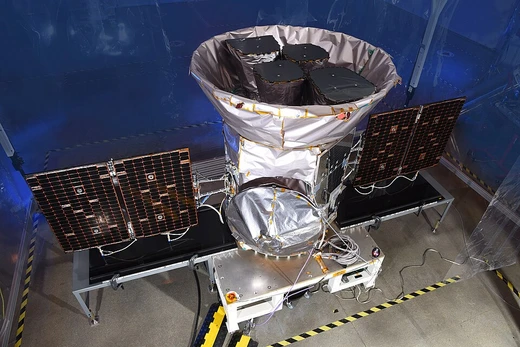
HAT-P-14b
A retrograde hot Jupiter selected for JWST instrument testing.
HAT-P-14b, officially named Sissi and also known as WASP-27b, is an extrasolar planet located approximately 224.2 light-years away in the constellation Hercules. It orbits the 10th-magnitude F-type main-sequence star HAT-P-14, which is named Franz. The planet was discovered in 2010 by the HATNet Project using the transit method and was independently detected by the SuperWASP project. It is notable for its retrograde orbit and for being selected as a target for testing the James Webb Space Telescope's spectroscopic instruments.
Quick Facts
- Discoverer
- HATNet Project
- Discovered
- 2010-03-10
- Discovery Method
- Transit
- Apsis
- astron
- Semimajor
- 0.06062 · 0.00065 · 0.00067 AU
- Eccentricity
- 0.1074 · 0.0076 · 0.0079
- Inclination
- 84.11670.0026 · 0.0025
- Star
- HAT-P-14
- Single Temperature
- 156621
- Surface Grav
- 7.490.36 g
Facts from the source article.
Lore & Background
HAT-P-14b was discovered in 2010 by the HATNet Project via the transit method, with an independent detection by the SuperWASP project. The planet orbits its host star, an F5V main-sequence star with an apparent magnitude of 9.98, every 4.6 days. Observations of the Rossiter–McLaughlin effect with the Keck telescope revealed that the planet orbits in a retrograde fashion relative to the rotation axis of its parent star, with a spin-orbit angle of -170.9°.
The planet was named Sissi as part of the NameExoWorlds campaign for the 100th anniversary of the IAU, with the name selected by Austria. The name references the character Sissi from the movie Sissi, who is married to Franz—the star HAT-P-14 was named Franz accordingly. The role of Sissi was played by actress Romy Schneider.
HAT-P-14b was selected as the target object for testing the James Webb Space Telescope instruments intended for spectroscopic studies of transiting exoplanets. It was chosen because its high surface gravity should produce a very flat spectrum, regardless of the planet's composition.
Reader's Guide
HAT-P-14b holds significance as a benchmark object for exoplanet characterization. Its selection for testing the James Webb Space Telescope's spectroscopic instruments underscores its utility in validating the performance of next-generation observatories. The planet's high surface gravity is expected to yield a flat transmission spectrum, making it an ideal calibration target that minimizes compositional variables. This property allows astronomers to isolate instrumental effects from astrophysical signals, refining the techniques used to study the atmospheres of other transiting exoplanets.
The planet's retrograde orbit, with a spin-orbit angle of -170.9°, provides a clear example of orbital misalignment, offering insights into planetary migration and dynamical interactions in exoplanetary systems. Such extreme obliquities challenge standard formation models and suggest that gravitational scattering or Kozai-Lidov mechanisms may have played a role in shaping its orbit.
Additionally, the naming of the system after characters from the Sissi film series—the star Franz and the planet Sissi—reflects the cultural engagement fostered by the NameExoWorlds campaign. This connection between astronomical discovery and public outreach highlights how exoplanets can serve as bridges between science and broader cultural narratives.
Did You Know?
- HAT-P-14b is also designated WASP-27b, having been independently detected by the SuperWASP project.
- The planet orbits its host star in a retrograde direction, with a spin-orbit angle of -170.9°.
- The planet and its host star are named Sissi and Franz, respectively, after characters from the movie Sissi.
Discovery and Dual Confirmation
In 2010, the HATNet Project identified a new world beyond our solar system by tracking the subtle dimming of starlight as a planet crossed in front of its host star. This transit-based detection revealed HAT-P-14b, an extrasolar planet situated roughly 224.2 parsecs (about 731 light-years) from Earth in the direction of the constellation Hercules. The discovery was not a solitary achievement: the SuperWASP project independently confirmed the planet's existence, lending the object its alternate designation WASP-27b. The planet circles an F-type main-sequence star, and its detection added another entry to the growing catalogue of transiting exoplanets. The dual confirmation by two separate survey programs strengthened confidence in the measurement and underscored how collaborative, ground-based photometry campaigns continue to expand humanity's inventory of distant worlds. The precision of the distance estimate, uncertain by only about 0.6 parsecs, reflects the quality of the underlying astrometric data available at the time of publication.
The Host Star, Franz
The star that anchors the HAT-P-14 system carries the informal name Franz, a designation that would later gain cultural resonance. Classified as an F5V main-sequence star, it shines with an apparent magnitude of 9.98, placing it well beyond what the unaided human eye can perceive. In terms of physical properties, Franz is a moderately massive and slightly larger-than-Sun star: its mass measures 1.386 solar masses with an uncertainty of roughly 0.045, while its radius extends to about 1.468 solar radii. The surface temperature sits near 6,477 kelvin, with a small asymmetric error bar of +13/−15 K, consistent with the expected range for an F-type dwarf. These parameters paint a picture of a star that is hotter and more luminous than the Sun but still firmly within the hydrogen-burning main sequence. Because the planet transits in front of this star, precise knowledge of the stellar radius and luminosity is essential for converting the observed dip in brightness into a reliable planetary radius. The star's relatively modest brightness also means that observations require telescopes equipped with sensitive photometric detectors rather than casual backyard equipment.
A Name from Austrian Cinema
In a celebration of international cooperation, the planet earned the name Sissi through the NameExoWorlds campaign, a public naming initiative organized to mark the 100th anniversary of the International Astronomical Union. Austria put forward the suggestion, drawing on a beloved figure from the classic film Sissi, in which the character is wed to a man named Franz. The role of Sissi in that movie was portrayed by the celebrated actress Romy Schneider, whose performance became an iconic part of European cinema. The naming convention was deliberately paired: the host star received the name Franz, echoing the romantic pairing from the film and giving the system a narrative coherence that purely numerical catalogues lack. This cultural layer adds a human dimension to an otherwise technical object in the exoplanet registry. The NameExoWorlds effort itself was significant because it invited the general public to participate in the naming of real astronomical bodies, bridging the gap between professional astronomy and popular engagement. For Austria, the selection was a chance to imprint a piece of national cultural heritage onto the sky.
Retrograde Orbit and a JWST Benchmark
HAT-P-14b completes a full circuit of its host star in just 4.6 days, a remarkably short period that places it in a tight, close-in orbit. Observations of the Rossiter–McLaughlin effect, carried out with the Keck telescope, revealed a striking orbital geometry: the planet travels in a retrograde direction relative to the spin axis of Franz, with a spin-orbit misalignment of −170.9 degrees (±5.1°). This near-antiparallel orientation suggests a complex dynamical history, possibly involving gravitational interactions that flipped the orbital plane. Beyond its orbital quirks, Sissi has taken on a special role in the next generation of space-based astronomy. It was selected as a calibration target for the James Webb Space Telescope's instruments designed to perform spectroscopic studies of transiting exoplanets. The rationale is elegant: the planet's high surface gravity is expected to compress atmospheric spectral features into an almost flat spectrum, regardless of what gases might be present. This makes Sissi an ideal benchmark for verifying that JWST's spectroscopic pipelines can distinguish genuine atmospheric signals from instrumental artifacts before the telescope turns its attention to more compositionally interesting targets.
Frequently Asked Questions
What is HAT-P-14b?
HAT-P-14b is a retrograde hot Jupiter exoplanet officially named Sissi, also catalogued under the designation WASP-27b. It orbits the F-type main-sequence star HAT-P-14, nicknamed Franz.
Where is HAT-P-14b located in the sky?
The system lies approximately 224.2 light-years from Earth in the constellation Hercules. Its host star appears as a 10th-magnitude F5V star to observers.
How was HAT-P-14b discovered?
The HATNet Project identified the planet in 2010 using the transit method, and the SuperWASP survey independently confirmed the detection around the same time.
Why is HAT-P-14b considered notable?
Its retrograde orbit—circulating opposite to its star's spin—sets it apart from many other hot Jupiters. It was also selected as a target for calibrating the James Webb Space Telescope's spectroscopic instruments.
What are the official names associated with HAT-P-14b?
The planet's official name is Sissi, while its host star is officially called Franz. In the broader literature it is also frequently referenced as WASP-27b.
More in Transiting Exoplanets, Part 5 1-24
Spotted an error? Know more?
Reader corrections go straight into our review queue. Suggest an edit · How this site is sourced