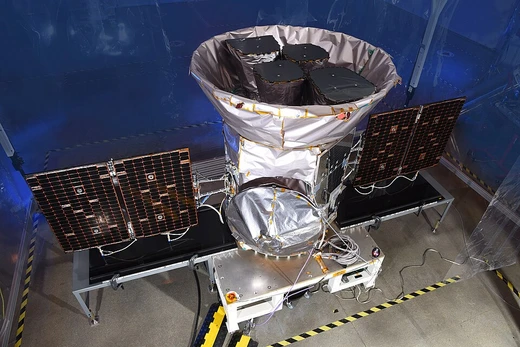
L 98-59 d
A dying mini-Neptune with a lava ocean and sulfurous atmosphere.
L 98-59 d (also designated TOI-175 d) is a super-Earth exoplanet located 34.6 light years from Earth, orbiting the star L 98-59. It is the third, and potentially fourth, planet in its system and was discovered in 2019 by the Transiting Exoplanet Survey Satellite (TESS). The planet is notable for having a cloud-free atmosphere composed of hydrogen, hydrogen sulfide, and sulfur dioxide, as well as a molten lava ocean on its surface, as observed by the James Webb Space Telescope (JWST).
Quick Facts
- Discovered
- March 2019
- Discovery Method
- Transit
- Eccentricity
- 0.006 · 0.007 · 0.004
- Inclination
- 88.44 · 0.05
- Star
- L 98-59
- Single Temperature
- 1900 C
Facts from the source article.
Lore & Background
L 98-59 d formed approximately 5 billion years ago as a sub-Neptune (mini-Neptune). Over time, its host star stripped away its original atmosphere, leaving behind a dense core. The planet's core has a mass of 66% of Earth's total mass and a radius of 55% of Earth's radius. Volcanic activity later produced a new atmosphere composed of hydrogen, hydrogen sulfide, and sulfur dioxide, which was detected by JWST in 2026. The same study revealed a molten surface of lava at 1900°C. The planet is considered a dying remnant of a mini-Neptune in the process of losing its atmosphere and becoming airless.
Reader's Guide
L 98-59 d represents a rare observational window into the final stages of planetary evolution. Its discovery by TESS in 2019, alongside two other planets in the same system, established it as a nearby super-Earth. The JWST's detection of a cloud-free atmosphere rich in hydrogen, hydrogen sulfide, and sulfur dioxide, combined with a lava ocean, makes it one of the few worlds where both a secondary atmosphere and active surface melting have been directly observed. The planet's low orbital eccentricity (0.006) and close-in orbit (4.94% of Earth's orbital distance) place it in a regime where stellar stripping is expected. Its formation history—starting as a mini-Neptune, losing its primordial envelope, and then regassing through volcanism—provides a natural laboratory for studying atmospheric escape and secondary atmosphere generation. The planet's core mass and radius, measured at 66% and 55% of Earth's values respectively, offer constraints on interior composition models. As a system with three confirmed planets (and a possible fourth), L 98-59 d also contributes to understanding multi-planet architectures around M-dwarf stars. Its ongoing atmospheric loss makes it a key target for future studies of planetary demise.
Did You Know?
- L 98-59 d has a lava ocean on its surface with a temperature of 1900°C.
- Its atmosphere is cloud-free and contains hydrogen, hydrogen sulfide, and sulfur dioxide.
- The planet's core makes up 66% of Earth's total mass and has a radius 55% that of Earth.
- It formed as a mini-Neptune about 5 billion years ago and is now losing its atmosphere.
Place in the 2025 Discovery Cohort
L 98-59 d occupies a position within the confirmed exoplanet roster first reported during 2025, a cohort that totals 238 newly catalogued worlds. This annual list serves as a snapshot of what the astronomical community verified and publicly announced within that calendar year, distinguishing it from earlier or later discoveries. The designation "d" signals that L 98-59 d is at least the fourth planet identified orbiting its host star, L 98-59, placing it within a multiplanetary architecture. As a confirmed entry rather than a mere candidate, L 98-59 d has passed the scrutiny required for inclusion in the official registry, setting it apart from the numerous extrasolar candidates that remain in provisional status. Its 2025 reporting date anchors it in a year that, while not the most prolific in raw numbers compared to peaks like 2016 with 1,498 entries or 2014 with 869, still represents a substantial and active period of exoplanet confirmation. The planet's inclusion in this specific annual grouping means researchers tracking yearly discovery trends will count it toward the 2025 total, contributing to the ongoing statistical picture of how many new worlds are identified each year.
Detection Methodology and Mass Caveats
The catalog entry for L 98-59 d carries an important methodological caveat that applies to a subset of exoplanets in the 2025 confirmed list. For planets whose detection relies solely on the radial velocity technique, the mass figure recorded in the registry represents a lower limit rather than a definitive measurement. This distinction matters because radial velocity measures the wobble of the host star caused by an orbiting body, and the observed signal depends on the inclination angle of the orbital plane relative to the observer's line of sight. The true mass can only be determined if the inclination is known independently, which is not always possible. For L 98-59 d, if its discovery and characterization depended on this spectroscopic method, any mass value associated with it should be interpreted as a minimum figure. The actual mass could be higher, potentially by a significant factor, depending on the unknown tilt of its orbit. This caveat is a standard note in the 2025 list documentation, reminding readers that not all mass entries carry equal certainty, and that the minimum-mass convention is a well-established practice in exoplanet science rather than an oversight in reporting.
Position in the Broader Exoplanet Catalog
L 98-59 d does not exist in isolation within astronomical records; it is one thread in a vast web of categorized exoplanet lists maintained for research and reference. The broader catalog includes specialized groupings such as directly imaged exoplanets, transiting worlds, circumbinary planets, and systems around white dwarfs or giant stars. There are also thematic lists covering extremes of temperature, size, and potential habitability, as well as compilations of multiplanetary systems and planets observed during specific missions like Kepler, K2, and TESS. Depending on its measured properties, L 98-59 d could find a place in several of these sub-lists simultaneously. For instance, if it is part of a multiplanet system as the "d" suffix in its name implies, it would appear in the multiplanetary systems compilation. If its orbital characteristics place it in a temperature range of interest, it might also be catalogued among the hottest or coldest exoplanets. The existence of this layered cataloging infrastructure means that a single planet like L 98-59 d can be accessed through multiple research lenses, each highlighting different physical or orbital attributes relevant to specific scientific questions.
Context in the Discovery Timeline
The 2025 reporting of L 98-59 d places it within a long-running record of exoplanet confirmations that stretches back to the very first discoveries before the year 2000, when only 31 worlds had been identified. The pace of discovery has fluctuated dramatically over the decades: the 2000 to 2009 decade yielded 375 planets, individual years in the 2010s ranged from 86 to 179, and the 2010s saw explosive years like 2014 with 869 and 2016 with 1,498. More recently, annual counts have settled into a range of roughly 150 to 312 per year, with 2025 contributing 238 confirmed additions to the registry. L 98-59 d is one of those 238, joining a cohort that includes planets reported in 2024 with 284 entries and those yet to be reported in 2026 with 283. The timeline also includes a 2026 list, suggesting that the catalog is a living document that continues to grow. For L 98-59 d, its 2025 designation is not merely a date stamp but a marker of its position in an accelerating, then stabilizing, global effort to map the planetary systems beyond our own solar system, a project that has now spanned more than two decades of continuous discovery.
Frequently Asked Questions
What is L 98-59 d?
L 98-59 d, also catalogued as TOI-175 d, is a super-Earth exoplanet roughly 1.6 times Earth's radius that circles the M-dwarf star L 98-59 about 34.6 light-years from the Solar System. It was flagged in 2019 by NASA's TESS mission and is the third—or possibly fourth—world in that tightly packed planetary family.
What makes L 98-59 d's atmosphere unusual?
JWST spectroscopy showed a completely cloud-free envelope of hydrogen, hydrogen sulfide, and sulfur dioxide, giving astronomers a remarkably clear chemical fingerprint for a small planet. The lack of cloud cover is rare at this temperature and lets researchers read the underlying gas composition without haze interference.
What does the surface of L 98-59 d look like?
At a surface temperature near 1900 °C, the planet is hot enough to maintain a global ocean of molten lava beneath its sulfurous sky. Fans and researchers alike often call it a 'dying mini-Neptune,' a world caught between a rocky super-Earth and a puffy gas dwarf.
How does L 98-59 d orbit its star?
It laps L 98-59 every 7.45 days at a distance of about 4.94% of Earth's orbital radius, tracing a nearly circular path with an eccentricity of only 0.006. Its mass works out to roughly 1.64 Earth masses, placing it firmly in the super-Earth class.
Why is L 98-59 d considered important to exoplanet science?
Because its atmosphere is free of clouds, it provides one of the cleanest natural laboratories for testing how heavy elements like sulfur partition between a lava ocean and a gaseous envelope at extreme temperatures. That makes it a key benchmark for models that try to explain the dividing line between rocky super-Earths and mini-Neptunes.
More in Transiting Exoplanets, Part 5 1-24
Spotted an error? Know more?
Reader corrections go straight into our review queue. Suggest an edit · How this site is sourced