WASP-96b
Hot Jupiter with water, clouds, and hazes confirmed by JWST.

NASA · Public domain
WASP-96b is a gas giant exoplanet orbiting the Sun-like star WASP-96 in the constellation Phoenix, approximately 1,140 light-years from Earth. It is notable for being one of the first exoplanets observed by the James Webb Space Telescope, whose spectrum revealed water, clouds, and hazes in its atmosphere.
Quick Facts
- Extrasolarplanet
- yes
- Apsis
- astron
- Discoverer
- Hellier et al. (WASP)
- Discovered
- October 2013
- Discovery Method
- Transit
- Eccentricity
- <0.11
- Single Temperature
- 1285 K
Facts from the source article.
Lore & Background
WASP-96b was discovered in 2013 by Coel Hellier and colleagues as part of the WASP-South survey, using the transiting method. It orbits its G-class star every 3.4 Earth days at a distance just one-ninth of the distance between Mercury and the Sun, classifying it as a hot Jupiter. The planet's mass is 0.48 times that of Jupiter, and it lies about 1,140 light-years away in the constellation Phoenix.
The planet gained significant attention in July 2022 when its transmission spectrum was featured in the initial science release from the James Webb Space Telescope. The spectrum confirmed the presence of water and provided evidence for clouds and hazes in the atmosphere, overturning prior assumptions that WASP-96b was cloud-free. A 2023 study further measured the abundance of certain chemical species, finding that models with patchy clouds and hazes best describe the observations.
Reader's Guide
WASP-96b's significance lies primarily in its role as a benchmark for atmospheric characterization of exoplanets using the James Webb Space Telescope. The transmission spectrum released in July 2022 was among the first science images from JWST, demonstrating the telescope's ability to detect unambiguous signatures of water and to reveal previously hidden atmospheric features such as haze and clouds. Prior to this, WASP-96b was thought to be cloud-free, but the JWST data showed evidence of clouds that had been suspected from earlier observations. A subsequent 2023 study refined these findings, measuring chemical abundances and confirming that patchy cloud and haze models best fit the data. The planet thus serves as a key example of how space-based infrared spectroscopy can transform understanding of exoplanet atmospheres, moving beyond basic detection to detailed chemical and physical characterization.
Did You Know?
- WASP-96b orbits its star every 3.4 Earth days at a distance one-ninth that of Mercury from the Sun.
- The James Webb Space Telescope's spectrum of WASP-96b confirmed water and revealed clouds and hazes.
- It was discovered in 2013 by Coel Hellier and the WASP-South survey.
Discovery and Orbital Profile
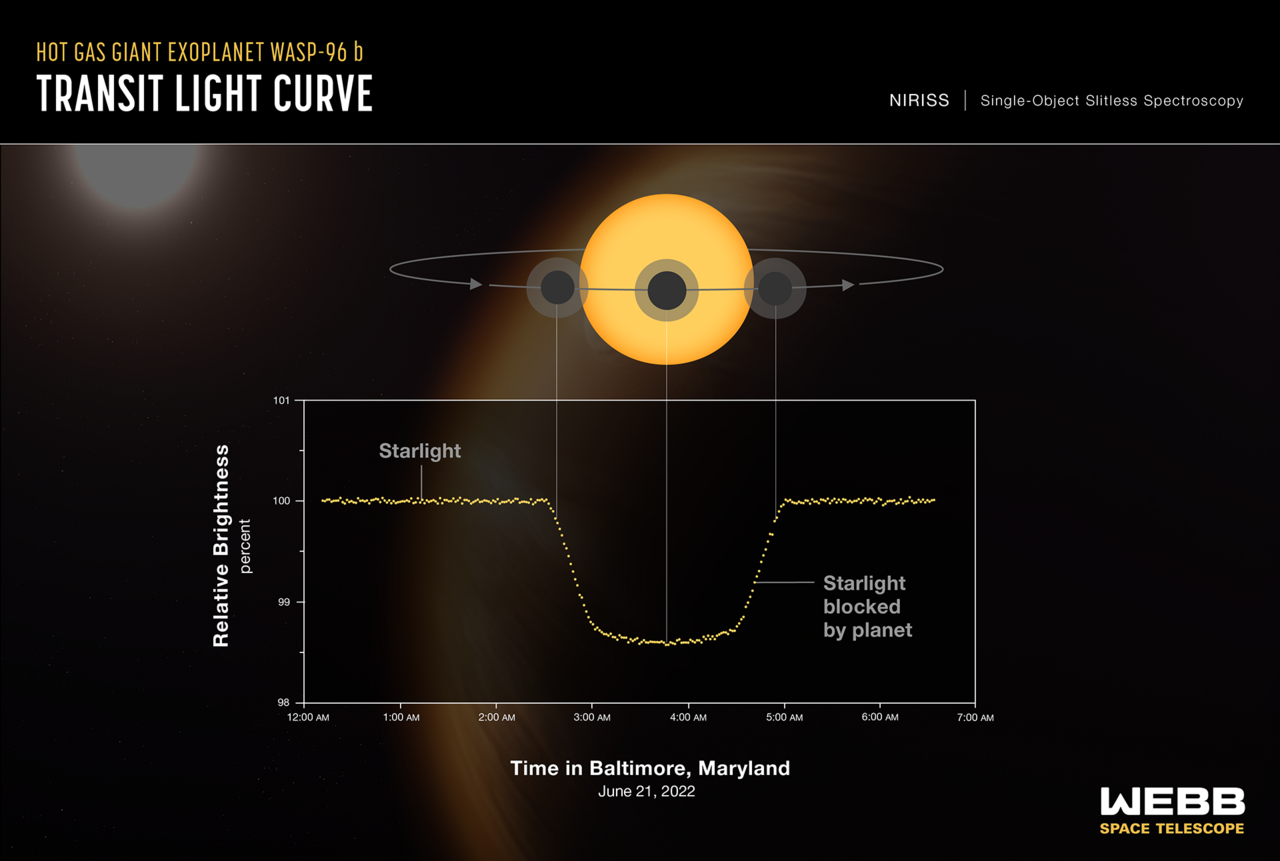
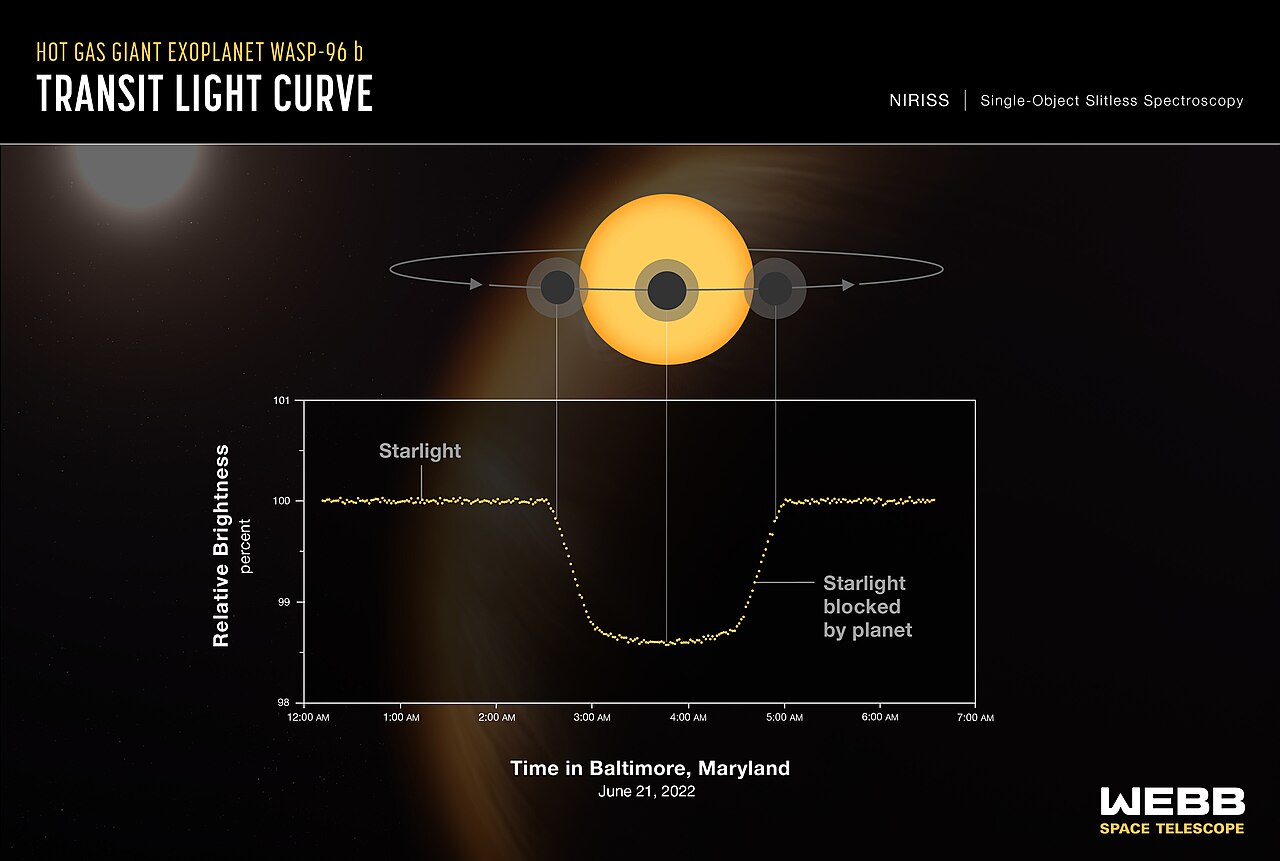
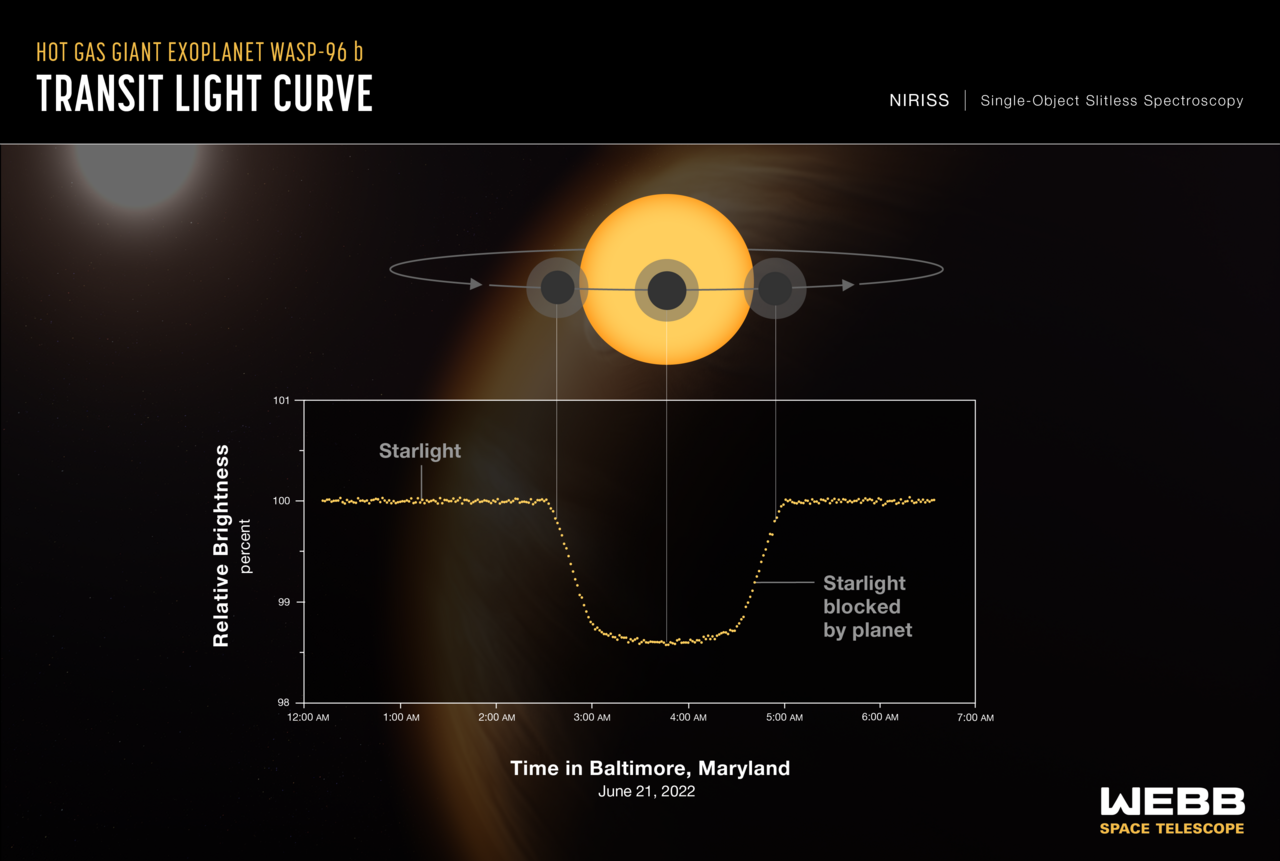
WASP-96b came to light in 2013 through the Wide Angle Search for Planets (WASP) program, specifically the WASP-South survey. The team led by Coel Hellier identified the planet using the transiting method, a technique that detects the dimming of a star's light as a planet passes in front of it. The world itself is a gas giant weighing roughly 0.48 times the mass of Jupiter. It circles its host star, WASP-96, a class G star similar to our own Sun, completing one full orbit in just 3.4 Earth days. That rapid pace is a direct consequence of its extremely tight orbit: the planet sits at only 0.0453 astronomical units from its star, a distance roughly one-ninth of the gap between Mercury and the Sun. Despite its proximity to its parent star, WASP-96b is no close neighbor to us. It resides approximately 1,140 light-years from Earth, nestled within the constellation Phoenix, a region of the southern sky.
The JWST Revelation
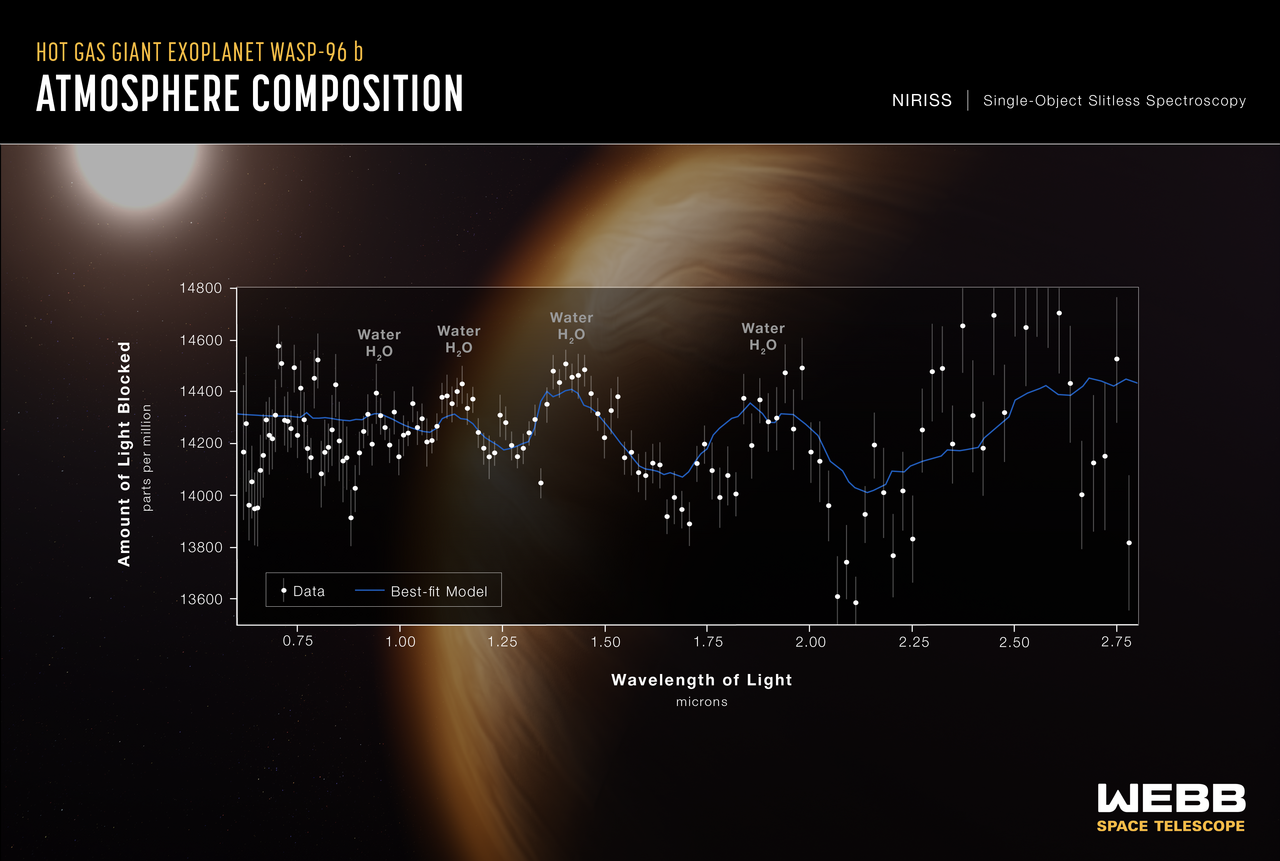
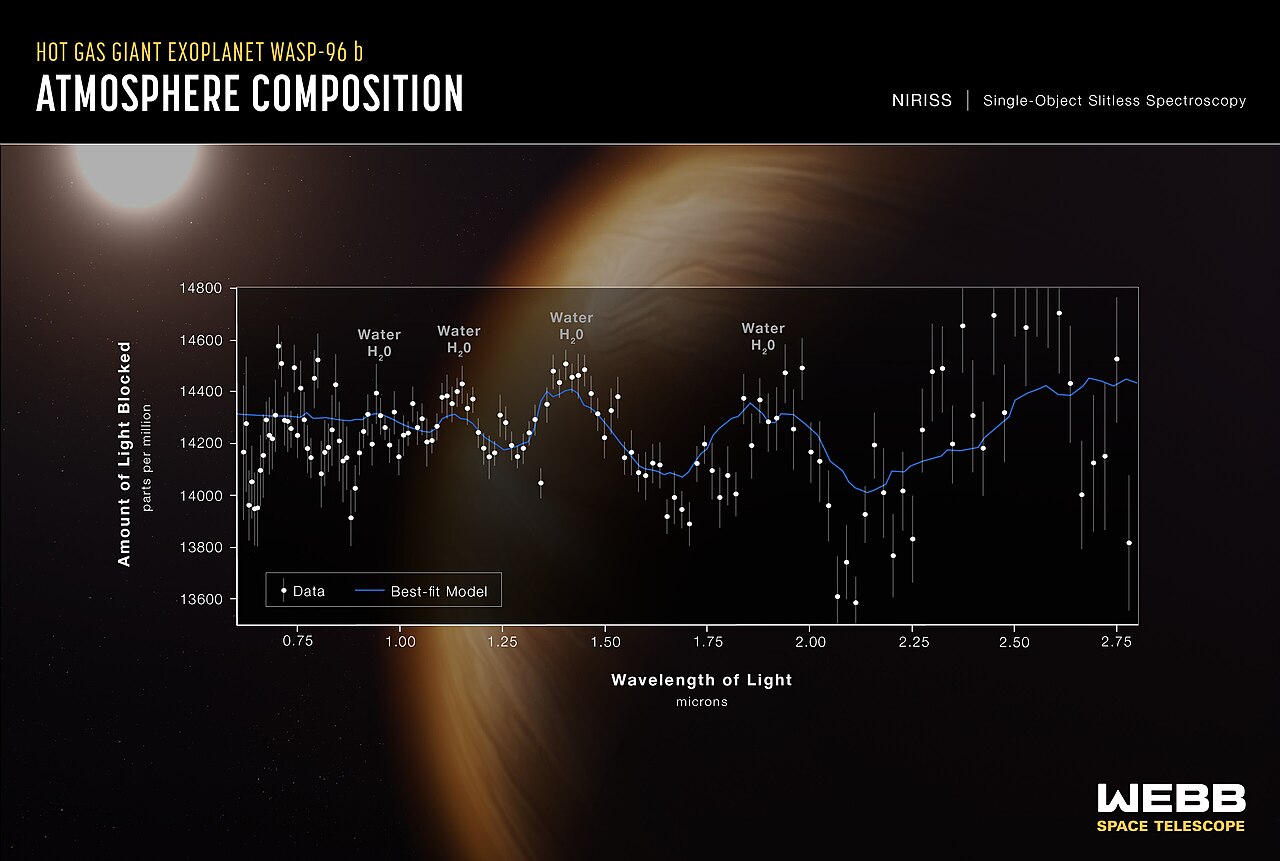
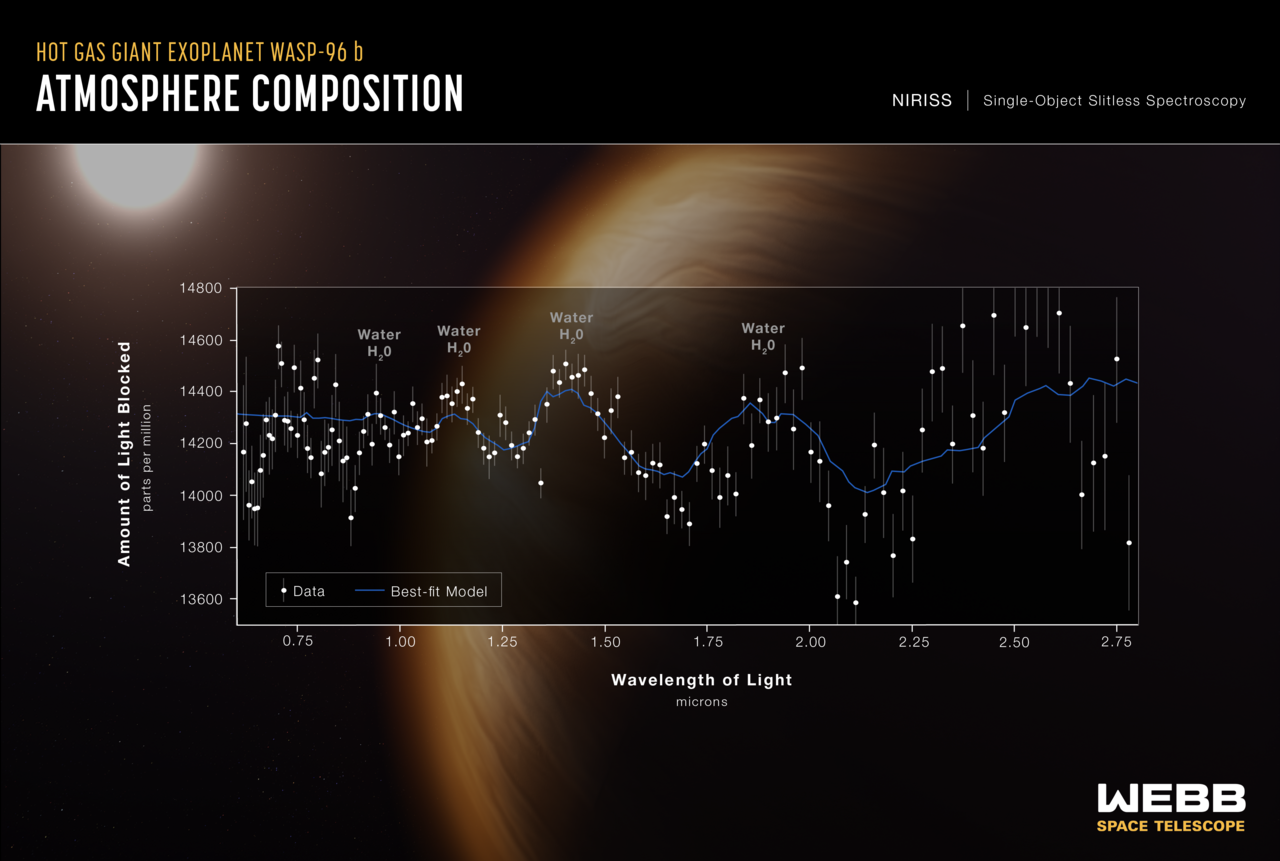
In July 2022, the James Webb Space Telescope made its initial science release, and one of the featured images was the spectrum of WASP-96b. This placement was no accident; the data represented a genuine breakthrough in exoplanet atmospheric science. The transmission spectrum captured by JWST revealed the unambiguous signature of water vapor in the planet's atmosphere, along with clear indications of haze and evidence for clouds. What made this particularly striking was that before the JWST observations, WASP-96b had been widely regarded as a cloud-free world. The new spectrum did not merely confirm what was already known—the planet's existence, its size, and the parameters of its orbit—but it peeled back a layer of atmospheric detail that ground-based and earlier space-based telescopes had been unable to resolve. For the first time, astronomers could see the chemical fingerprints and particulate structures that had been hidden in the noise of previous measurements.
From Cloud-Free to Cloudy: A Revised Understanding
For years, the working model of WASP-96b's atmosphere assumed it was essentially clear, free of the cloud decks and haze layers that complicate the spectra of many other hot Jupiters. That assumption made the planet a relatively clean laboratory for studying atmospheric composition. The JWST transmission spectrum shattered that picture. The data not only confirmed the presence of water but also pointed to clouds and hazes that had been suspected in earlier observations but never definitively confirmed. By 2023, a dedicated study measured the abundances of specific chemical species in the atmosphere and found that models incorporating patchy clouds and hazes provided the best fit to the JWST observations. This revision mattered because cloud coverage fundamentally alters how light is absorbed and scattered, meaning every prior estimate of atmospheric composition for WASP-96b had to be re-examined in light of the new, more complex picture.
A Benchmark for Hot-Jupiter Science
WASP-96b occupies a special niche in the study of hot Jupiters. Its discovery in 2013 by the WASP-South survey added to the growing catalog of close-in gas giants, but it was the 2022 JWST observations that elevated it to a benchmark target. The planet's 3.4-day orbit around a Sun-like class G star, combined with its 0.48 Jupiter mass, places it squarely in the hot-Jupiter regime where atmospheric chemistry is expected to be extreme. Yet the surprise was not the heat but the complexity: a world once modeled as a clean, cloud-free sphere turned out to harbor patchy clouds and hazes that significantly shape its spectrum. The fact that its transmission spectrum was selected for JWST's very first science release underscores how representative it became of the new era of exoplanet characterization. For researchers, WASP-96b now serves as a critical test case for atmospheric models that must account for both molecular abundances and the scattering effects of particulates.
Gallery
Frequently Asked Questions
What is WASP-96b?
WASP-96b is a Hot Jupiter-class gas giant that circles the Sun-like star WASP-96 in the southern constellation Phoenix. It was identified in 2013 and sits roughly 1,140 light-years from our solar system.
What are WASP-96b's orbital and physical stats?
The planet has a mass of about 0.48 Jupiter masses and completes one orbit around its host star every 3.4 Earth days. Its orbital radius is approximately 0.0453 AU, placing it very close to its star.
Why did WASP-96b make headlines in 2022?
It became one of the very first exoplanets targeted by the James Webb Space Telescope. The JWST transmission spectrum provided the clearest early confirmation of water vapor, cloud layers, and photochemical hazes in a distant exoplanet atmosphere.
What does WASP-96b's atmosphere actually contain?
JWST spectroscopy detected water molecules, reflective cloud decks, and high-altitude haze particles in its upper atmosphere. This made it a landmark result because it was among the first times such a full atmospheric picture was captured for a hot Jupiter.
How far away is WASP-96b and where can I see it?
It resides in the constellation Phoenix, about 1,140 light-years from Earth. Because of that distance, it is far beyond the reach of any ground-based telescope and can only be studied with space-based instruments.
More in Transiting Exoplanets, Part 5 1-24
Spotted an error? Know more?
Reader corrections go straight into our review queue. Suggest an edit · How this site is sourced