TOI-677 b
A warm super-Jupiter with a highly eccentric orbit.
TOI-677 b is a warm super-Jupiter exoplanet that orbits the F-type main sequence star TOI-677, located in the constellation Ophiuchus about 466 light-years from Earth. Its mass is 1.252 times that of Jupiter, and its radius is 1.179 times Jupiter’s. The planet has a temperature of 1,252 K (979 °C; 1,794 °F) and completes one orbit every 11.24 days. Its orbit is highly eccentric, with an eccentricity of 0.435. This eccentricity may result from interactions between the protoplanetary disk and the planet itself. If a brown dwarf object exists in the outer TOI-677 system, it could have contributed to the planet’s high eccentricity.
The planet belongs to an emerging category of exoplanets known as tidally detached gas giants, which have high orbital eccentricities but low stellar obliquity. It is also part of a group of planetary systems where eccentric super-Jupiters orbit stars hotter than 6,100 Kelvin.
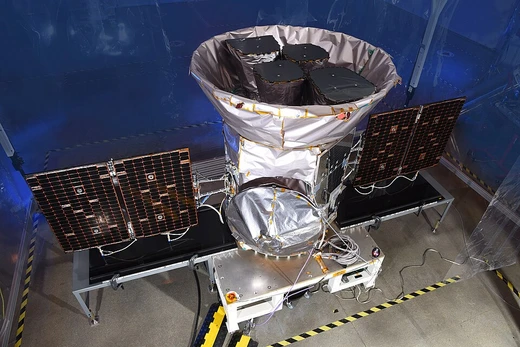
TOI-677 b was discovered by NASA’s Transiting Exoplanet Survey Satellite (TESS) using the transit method, which measures the dimming of a star as a planet passes in front of it. The discovery was announced on 13 November 2019.
Quick Facts
- Discovery Site
- Transiting Exoplanet Survey Satellite
- Discovered
- 2019
- Discovery Method
- Transit method
- Semimajor
- 0.1038 AU
- Period
- 11.24 d
- Inclination
- 87.63
- Star
- TOI-677
- Single Temperature
- 1252 K
Facts from the source article.
Lore & Background
TOI-677 b was discovered by NASA's Transiting Exoplanet Survey Satellite (TESS) using the transit method, which measures the dimming of starlight as the planet crosses in front of its host star. The discovery was announced on 13 November 2019. The planet orbits its star once every 11.24 days on an eccentric path with an eccentricity of 0.435. Its mass is 1.252 Jupiter masses and its radius is 1.179 Jupiter radii, giving it a temperature of 1,252 K (979 °C; 1,794 °F).
The high eccentricity of TOI-677 b may be due to interactions between the protoplanetary disk and the planet itself. If claims of an outer brown dwarf object in the TOI-677 system are true, that brown dwarf may have also played a role in shaping the planet's eccentric orbit. The planet belongs to an emerging class of exoplanets called tidally detached gas giants, characterized by high eccentricities and low stellar obliquity, and is also part of a group of systems with eccentric super-Jupiters orbiting stars hotter than 6100 Kelvin.
Reader's Guide
TOI-677 b is significant as a representative of an emerging class of exoplanets known as tidally detached gas giants, which challenge traditional models of planetary system formation and evolution. These planets exhibit high orbital eccentricities while maintaining low stellar obliquity, a combination that is not easily explained by standard migration or scattering mechanisms. The planet's eccentricity of 0.435 is particularly notable, and its possible origins—either from disk–planet interactions or from gravitational perturbations by a putative outer brown dwarf—highlight the complex dynamical histories that can shape such systems.
As a warm super-Jupiter orbiting an F-type star hotter than 6100 Kelvin, TOI-677 b also contributes to the growing sample of eccentric giant planets around hot stars, a population that may offer insights into how stellar properties influence planetary architectures. The planet's discovery by TESS using the transit method underscores the ongoing role of space-based surveys in finding and characterizing diverse exoplanetary systems. Its legacy lies in helping to define and populate the category of tidally detached gas giants, providing a benchmark for future studies of eccentric, warm Jupiters and the processes that produce them.
Did You Know?
- TOI-677 b has a mass of 1.252 Jupiter masses and a radius of 1.179 Jupiter radii.
- Its orbital eccentricity of 0.435 is possibly due to interactions with the protoplanetary disk or an outer brown dwarf.
- It is part of an emerging class called tidally detached gas giants with high eccentricity and low stellar obliquity.
More in Transiting Exoplanets, Part 5 1-24
Spotted an error? Know more?
Reader corrections go straight into our review queue. Suggest an edit · How this site is sourced