TOI-4138 b
An inflated hot Jupiter orbiting an evolved subgiant star.
TOI-4138 b is a hot Jupiter that transits its host star, a G-type subgiant named TOI-4138. The star lies 1,674 light-years away in the northern circumpolar constellation Ursa Minor and has an apparent magnitude of 11.8, making it invisible without a telescope. The planet completes one orbit every 3.6 days, placing it at a distance from its star roughly one-eighth of Mercury’s separation from the Sun. Its orbital inclination is known, allowing Doppler spectroscopy to determine a mass just 67% that of Jupiter. The planet’s radius, measured from its transit, is 1.49 times Jupiter’s, yielding a density only 25% that of water. This low density is due to inflation from the star’s high luminosity, a consequence of the star’s evolved state. The host star has 1.32 times the Sun’s mass, an effective temperature of 6128 K, and an intermediate age of about 3.5 billion years. Its radius and luminosity are enlarged compared to the Sun. The planet’s orbital separation is comparable to that of HD 209458 b, but TOI-4138 b is much larger because its star is more evolved. The discovery was announced in October 2021, based on data from the TESS mission using the transit method.
Quick Facts
- Extrasolarplanet
- yes
- Apsis
- astron
- Discoverer
- Montalto et al.
- Discovery Site
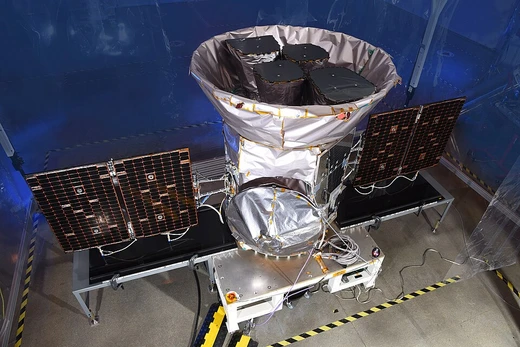
- TESS
- Discovered
- 13 October 2021
- Discovery Method
- Transit
- Periastron
- 0.049 AU
- Apoastron
- 0.052 AU
- Semimajor
- 0.051 ±
- Eccentricity
- 0.03 ± 0.02
- Period
- 3.660028 ± 0.000006 d
- Time Periastron
- 2,458,708.9983 ± 0.0003 JD
Facts from the source article.
Lore & Background
TOI-4138 b was discovered by the TESS mission using the transit method, which detects planets by measuring the dimming of a star's light during a planetary eclipse. Its discovery was announced in October 2021. The planet's orbital period of 3.6 days places it very close to its host star, at a separation roughly one eighth of Mercury's distance from the Sun. This proximity, combined with the star's high luminosity, heats the planet and causes it to become inflated.
The planet's mass is 67% that of Jupiter, while its radius is 1.49 times Jupiter's, yielding a density only 25% that of water. Its orbital separation is comparable to that of HD 209458 b, but TOI-4138 b is much larger due to the evolved state of its host star. The host star TOI-4138 is a subgiant with an enlarged radius, a luminosity of 1.32 times the Sun's mass, an effective temperature of 6128 K, and an intermediate age of about 3.5 billion years. Its apparent magnitude of 11.8 makes it invisible to the naked eye.
Reader's Guide
TOI-4138 b serves as a clear example of how stellar evolution influences planetary properties. The host star's transition to a subgiant phase has increased its luminosity, which in turn heats the planet and drives atmospheric expansion, resulting in an unusually low density for a hot Jupiter. This object helps refine models of planetary inflation and the long-term effects of stellar evolution on close-in exoplanets. Its orbital period of 3.6 days and mass of 0.67 Jupiter masses place it within the typical hot Jupiter population, but its radius of 1.49 Jupiter radii and density of 0.25 g/cm³ highlight the role of stellar irradiation. The planet's discovery by TESS using the transit method, and the subsequent mass measurement via Doppler spectroscopy, provide a well-characterized system for studying the interplay between a planet's orbit, its host star's evolutionary stage, and its physical structure. The system's location in Ursa Minor adds to the diversity of known exoplanet hosts in the northern sky.
Did You Know?
- TOI-4138 b has a density only 25% that of water.
- Its orbital separation is about one eighth of Mercury's distance from the Sun.
- The planet's radius is 1.49 times that of Jupiter.
More in Transiting Exoplanets, Part 5 1-24
Spotted an error? Know more?
Reader corrections go straight into our review queue. Suggest an edit · How this site is sourced