TOI-270 b
Innermost volatile-rich super-Earth with possible water-vapor atmosphere.
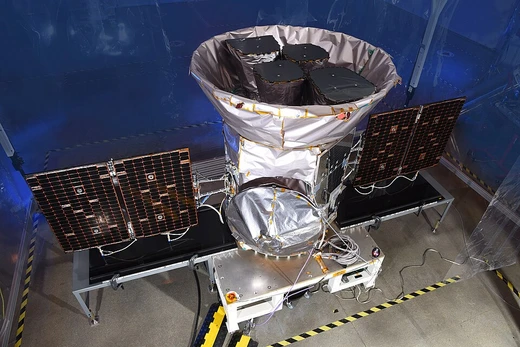
TOI-270 b is the innermost planet in the TOI-270 system, a volatile-rich super-Earth discovered by the transit method with TESS. It is notable for its possible atmosphere rich in water vapor, as suggested by revised density values and JWST transmission spectroscopy results.
- Host star
- TOI-270 (L 231-32)
- Star type
- red dwarf
- Star distance
- 73.3 ly
- Star mass
- 0.39 solar masses
- Star radius
- 0.38 solar radii
- Star temperature
- 3506 K
- Planet type
- volatile-rich super-Earth
Lore & Background
TOI-270 b was discovered in 2019 via the transit method by the TESS mission. It is the innermost of three known planets orbiting the red dwarf star TOI-270, also designated L 231-32, located 73.3 light-years away in the constellation Pictor. The planet's mass has been measured through both Doppler spectroscopy and transit-timing variations. TOI-270 b and the next planet, TOI-270 c, orbit near a 5:3 resonance. Based on a revised density value and JWST transmission spectroscopy results, it was found that TOI-270 b possibly has an atmosphere rich in water vapor.
Reader's Guide
TOI-270 b holds significance as a volatile-rich super-Earth whose atmospheric composition may include substantial water vapor, a finding derived from revised density calculations and JWST transmission spectroscopy. This makes it a valuable target for understanding the diversity of super-Earth atmospheres and the potential for water-rich worlds in close-in orbits around red dwarfs. Its position as the innermost planet in a system with two outer mini-Neptunes, TOI-270 c and d, provides context for studying planetary system architectures and orbital resonances. The planet's proximity to a 5:3 resonance with TOI-270 c further informs models of planetary migration and dynamical evolution. While TOI-270 c and d are noted as good targets for atmospheric detection with JWST, TOI-270 b itself has already yielded atmospheric hints from JWST data, contributing to the growing body of knowledge on exoplanet atmospheres. Its legacy lies in demonstrating that even super-Earths can retain detectable atmospheres, and in providing a benchmark for future comparative studies of inner versus outer planets in multi-planet systems.
Did You Know?
- TOI-270 b is a volatile-rich super-Earth, the innermost of three known planets in the system.
- It was discovered in 2019 by the transit method with TESS.
- Its mass was measured by both Doppler spectroscopy and transit-timing variations.
- It possibly has an atmosphere rich in water vapor, based on revised density and JWST transmission spectroscopy.
More in Transiting Exoplanets, Part 5 1-24
Spotted an error? Know more?
Reader corrections go straight into our review queue. Suggest an edit · How this site is sourced