LP 791-18 b
Innermost super-Earth in a three-planet red dwarf system.
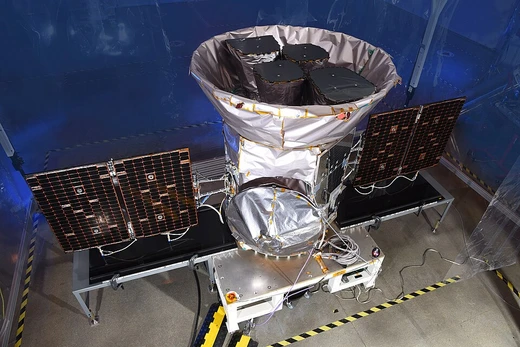
LP 791-18 b is a super-Earth exoplanet orbiting the cool red dwarf star LP 791-18 (TOI-736) in the constellation Crater. It is the innermost planet in a three-planet system and was discovered in 2019 by the TESS mission.
- Type
- super-Earth
- Discovery year
- 2019
- Discovery method
- transit
- Host star
- LP 791-18 (TOI-736)
- Constellation
- Crater
- Distance
- 26.65 pc
- Orbital position
- innermost planet
Lore & Background
LP 791-18 b was announced in 2019 alongside the outermost planet, c, after being detected in transit by the TESS space telescope. The host star is one of the smallest known stars to host exoplanets, a cool red dwarf located 26.65 parsecs away in the constellation Crater. The system later gained a third planet, d, discovered in 2023 from Spitzer Space Telescope data. Planet b is classified as a super-Earth, while planet c is a sub-Neptune and planet d is an Earth-mass world. The middle planet d may be tidally heated by interactions with planet c, potentially leading to volcanic activity similar to Jupiter's moon Io, and lies at the inner edge of the habitable zone where liquid water could condense on the side facing away from the star.
Reader's Guide
LP 791-18 b is notable as part of a compact multi-planet system around one of the smallest known exoplanet-hosting stars. Its discovery in 2019 by TESS contributed to the growing census of super-Earths around low-mass stars. The system gained further attention when planet c was suggested in 2021 for atmospheric analysis by the James Webb Space Telescope, and in 2025 JWST observations revealed planet c's atmosphere to be rich in haze and methane but lacking clear evidence of carbon dioxide, distinguishing it from other temperate sub-Neptunes like K2-18 b and TOI-270 d. While planet b itself has not been the subject of such atmospheric study, its position as the innermost world in a system with a tidally heated Earth-mass planet and a chemically unusual sub-Neptune underscores the diversity of planetary environments around red dwarfs. The system's architecture—a super-Earth, a sub-Neptune, and a potentially volcanic Earth-mass world—provides a comparative laboratory for understanding planetary formation and evolution under different stellar and orbital conditions.
Did You Know?
- LP 791-18 b is a super-Earth and the innermost planet in its system.
- The system also contains a sub-Neptune (c) and an Earth-mass world (d) discovered in 2023.
More in Transiting Exoplanets, Part 5 1-24
Spotted an error? Know more?
Reader corrections go straight into our review queue. Suggest an edit · How this site is sourced