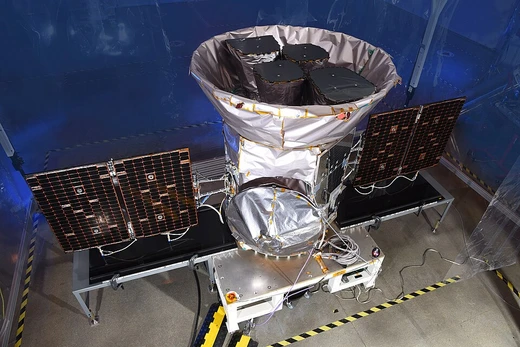
LHS 1478 b
A hot super-Earth with a possible Venus-like atmosphere.
LHS 1478 b is a hot super-Earth exoplanet that orbits the red dwarf star LHS 1478, 59.4 light-years away in the constellation Cassiopeia. Its orbit is extremely close to the star—just 0.018 astronomical units—with an inclination of 87° relative to the plane of the sky, completing one full orbit in about 1.9 days. The planet has a mass 2.27 times that of Earth and a radius 1.17 times Earth’s, giving it a bulk density of 7.7 grams per cubic centimeter. This density suggests a terrestrial composition, roughly 30% iron and 70% magnesium silicate. With an equilibrium temperature of 585 Kelvin, it receives 21 times more energy from its star than Earth does from the Sun, making liquid water impossible on its surface and hinting at a possible Venus-like atmosphere. The host star is fairly inactive, which makes the planet a good target for spectroscopic study with the James Webb Space Telescope (JWST). It joins a small group of rocky planets—including GJ 357 b, GJ 1132 b, and GJ 486 b—where JWST can make meaningful measurements. Observations from JWST rule out a low-albedo bare rock, indicating the planet either has an atmosphere or a high-albedo surface without one.
Quick Facts
- Extrasolarplanet
- yes
- Discoverer
- M. G. Soto, et al.
- Discovery Site
- TESS
- Discovered
- February 2021
- Discovery Method
- Transit
- Apsis
- astron
- Eccentricity
- 0.038 · 0.16 · 0.033
- Star
- LHS 1478
Facts from the source article.
Lore & Background
LHS 1478 b was discovered as a transiting exoplanet around a fairly inactive red dwarf star. Its orbit is extremely close to the star, at just 0.018 AU, completing one revolution every 1.9 days. The planet's inclination of 87° relative to the plane of the sky allows it to transit its host star as seen from Earth.
The planet has a mass of 2.27 Earths and a radius of 1.17 Earths, yielding a bulk density of 7.7 g/cm³. This density is consistent with a terrestrial composition dominated by iron (roughly 30%) and magnesium silicate (roughly 70%). With an equilibrium temperature of 585 Kelvin, LHS 1478 b receives 21 times more stellar energy than Earth does from the Sun, making liquid water impossible on its surface and suggesting the presence of a Venus-like atmosphere.
The host star's low activity level makes LHS 1478 b a favorable target for spectroscopic studies with the James Webb Space Telescope. It belongs to a family of small rocky planets—including GJ 357 b, GJ 1132 b, and GJ 486 b—where meaningful JWST measurements are feasible. JWST observations disfavor the possibility of a low-albedo bare rock, indicating that the planet either possesses an atmosphere or has a high albedo without one.
Reader's Guide
LHS 1478 b holds significance as a nearby super-Earth that can be studied in detail with the James Webb Space Telescope. Its host star's low activity reduces interference for spectroscopic observations, placing it among a select group of small rocky planets where JWST can obtain meaningful measurements. The planet's high density and composition—roughly 30% iron and 70% magnesium silicate—mark it as a terrestrial world, while its extreme insolation and equilibrium temperature of 585 K rule out liquid surface water. The JWST data disfavor a low-albedo bare rock scenario, leaving two possibilities: the planet has an atmosphere, or it has a high albedo without an atmosphere. This ambiguity underscores the planet's legacy as a test case for distinguishing between bare rocky surfaces and atmospheres on hot super-Earths. Its Venus-like atmospheric potential makes it a comparative analog for understanding how close-in rocky planets evolve under intense stellar irradiation. The planet's inclusion in a family of JWST-accessible rocky worlds highlights its role in advancing the characterization of terrestrial exoplanet atmospheres.
Did You Know?
- LHS 1478 b orbits its star at a distance of only 0.018 AU, completing an orbit every 1.9 days.
- The planet has a bulk density of 7.7 g/cm³, consistent with a composition of roughly 30% iron and 70% magnesium silicate.
- JWST observations disfavor a low-albedo bare rock, suggesting the planet may have an atmosphere or a high albedo without one.
More in Transiting Exoplanets, Part 5 1-24
Spotted an error? Know more?
Reader corrections go straight into our review queue. Suggest an edit · How this site is sourced