TRAPPIST-1h
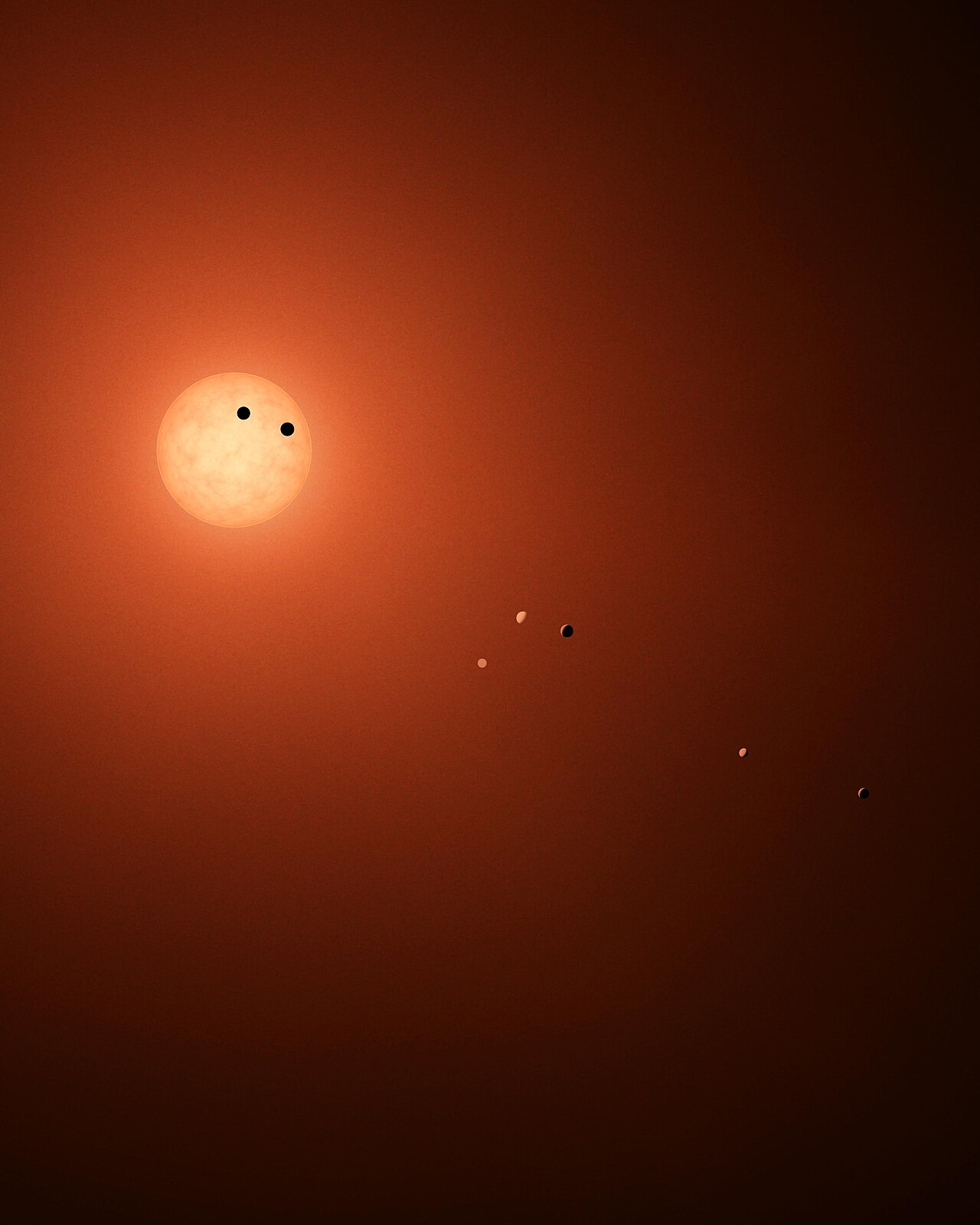
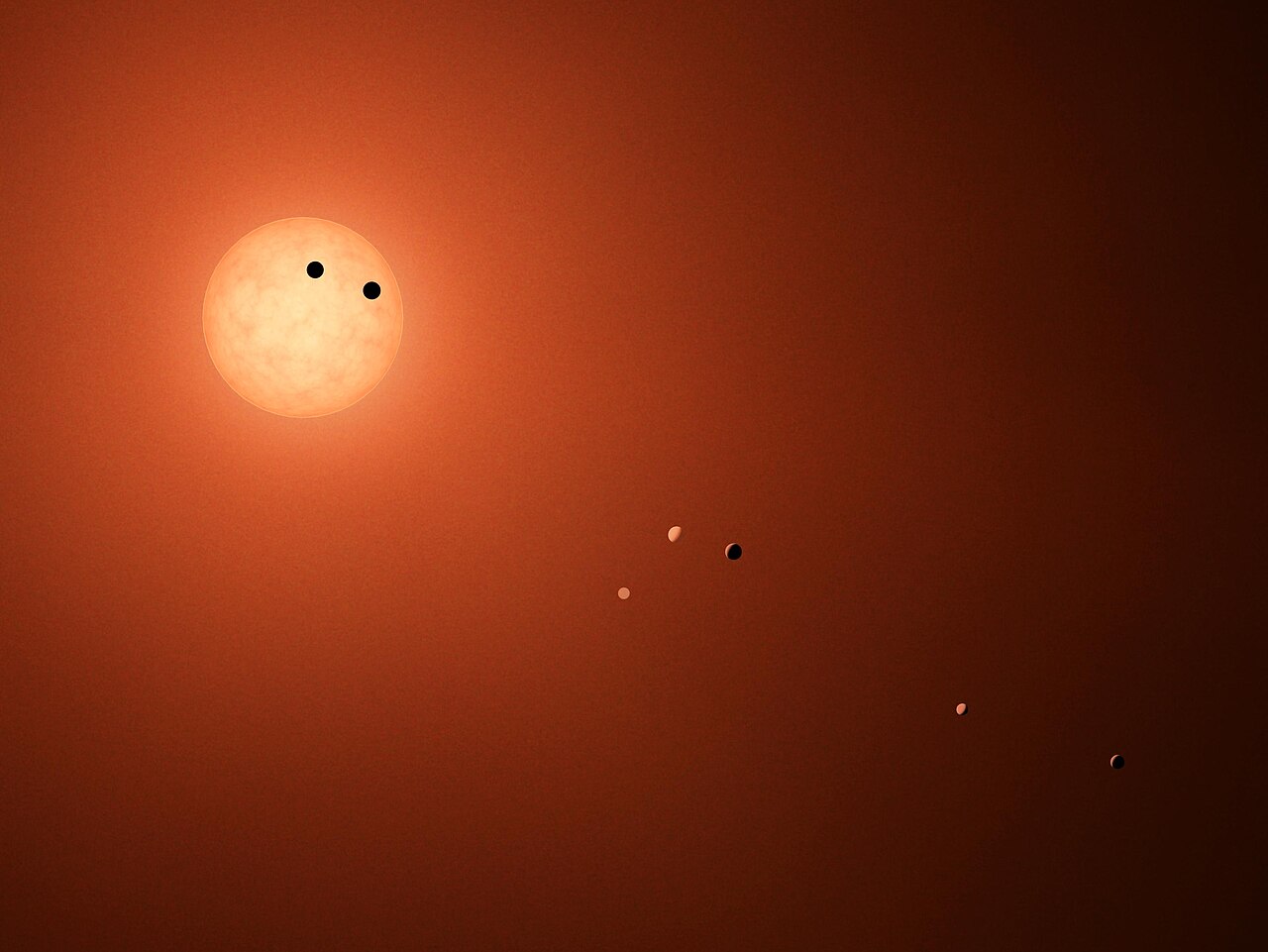
Outermost known planet in the TRAPPIST-1 system.

NASA/JPL-Caltech · Public domain
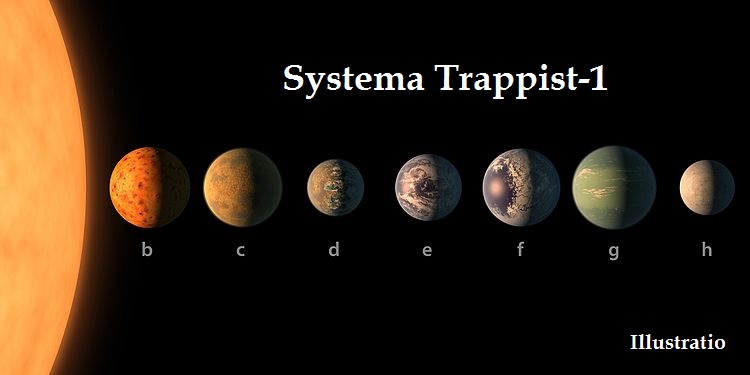
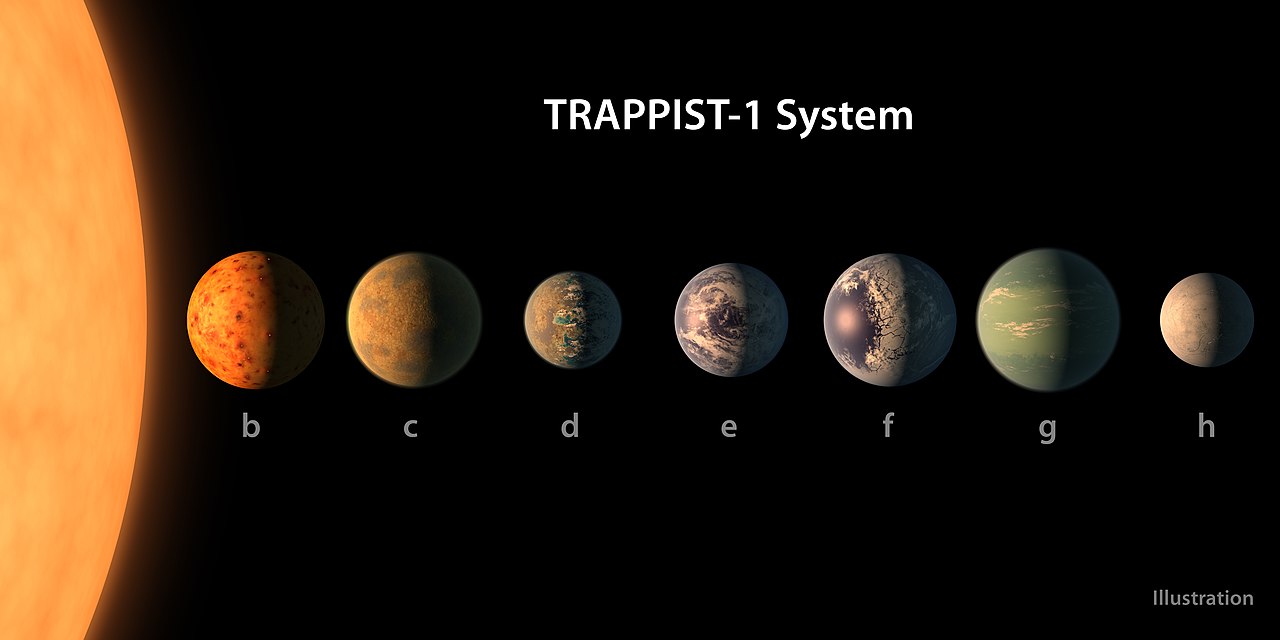
TRAPPIST-1h is the outermost known exoplanet in the TRAPPIST-1 system, a seven-planet system orbiting an ultra-cool red dwarf star 40.7 light-years away in the constellation Aquarius. It is notable for being roughly one third the mass of Earth and about 76% as large, with a relatively low density suggesting a water-rich composition.
Quick Facts
- Discoverer
- Michaël Gillon et al.
- Discovery Site
- Spitzer Space Telescope
- Discovered
- 22 February 2017
- Discovery Method
- Transit
- Apsis
- astron
- Eccentricity
- 0.00567 · 0.00121
- Star
- TRAPPIST-1
Facts from the source article.
Lore & Background
TRAPPIST-1h was discovered in 2017 using observations from the Spitzer Space Telescope, one of seven planets found orbiting the ultracool dwarf star TRAPPIST-1. Subsequent studies refined its physical parameters. The planet has a radius of 0.76 Earth radii and a mass of 0.33 Earth masses, giving it about 57% of Earth's surface gravity. Its density of 3.97 g/cm³ is similar to that of Mars, and at most 5% of its mass may be water, likely in the form of a thick ice shell due to receiving only 13% of the stellar flux Earth does. Its equilibrium temperature is 169 K, comparable to Earth's south pole.
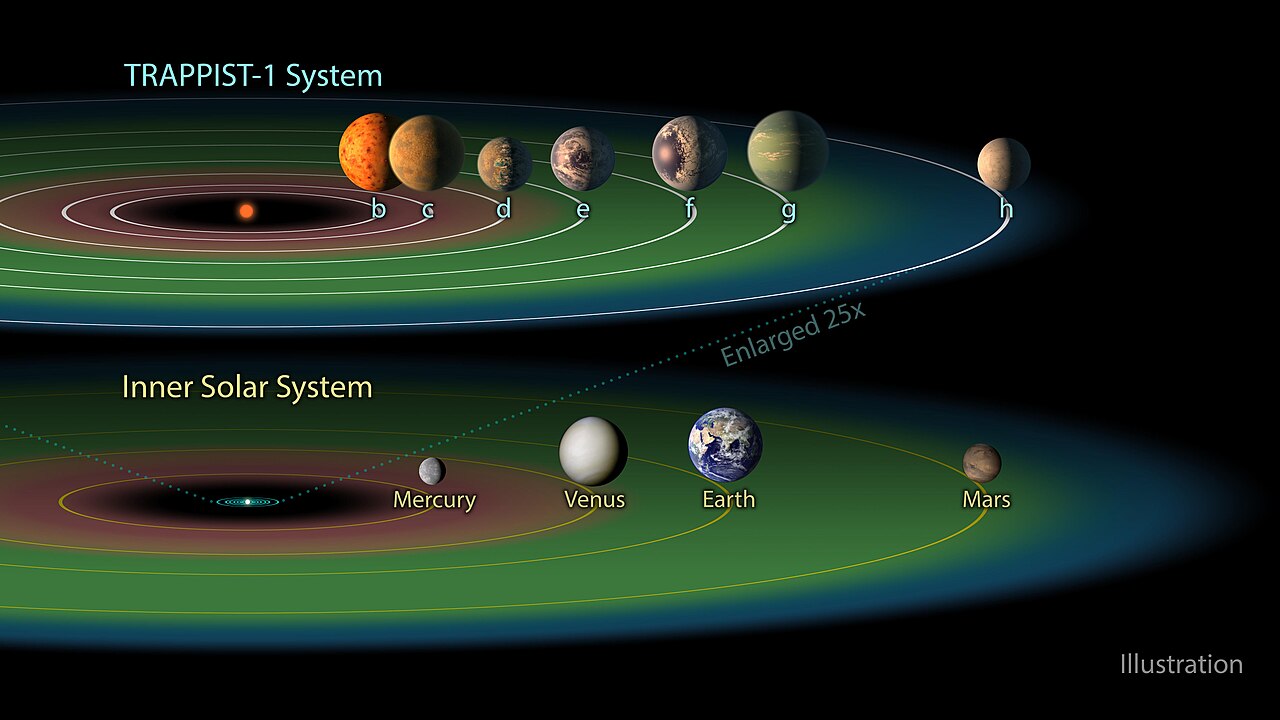
The host star TRAPPIST-1 has a temperature of 2566 K and an age of about 7.6 billion years, with a luminosity only 0.05% that of the Sun. Despite being the most distant known planet in its system, TRAPPIST-1h orbits at just 0.0619 AU, smaller than Mercury's orbit, with an orbital period of 18.77 days. It is in a 3:2 orbital resonance with TRAPPIST-1g.
Reader's Guide
TRAPPIST-1h's significance lies in its position as the outermost known planet of the TRAPPIST-1 system, a compact system of seven Earth-sized worlds. Its low density and water-rich potential make it a key object for studying planetary composition in ultracool dwarf systems. Although its orbit falls near the star's frost line, the possibility of liquid water under an H2-rich atmosphere was considered, but observations in 2021 and 2022 strongly disfavored such an atmosphere. Alternatively, if ice-covered, tidal heating could sustain a subsurface ocean, potentially leading to cryovolcanism in the form of erupting geysers. The planet's small orbital distance—0.0619 AU—despite being the farthest in its system, highlights the extreme compactness of the TRAPPIST-1 planetary system. Its equilibrium temperature of 169 K and low stellar flux place it in a regime where ice is stable, yet internal heating mechanisms offer a possible path to subsurface liquid water. The planet's discovery and characterization have contributed to understanding the diversity of exoplanets around ultracool dwarfs, particularly regarding water content and habitability potential in systems very different from our own.
Did You Know?
- TRAPPIST-1h is the outermost known planet in the TRAPPIST-1 system.
- The planet orbits its star at a distance of 0.0619 AU, smaller than Mercury's orbit.
The Road to Discovery
The star we now call TRAPPIST-1 first entered the astronomical record in 1999, when John Gizis and his colleagues catalogued it during a survey targeting nearby ultra-cool dwarf stars. It appeared in sample C of that survey, collected in June of that year, though the formal publication did not arrive until 2000. The name itself honours the TRAPPIST project—the Transiting Planets and Planetesimals Small Telescope initiative—that would later reveal the star's planetary family. In 2016, Belgian astronomer Michaël Gillon and his team at the University of Liège identified anomalies in light curves originally measured in 2015 at La Silla Observatory in Chile. What was first read as three planets quickly resolved into a more complex picture as additional data from the Spitzer Space Telescope, TRAPPIST-North in Morocco, the South African Astronomical Observatory, and Spanish facilities filled in the gaps. By 2017, five further terrestrial worlds had been confirmed. The effort was jointly funded by NASA and the European Research Council, a collaboration that some early news reports mistakenly credited to a single agency.
A Star at the Edge of Fusion
TRAPPIST-1 is an ultra-cool red dwarf of spectral class M8.0, sitting just barely above the threshold where nuclear fusion can sustain itself. Its mass is roughly nine percent of the Sun's, and its radius—only twelve percent of the solar value—is just a hair larger than Jupiter's, making it one of the smallest stars known to harbour planets. With a surface temperature of approximately 2,566 kelvins, it was, as of 2022, the coldest confirmed planet-hosting star. Its luminosity is a mere 0.055 percent of the Sun's, radiated predominantly in the infrared. The star's density is anomalously low for a red dwarf, and JWST observations suggest that cold starspots may blanket as much as a quarter of its photosphere. It rotates every 3.3 days and shows no clear stellar activity cycle. Faint X-ray and ultraviolet emissions have been detected, but no radio waves. At an estimated 7.6 billion years of age, it predates our own Solar System, and its hydrogen supply is expected to last on the order of ten trillion years—roughly seven hundred times the current age of the universe.
Seven Worlds in a Tight Dance
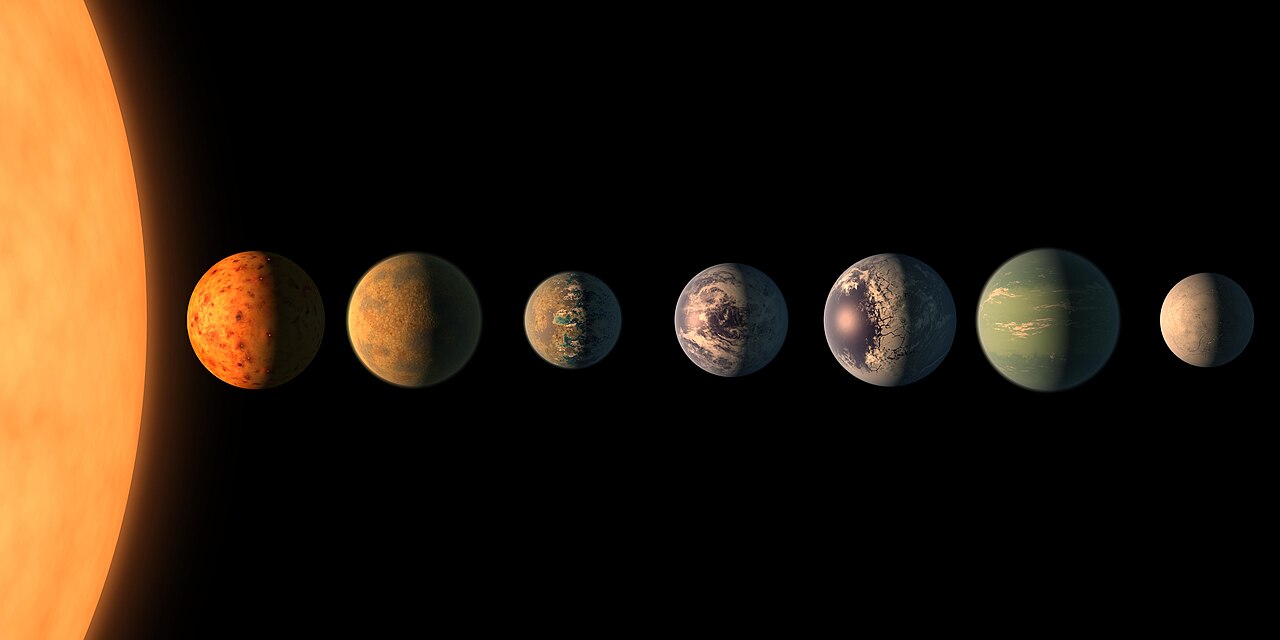
The seven planets circling TRAPPIST-1 complete their orbits in just 1.5 to 19 days, tracing nearly circular paths that all lie in the same plane. Because they are so close to their dim host star, each is almost certainly tidally locked, presenting one hemisphere in perpetual daylight and the other in endless night. Their masses are comparable to Earth's, yet their densities are notably low, hinting at substantial volatile content rather than purely rocky composition. Detection was possible because the coplanar geometry means every planet transits the star as seen from Earth, dimming its apparent brightness in a measurable way. Four of the seven—designated d, e, f, and g—sit at orbital distances where liquid water could plausibly persist, placing them in a potentially habitable band. However, no atmosphere has been confirmed on any of the worlds; observations of TRAPPIST-1b in particular have ruled one out. Whether the star's radiation environment would permit atmospheres to survive at all remains an open question.
Why the System Captured the Imagination
The TRAPPIST-1 system has become one of the most discussed planetary families in modern astronomy, largely because of its remarkable compactness and the genuine possibility that several of its members could support liquid water. The discovery is widely regarded as among the most significant scientific returns from the Spitzer Space Telescope, and the system has since featured in popular culture as a shorthand for a nearby world where life might exist. Research interest has been sustained by the star's unusual properties—its extreme cold, its ancient age, and the unresolved question of whether its planets ever retained atmospheres. The James Webb Space Telescope has been brought to bear on the system, probing the star's photospheric features and the polarisation signatures of condensates in its atmosphere. The project's international, multi-agency funding structure—spanning NASA, the European Research Council, and observatories across Chile, Morocco, South Africa, and Spain—has made it a model for how large-scale exoplanet science is conducted in the twenty-first century.
Gallery
Frequently Asked Questions
Who is TRAPPIST-1h?
TRAPPIST-1h is the farthest-known planet orbiting the ultra-cool red dwarf star TRAPPIST-1, located roughly 40.7 light-years from us in the constellation Aquarius. It completes the seven-planet family that makes this system one of the most studied in the sky.
What are TRAPPIST-1h's key physical stats?
The planet weighs about 0.33 Earth masses and spans roughly 76 percent of Earth's radius, giving it a surface gravity at just 57 percent of what we feel here. Its density of 3.97 g/cm³ is notably low for a rocky world, hinting at a large fraction of water or ice in its interior.
Where does TRAPPIST-1h sit in the TRAPPIST-1 system?
It is the outermost confirmed planet in the seven-planet TRAPPIST-1 chain, taking 18.77 Earth days to complete one orbit around its host star. Being the most distant member, it receives the least stellar energy of the group.
What is TRAPPIST-1h's surface environment like?
With an equilibrium temperature of only about 169 K, the planet is far too cold for liquid water to persist at the surface. Its low gravity and frigid climate make it a frozen, low-density world compared to its inner siblings.
Why is TRAPPIST-1h important to exoplanet science?
As the outermost member of a compact, multi-planet system around a small star, it helps astronomers test models of how planetary systems assemble and migrate. Its water-rich composition, inferred from the low density, also makes it a key data point in the search for ocean-world candidates.
More in Transiting Exoplanets, Part 4 1-24
Spotted an error? Know more?
Reader corrections go straight into our review queue. Suggest an edit · How this site is sourced