Kepler-21b
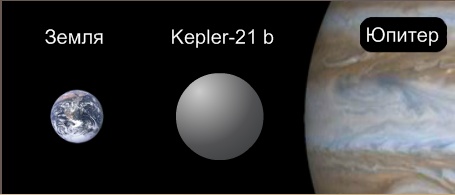
A rocky, molten exoplanet transiting a bright subgiant star.

Beard et. al. · CC BY 4.0
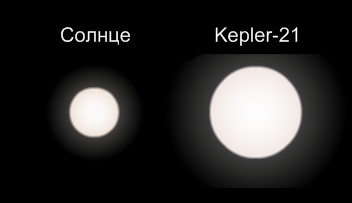
Kepler-21b is a transiting exoplanet orbiting the F-type subgiant star Kepler-21 (HD 179070) in the constellation Lyra. It was the first validated planet discovered around the brightest star observed by the Kepler spacecraft, until a later exoplanet was found orbiting HD 212657.
- Host star
- Kepler-21 (HD 179070)
- Stellar classification
- F6 IV
- Star distance
- 354 ly
- Star mass
- 1.4 solar masses
- Star radius
- 1.9 solar radii
- Star luminosity
- 5 solar luminosities
- Star effective temperature
- 6,305 K
Lore & Background
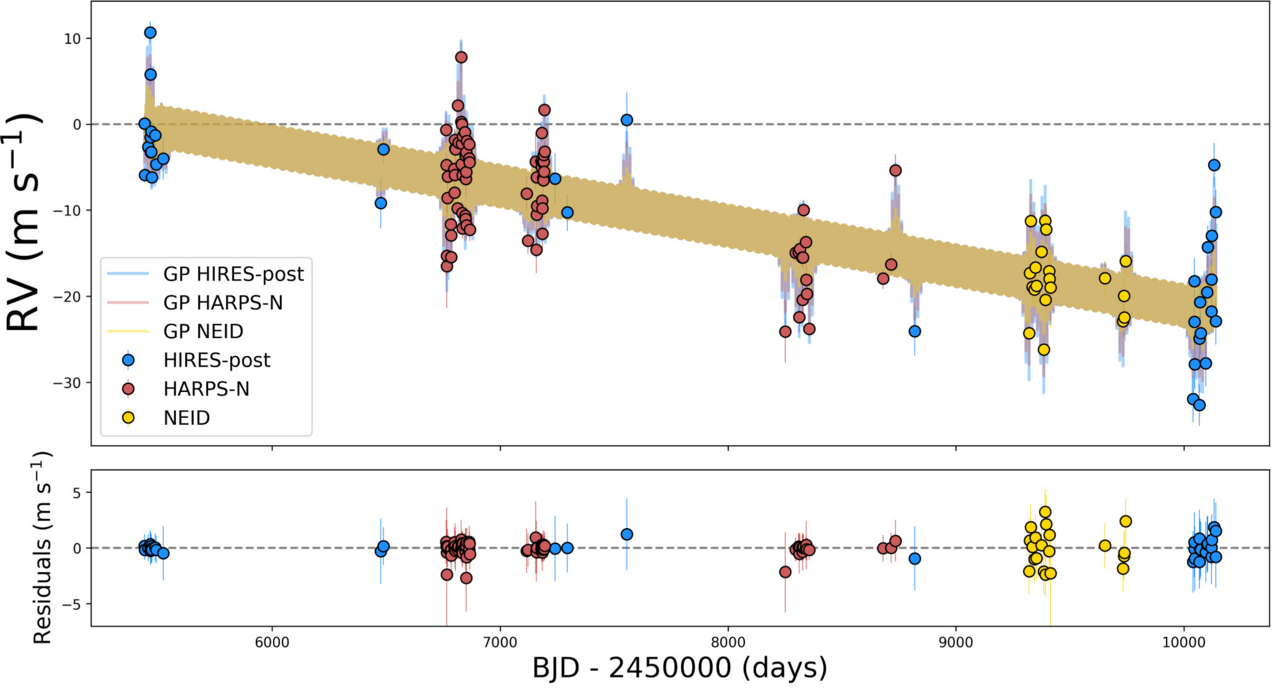
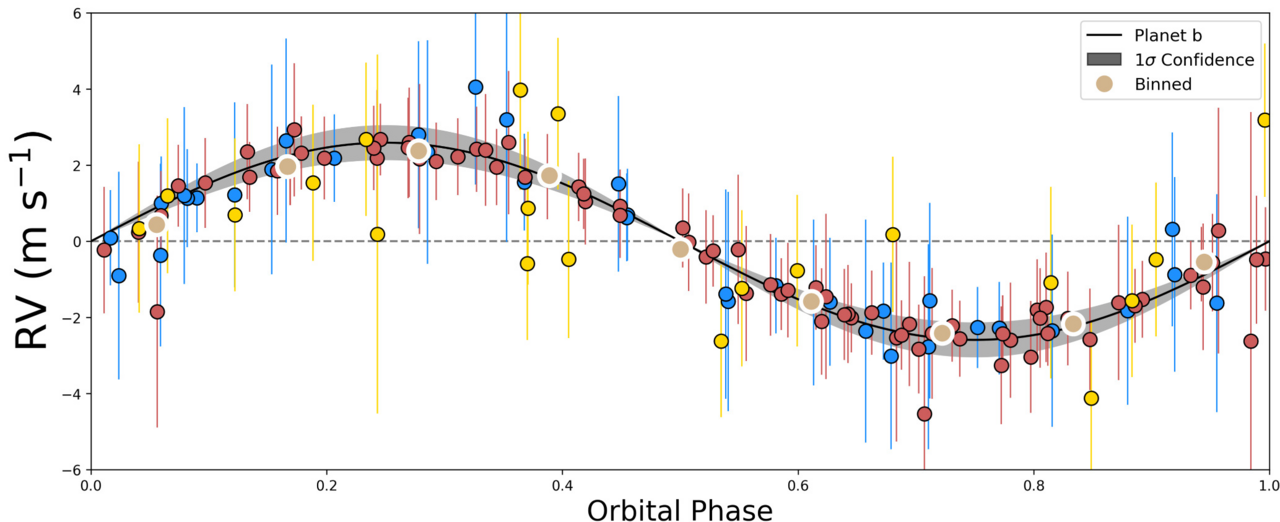
Kepler-21b was identified as a candidate transiting exoplanet from the first four months of photometric data collected by the Kepler spacecraft. Confirmation came after extensive follow-up observations and analysis of the Kepler light curves. The planet's calculated density is similar to Earth's, suggesting a rocky composition. With an equilibrium temperature of 2,025 Kelvin, the top few hundred kilometers of the planet are probably molten. Tidal effects cause an orbital decay rate of 3.88 milliseconds per year, a change of only 4 seconds every thousand years, which would be undetectable over any reasonable timescale. The system may host another exoplanet, a gas giant with at least 3.7 times the mass of Jupiter, designated Kepler-21c.
Reader's Guide
Kepler-21b is notable as the first validated planet orbiting the brightest star observed by the Kepler spacecraft, highlighting the mission's ability to detect small planets around relatively bright stars. Its Earth-like density indicates a rocky composition, while its extreme equilibrium temperature places it in a regime where the surface is likely molten, offering a window into the nature of ultra-hot rocky worlds. The presence of a co-moving stellar companion, HD 179070 B, may have influenced the planet's formation and orbital evolution. The slow, undetectable orbital decay from tidal interactions underscores the long-term stability of the system. The possible additional gas giant, Kepler-21c, suggests a multi-planet architecture, though only Kepler-21b is confirmed as a transiting planet.
Did You Know?
- Kepler-21b has a density similar to Earth's, suggesting a rocky composition.
- Its equilibrium temperature is 2,025 Kelvin, making its surface probably molten.
- The planet's orbital period decreases by 3.88 milliseconds per year due to tidal effects.
- The host star Kepler-21 is an evolving F-type subgiant with 1.4 times the Sun's mass.
Engineering the CoRoT Spacecraft
The CoRoT satellite was a purpose-built platform for staring at stars for extended periods, and its engineering reflected that singular goal. At its heart sat a 27-centimeter off-axis afocal telescope, enclosed within a two-stage opaque baffle engineered to block sunlight bouncing off the Earth's surface. This design kept stray light from washing out the faint stellar signals the mission needed. Behind the optics, four CCD detectors from E2V Technologies—model 4280, frame-transfer and back-illuminated with 2,048-by-2,048 pixel arrays—were arranged in a square, two assigned to planet hunting and two to asteroseismology. Each pixel measured 13.5 micrometers, translating to roughly 2.32 arcseconds of sky. The detectors were chilled to minus 40 degrees Celsius and shielded by ten millimeters of aluminum against radiation. A prism in front of the planet-detection sensors spread light into a small spectrum weighted toward blue wavelengths, while the asteroseismology sensors were deliberately defocused by 760 micrometers to prevent the brightest stars from saturating them. The whole spacecraft, assembled at the Cannes Mandelieu Space Center, weighed 630 kilograms at launch, stretched 4.10 meters in length, and carried two solar panels for power.
Staring at the Sky: Observation Strategy
CoRoT's orbital geometry gave it a key advantage: it pointed its telescope perpendicular to its orbital plane, eliminating Earth occultations and enabling observation stretches of up to 150 consecutive days. These marathon sessions, termed Long Runs, were the backbone of the exoplanet search because they allowed detection of smaller planets with longer orbital periods. Between the two Long Runs each year, roughly 30 days were set aside for Short Runs, during which the spacecraft swept across different sky patches to feed the asteroseismology program with a broader stellar sample. To keep the Sun out of the field of view, CoRoT alternated its gaze seasonally—toward the Galactic Center in Serpens Cauda during northern summer, and toward the Galactic anticenter in Monoceros during winter. Years of preliminary ground-based work between 1998 and 2005 produced the CoRoTsky database, a catalog of stars in those two fields that let planners select optimal targets: dense enough to yield many dwarf stars for transit hunting, bright enough for asteroseismology, yet not so crowded that individual stars blurred together. After a Data Processing Unit failure in March 2009 halved the usable field of view, the strategy shifted to three-month runs to maximize efficiency with the reduced aperture.
Pioneering the Transit Method
CoRoT holds a singular place in the history of exoplanet science as the first spacecraft designed and dedicated entirely to detecting transiting extrasolar planets. Launched atop a Soyuz 2.1b rocket on 27 December 2006, the probe reported first light on 18 January 2007 and began collecting science data on 2 February 2007. Just three months into its observing campaign, in May 2007, it confirmed its first exoplanet, CoRoT-1b. The mission's most celebrated discovery came in 2009 with CoRoT-7b, which became the first exoplanet shown to possess a rock- or metal-dominated composition—a milestone that reshaped expectations about what worlds beyond our solar system could look like. Led by France's CNES in partnership with ESA and other international collaborators, CoRoT pursued two parallel scientific goals: hunting short-period planets of large terrestrial size and performing asteroseismology by measuring solar-like oscillations in stars. By proving that a dedicated transit survey could deliver both novel planetary discoveries and fundamental stellar physics, CoRoT opened the conceptual and technical pathway for the more ambitious missions that followed, including Kepler and TESS.
A Sudden End: Failure and Decommissioning
CoRoT was originally designed for a flight-operations window of roughly two and a half years from its December 2006 launch, but the mission's scientific productivity convinced operators to extend operations well beyond that horizon, pushing the end date to 2013. That extended life came to an abrupt halt on 2 November 2012, when a computer failure rendered it impossible to retrieve any data from the telescope. Despite repair attempts, the spacecraft never regained full functionality. On 24 June 2013, the mission team announced that CoRoT would be formally retired and decommissioned. Rather than leaving the 630-kilogram satellite to drift indefinitely in its orbit, operators lowered its trajectory so that it would eventually re-enter Earth's atmosphere and burn up, ensuring no long-term debris would remain. The end of CoRoT marked the close of a pioneering era in space-based exoplanet detection. Its legacy, however, endured in the data it had already gathered—thousands of stars catalogued across its many observing fields, the first exoplanet shown to have a rock or metal-dominated composition, and the operational blueprint that would inform the design of Kepler, TESS, and the next generation of planet-hunting missions.
Gallery
Frequently Asked Questions
What is Kepler-21b?
Kepler-21b is a rocky, molten exoplanet that periodically crosses the face of its host star as seen from Earth, earning its classification as a transiting world. It orbits the F-type subgiant Kepler-21 in the constellation Lyra.
What star does Kepler-21b circle?
Its host is Kepler-21 (HD 179070), an F6 IV subgiant with about 1.4 solar masses, a radius near 1.9 times the Sun's, and roughly five times the Sun's luminosity.
How far is the Kepler-21 system from us?
The star and its planet sit approximately 354 light-years away in the direction of Lyra.
Why is Kepler-21b considered a milestone discovery?
It was the first confirmed planet identified around the brightest star in the entire Kepler survey field. That particular distinction was later overtaken when a planet was validated around HD 212657.
What is Kepler-21b like physically?
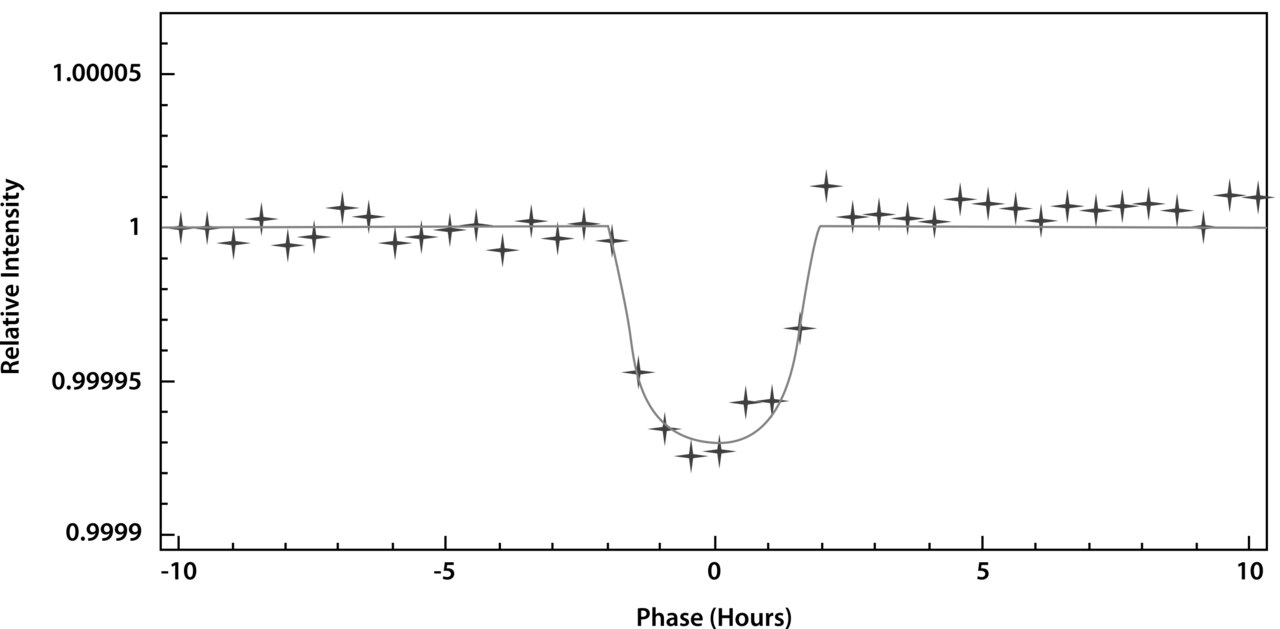
It is characterized as a hot, rocky, molten world, implying a surface that is largely or fully liquid rock rather than a solid, temperate crust. Its detectability comes from the periodic dimming it causes as it transits its bright subgiant host.
More in Transiting Exoplanets, Part 4 1-24
Spotted an error? Know more?
Reader corrections go straight into our review queue. Suggest an edit · How this site is sourced