HAT-P-38b
A hot Saturn with water vapor and a bloated atmosphere.

400Weir · CC0
HAT-P-38b, also known as Hiisi, is a transiting exoplanet 821 light-years away in the constellation Triangulum. It orbits the G-type star HAT-P-38. The planet’s name comes from its host star and the fact it was the first planet found there. In 2019, it was chosen for Finland’s second NameExoWorlds campaign during the IAU’s 100th anniversary. Hiisi refers to sacred places and later evil spirits in Finnic mythology, and it is also the name of the binary companion of the trans-Neptunian object 47171 Lempo.
Discovered between August and November 2010, the planet’s transits were observed by the HATNet Project’s HAT-6 telescope in Arizona and HAT-8 telescope in Hawaii. Astronomers detected a transit curve with a period of 4.64033 days. Follow-up radial velocity measurements with the High Dispersion Spectrograph confirmed it as a planet and determined its mass.
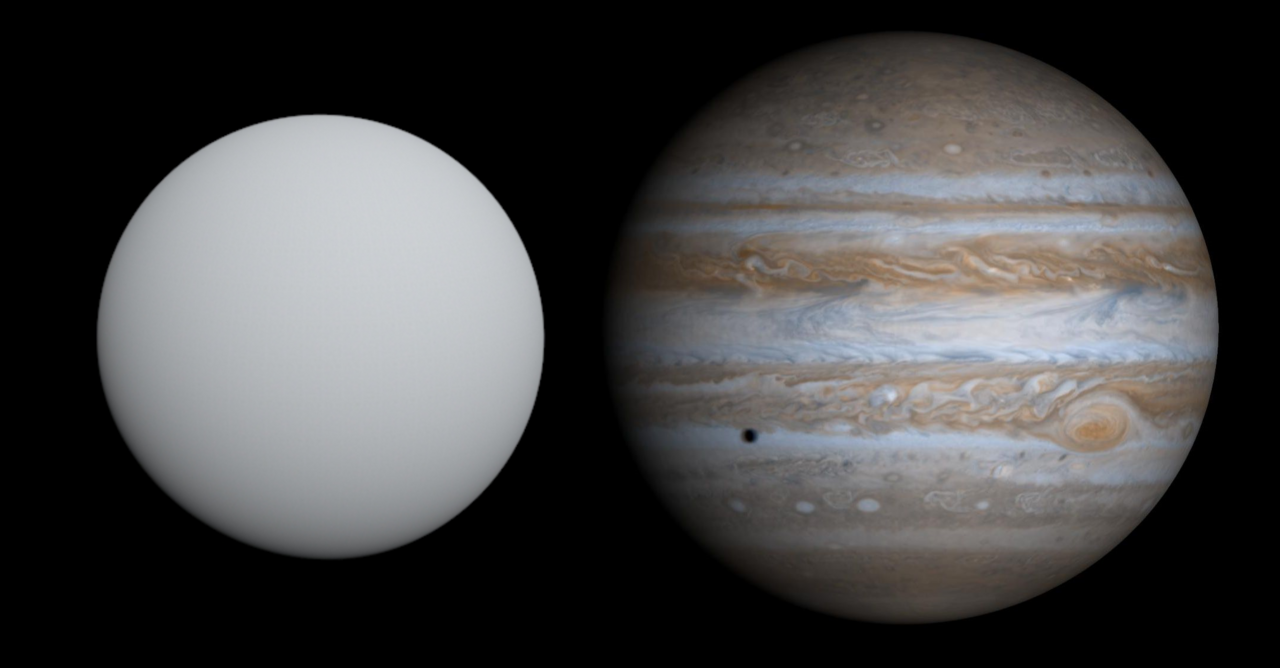
HAT-P-38b is a hot Saturn. It takes over four days to circle its star in a tight, nearly circular orbit at a distance of 0.0519 astronomical units. Its mass is 26.6% that of Jupiter, similar to Saturn. Tidal heating from its star causes the planet to swell to 82.5% of Jupiter’s radius. Its equilibrium temperature and density are not listed, but its density is half that of water (1,000 kg/m³). The planet’s average surface gravity is slightly less than Earth’s.
In 2017, astronomers compared the atmospheres of HAT-P-38b and WASP-67b because of their similarities. Giovanni Bruno and colleagues detected water vapor in both, with HAT-P-38b having a greater abundance, suggesting its atmosphere lacks clouds or hazes.
Quick Facts
- Extrasolarplanet
- yes
- Apsis
- astron
- Discoverer
- Sato et al. (HATNet)
- Discovered
- October 2012
- Discovery Method
- Transit
- Eccentricity
- <0.055
- Star
- HAT-P-38
Facts from the source article.
Lore & Background
HAT-P-38b was discovered through transit observations made between August and November 2010 using the HAT-6 telescope in Arizona and the HAT-8 telescope in Hawaii, part of the HATNet Project. A transit curve with a period of 4.64033 days was observed, and subsequent radial velocity measurements with the High Dispersion Spectrograph confirmed the planet's status and yielded its mass. The planet's designation comes from its host star and its status as the first discovered planet around that star. In 2019, it was selected for the second NameExoWorlds campaign for Finland, receiving the name Hiisi, which refers to sacred localities and later evil spirits in Finnic mythology; this name is shared with the binary companion of the trans-Neptunian object 47171 Lempo.
HAT-P-38b is a hot Saturn with a mass 26.6% that of Jupiter, similar to Saturn, but its radius is 82.5% of Jupiter's due to tidal heating from its host star. It orbits HAT-P-38 every 4.64033 days in a relatively circular and tight orbit at a separation of 0.0519 astronomical units. Its density is half that of water, and its average gravitational acceleration is slightly smaller than Earth's. In 2017, its atmosphere was compared with that of WASP-67b; water vapor was detected in both, with HAT-P-38b having a greater abundance, indicating a lack of clouds or hazes.
Reader's Guide
HAT-P-38b's significance lies in its role as a benchmark for comparative exoplanet atmospheric studies. In 2017, astronomers Giovanni Bruno and colleagues compared its atmosphere with that of WASP-67b, both planets having similar properties. The detection of water vapor in HAT-P-38b, with a greater abundance than in WASP-67b, suggests that its atmosphere lacks clouds or hazes, providing insight into the diversity of hot Saturn atmospheres. The planet's formal name Hiisi, assigned through the IAU's NameExoWorlds campaign for Finland, connects it to Finnic mythology and the broader cultural naming of celestial bodies. Its discovery via the HATNet Project, using telescopes in Arizona and Hawaii, and its characterization through radial velocity measurements, exemplify the collaborative observational efforts that have expanded the catalog of transiting exoplanets. The planet's bloated radius, resulting from tidal heating, and its low density highlight the range of physical states possible for close-in gas giants, contributing to the understanding of planetary evolution under stellar influence.
Did You Know?
- The planet's density is half that of water.
- Water vapor was detected in its atmosphere, with a greater abundance than in WASP-67b.
Nomenclature & Cultural Identity
The planet's catalog designation follows a straightforward convention: the letter "b" appended to the host star's name signals that it is the first world detected in orbit around HAT-P-38. The story becomes more culturally resonant in 2019, when the planet was selected as Finland's entry in the IAU's NameExoWorlds campaign, a global naming initiative launched to mark the organization's 100th anniversary. The approved name, Hiisi, is drawn from Finnic mythology, where the word originally referred to sacred localities before its meaning shifted over time to denote evil spirits. That duality—a term that once marked holy ground and later came to signify dark, malevolent presences—lends the exoplanet a mythological depth that few catalogued worlds possess. The name also creates an unexpected link within our own Solar System: the binary companion of the trans-Neptunian object 47171 Lempo carries the same designation, tying a scorching gas giant 821 light-years out in the constellation Triangulum to a small, frozen body lurking in the Kuiper Belt.
Discovery & Spectroscopic Confirmation
The first signs of HAT-P-38b emerged during a series of transit observations carried out between August and November 2010. Two instruments belonging to the HATNet Project played the leading roles: the HAT-6 telescope stationed in Arizona and the HAT-8 telescope on Hawaii. Together they captured a repeating dimming of the host star's light, tracing a transit curve that revealed an orbital period of 4.64033 days. A transit signal alone, however, does not guarantee a planet—stellar spots or a binary companion can mimic the same photometric dip. Confirmation arrived through radial-velocity measurements taken with the High Dispersion Spectrograph, which detected the tiny gravitational wobble the world impresses on its G-type host star. That same spectroscopic work yielded the planet's mass, anchoring HAT-P-38b firmly in the planetary regime and giving researchers a solid baseline against which every subsequent property measurement could be calibrated.
Physical Character & the Bloat Puzzle
HAT-P-38b is classified as a hot Saturn, a label that captures both its mass and its scorching environment. At 26.6 percent of Jupiter's mass, it sits close to Saturn's own weight, yet its radius swells to 82.5 percent of Jupiter's. The driving force behind that inflation is tidal heating: the planet's tight, nearly circular orbit at just 0.0519 astronomical units subjects it to relentless gravitational tugging by HAT-P-38, puffing up its envelope well beyond what its mass alone would predict. The result is a remarkably low bulk density of 590 kilograms per cubic meter—only half that of liquid water. Its equilibrium temperature reaches 1,082 kelvin, and the surface gravity of 9.77 meters per second squared falls just below Earth's 9.81. A world that weighs like Saturn but stretches nearly to Jupiter's girth, held together at barely half the density of the ocean, presents a striking case study in how close-in orbits reshape gas giants.
Atmospheric Probes & Comparative Context
In 2017, Giovanni Bruno and colleagues turned their attention to a comparative study pairing HAT-P-38b with WASP-67b, two hot Jupiters sharing broadly similar bulk properties. The team detected water vapor in both atmospheres, but the abundance was noticeably higher in HAT-P-38b. That stronger spectral signature carried an important implication: the planet's upper atmosphere appears largely free of the clouds or photochemical hazes that typically mute molecular features in other hot Jupiters. A clearer window into the deep atmosphere means the water signal is less diluted, offering a cleaner benchmark for atmospheric modeling. The comparison also highlighted how two worlds of comparable mass, radius, and temperature can differ in their cloud coverage, reminding researchers that small compositional or dynamical differences can produce markedly different observable signatures. For a planet already unusual in its bloated, low-density structure, the relatively transparent atmosphere adds another distinctive layer to Hiisi's profile.
Gallery
Frequently Asked Questions
Who is HAT-P-38b?
HAT-P-38b is a hot Saturn-class exoplanet situated about 821 light-years away in the Triangulum constellation, circling the G-type star HAT-P-38. It earned its number because it was the first planet ever identified around that particular host star.
What does the name "Hiisi" refer to?
Hiisi was adopted through Finland's second NameExoWorlds campaign in 2019, timed to mark the IAU's 100th anniversary. In Finnic mythology the word denotes sacred places that later became linked to malevolent spirits, and it also labels the binary companion of the trans-Neptunian object 47171 Lempo.
What are HAT-P-38b's key physical properties?
The planet weighs roughly 26.6% of Jupiter's mass and spans about 82.5% of Jupiter's radius, yielding a density of only around 500 kg/m³—half that of liquid water. Its surface gravity is just slightly below Earth's, and it laps its star every 4.64 days at a separation of 0.0519 AU.
How was HAT-P-38b discovered?
Transit signals from the planet were captured between August and November 2010 by the HATNet photometric survey. Follow-up observations confirmed a periodic dimming of HAT-P-38 consistent with a close-in giant planet crossing the stellar disk.
Why is HAT-P-38b important to exoplanet research?
Its extremely low density—half that of water—makes it a textbook case of a bloated hot Saturn, shedding light on how close-in sub-Jupiter planets inflate their envelopes. Spectroscopic evidence of water vapor in its puffed-up atmosphere also gives researchers a useful benchmark for modeling the thermal evolution of giant planets below Jupiter's mass.
More in Transiting Exoplanets, Part 4 1-24
Spotted an error? Know more?
Reader corrections go straight into our review queue. Suggest an edit · How this site is sourced