LTT 9779 b
The most reflective exoplanet known, orbiting its star in under a day.

James Webb Space Telescope · CC BY 2.0
LTT 9779 b, officially named Cuancoá, is a Neptune-sized exoplanet orbiting the sunlike star LTT 9779 (Uúba). Discovered in 2020 using data from the Transiting Exoplanet Survey Satellite (TESS), it is notable for having the highest-known albedo of any planet as of 2023, reflecting 73% of light. It is one of the few known planets in the Neptunian desert, a rare class of ultra-hot Neptune planets.
Quick Facts
- Discoverer
- Jenkins et al.
- Discovery Site
- Transiting Exoplanet Survey Satellite
- Discovered
- 2020
- Discovery Method
- Transit
- Extrasolarplanet
- LTT 9779 b
- Period
- 0.79206418 · (12) days
- Albedo
- 0.73 · 0.11
- Star
- LTT 9779
Facts from the source article.
Lore & Background
LTT 9779 b was discovered in 2020 via TESS data and later officially named Cuancoá in 2022 by the International Astronomical Union as part of the NameExoWorlds competition. The name refers to the morning star in the Uwa language (Tunebo), while its host star was named Uúba after the word for 'star', 'seed', and 'eye' in the same language.
The planet completes an orbit in less than a day, causing dayside temperatures to exceed 2,000 degrees Celsius. Global climate models indicate a very metal-rich atmosphere with likely silicate clouds. A study using JWST NIRISS found highly reflective white clouds on the western dayside, composed of MgSiO3 (enstatite) and Mg2SiO4 (forsterite), and detected water vapor at 1.4 μm. The dayside temperature was measured, and the nightside temperature was measured to be less than 1,330 K. However, a 2025 study suggests that a pure cloudy atmosphere is inconsistent with the results, indicating mixing processes may have affected the atmospheric composition. Another 2025 study confirms a metal-rich atmosphere and likely silicate (MgSiO3) clouds.
Reader's Guide
LTT 9779 b holds significant scientific value as one of the few known planets in the Neptunian desert—a region where planets of its size and orbital period are extremely rare. It is estimated that only 1 in 200 Sun-like stars host a planet with an orbital period of less than a day, and most of those are Hot Jupiters or rocky planets, making ultra-hot Neptune planets like LTT 9779 b exceptional. Its high albedo, the highest of any known planet, and its reflective silicate clouds have made it a target for extensive study by space telescopes including Hubble and the James Webb Space Telescope (JWST). The detection of water vapor and the characterization of its cloud composition provide insights into atmospheric processes under extreme temperatures. The 2025 studies highlighting potential mixing processes and confirming metal-rich composition underscore ongoing refinement in understanding this rare world. Its legacy lies in challenging models of planetary formation and atmospheric dynamics in the Neptunian desert.
Did You Know?
- LTT 9779 b has the highest-known albedo of any planet, reflecting 73% of light.
- It completes an orbit around its star in less than one day.
- Its dayside temperature exceeds 2,000 degrees Celsius.
- The planet's clouds are likely made of silicate minerals such as enstatite and forsterite.
Discovery & a Rare Corner of the Cosmos
LTT 9779 b first entered the astronomical record in 2020 when researchers analyzed data collected by the Transiting Exoplanet Survey Satellite. Under its survey designation TOI-193 b, the Neptune-sized world quickly attracted attention for a reason that goes beyond its mere existence: it occupies one of the most sparsely populated regions of the exoplanet landscape, the so-called Neptunian desert. Statistical estimates suggest that roughly one in two hundred Sun-like stars hosts any planet completing an orbit in under a single day, and the vast majority of those are either massive Hot Jupiters or small rocky worlds. A Neptune-mass body with such a blisteringly short year is an extraordinary statistical outlier. Because so few comparable planets are known, LTT 9779 b has become a priority target for follow-up observations. Both the Hubble Space Telescope and the James Webb Space Telescope have dedicated significant time to characterizing its atmosphere, making it one of the most intensely studied ultra-hot Neptunes in the catalog.
A Mirror in the Sky: Record-Breaking Reflectivity
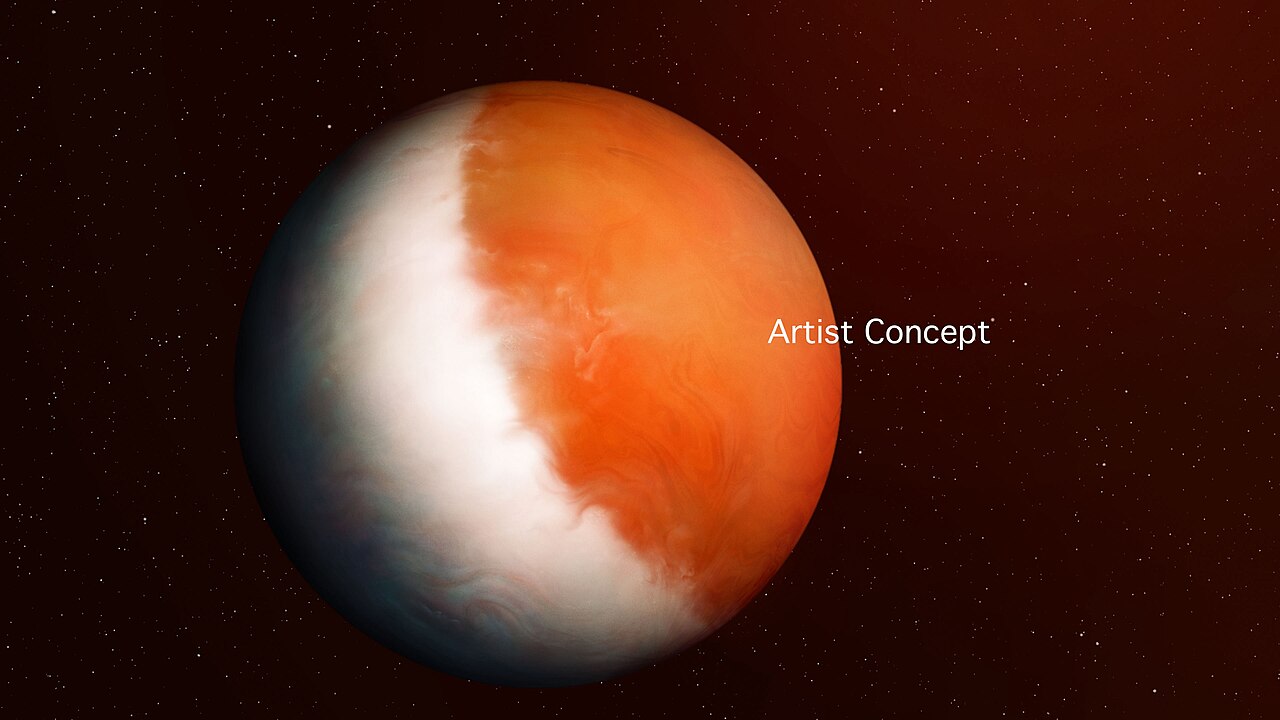
As of 2023, LTT 9779 b holds the title of the most reflective exoplanet ever detected, with a geometric albedo measured at 0.73 with an uncertainty of roughly eleven percent. In plain terms, the planet bounces back about three-quarters of the starlight that strikes it, a figure that surpasses the reflectivity of every other known world beyond our solar system. The James Webb Space Telescope's Near-Infrared Imager and Slitless Spectrograph provided a striking visual explanation: a broad band of brilliant white clouds stretching across the western portion of the dayside. Spectroscopic analysis points to those clouds being composed of silicate minerals, specifically enstatite (MgSiO3) and forsterite (Mg2SiO4), suspended in an atmosphere that is overwhelmingly rich in metals. A 2025 follow-up study reinforced the metal-rich interpretation and independently confirmed the likely presence of silicate cloud decks, cementing LTT 9779 b's reputation as a luminous, mineral-laden world unlike anything else in the exoplanet inventory.
A World Forged in Fire: Climate and Atmospheric Dynamics
LTT 9779 b circles its host star in less than a single Earth day, a pace that drives the dayside temperature above two thousand degrees Celsius. Precise thermal measurements place the dayside at approximately 2,260 kelvin, with an uncertainty range of plus forty and minus fifty, while the nightside cools to below 1,330 kelvin, producing a dramatic thermal contrast across the globe. Global climate models attribute the planet's unusual cloud distribution to a powerful eastward equatorial jet stream. This jet shifts the hottest region away from the substellar point, leaving the western dayside comparatively cooler and creating the conditions necessary for silicate vapor to condense into visible cloud decks. The same JWST observations that revealed those clouds also detected a spectral signature of water vapor, identified as a dip at a wavelength of 1.4 micrometres. However, a 2025 study cautioned that a purely cloudy atmosphere cannot fully reconcile all the data, suggesting that additional atmospheric mixing processes may be reshaping the chemical composition in ways not yet fully understood.
Cuancoá: A Name Rooted in Indigenous Astronomy
In 2022, the International Astronomical Union bestowed an official proper name on LTT 9779 b through its annual NameExoWorlds competition, a global initiative that invites the public to contribute indigenous-language names to newly discovered worlds. The planet was given the name Cuancoá, a term from the Uwa language of the Tunebo people that refers to the morning star. The host star received the companion name Uúba, which in the same Uwa tradition carries the meanings of star, seed, and eye, weaving together celestial and terrestrial imagery. The pairing gives the system a poetic coherence: a luminous seed or eye in the sky, orbited by a bright morning-star-like companion. For the Tunebo community and for the broader astronomical public, the naming transforms a dry catalog designation into a story, anchoring a distant, ultra-hot Neptune in a living linguistic and cultural tradition that has tracked the movements of bright objects across the night sky for generations.
Gallery
Frequently Asked Questions
Who is LTT 9779 b?
LTT 9779 b, officially named Cuancoá, is a Neptune-sized exoplanet that circles the sunlike star Uúba (also catalogued as LTT 9779). It was first identified in 2020 and carries the alternate designation TOI-193 b.
What are LTT 9779 b's powers/role?
The planet's signature trait is its extraordinary reflectivity: it bounces back roughly 73 percent of the starlight it receives, the highest albedo measured for any planet as of 2023. It also belongs to the rare Neptunian-desert class of ultra-hot Neptune-type worlds.
How was LTT 9779 b discovered?
The planet was picked out in 2020 from transit data gathered by the Transiting Exoplanet Survey Satellite (TESS). Its sub-day orbital period around Uúba produced the repeating brightness dips that flagged it to the survey pipeline.
How long is LTT 9779 b's orbit?
The planet completes one full circuit of its star in less than a single Earth day. That extremely short period classifies it as an ultra-hot exoplanet and helps explain its scorching atmospheric conditions.
Why is LTT 9779 b important?
Its record-setting 73-percent albedo pushes back against standard models of how planetary atmospheres behave under intense stellar heating. Because it sits in the Neptunian desert—a regime where Neptune-mass planets are expected to be rare—it also serves as a critical test case for planet-formation and evolution theory.
More in Transiting Exoplanets, Part 4 1-24
Spotted an error? Know more?
Reader corrections go straight into our review queue. Suggest an edit · How this site is sourced