Gliese 367 b
A sub-Earth with a 7.7-hour orbit and a dense iron core.

Martin Vargic / Halcyonmaps Incorporating public domain imagery from NASA · CC BY 4.0
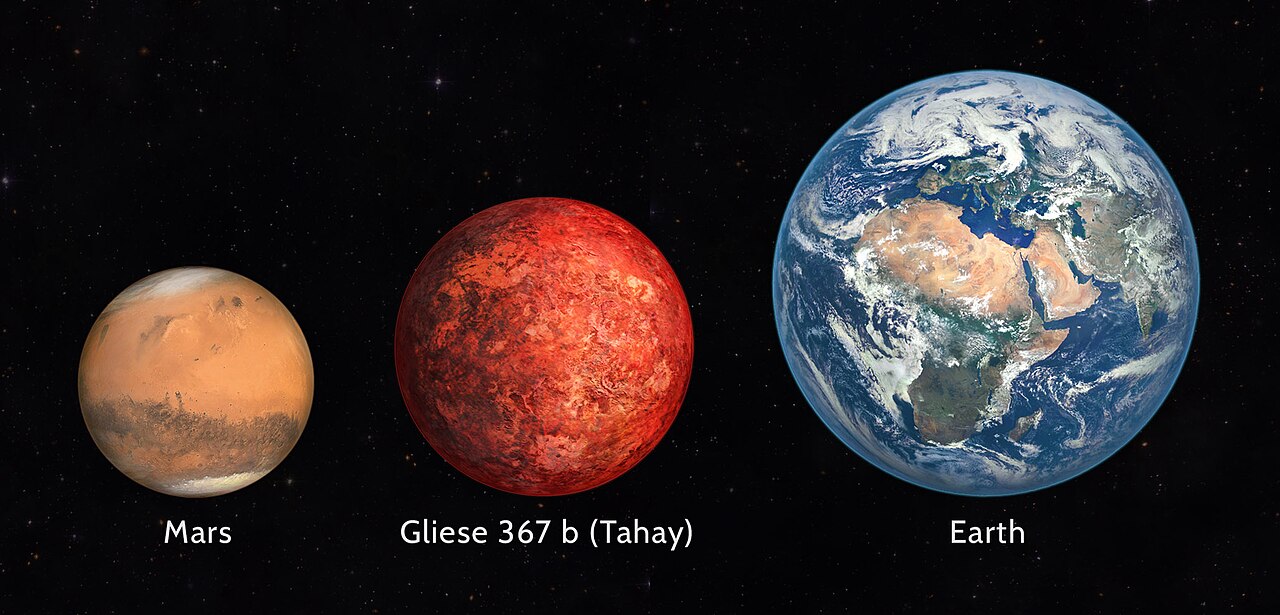
Gliese 367 b, formally named Tahay, is a sub-Earth exoplanet orbiting the red dwarf star Gliese 367 (GJ 367), located 30.7 light-years from Earth in the constellation of Vela. It is notable for having one of the shortest orbital periods of any known planet, completing a full orbit in just 7.7 hours. It is also the smallest exoplanet within 10 parsecs of the Solar System that has a measured radius.
Quick Facts
- Extrasolarplanet
- yes
- Apsis
- astron
- Discoverer
- Kristine Lam, et al.
- Discovery Site
- TESS
- Discovered
- December 2021
- Discovery Method
- Transit
- Eccentricity
- 0.06 · 0.07 · 0.04
- Star
- Gliese 367
Facts from the source article.
Lore & Background
Gliese 367 b was among 20 systems named by the third NameExoWorlds project, with approved names announced in June 2023. The planet is named Tahay, and its host star is named Añañuca, after Chilean wildflowers. The name Tahay alludes to the bloom duration of Calydorea xiphioides, which flowers for only 7 to 8 hours each year, mirroring the planet's short orbital period.
Due to its extremely close orbit, the planet receives over 500 times more radiation than Earth receives from the Sun, resulting in dayside temperatures around 1728 K. The planet is presumably tidally locked, and any atmosphere it may have had would have boiled away. Observations from the James Webb Space Telescope indicate that the planet lacks an atmosphere and has a low albedo, with no day–night heat recirculation suggesting significant volatile loss.
The planet's core is likely composed of iron and nickel, similar to Mercury's core, and is extremely dense, making up about 91% of the planet's mass. The overall density is about twice that of Earth. The planet may have been stripped of its outer silicate layers due to collisions or evaporation by extreme stellar radiation.
Reader's Guide
Gliese 367 b holds significance as the smallest exoplanet within 10 parsecs of the Solar System that has a measured radius, though Proxima Centauri d and the planets of Barnard's Star are less massive and could be smaller. Its exceptional density raises intriguing hypotheses about its origin, including mantle evaporation or Mercury-like collisions. The discovery prompts broader inquiries into the habitability of small rocky planets orbiting M dwarfs and offers insights into planetary formation and atmospheric dynamics. The planet's extreme environment—with a 7.7-hour orbit, tidally locked state, and lack of atmosphere—provides a natural laboratory for studying the effects of intense stellar radiation on planetary surfaces and interiors. Its iron-rich core, making up the vast majority of its mass, challenges models of planetary composition and evolution, suggesting that such planets may be common around red dwarfs. The James Webb Space Telescope observations confirming the absence of an atmosphere and low albedo further constrain theories of volatile loss and surface processes on close-in exoplanets.
Did You Know?
- Gliese 367 b orbits its star in just 7.7 hours, one of the shortest orbital periods of any known planet.
- The planet's dayside temperature is around 1728 K.
- Its core is composed of iron and nickel, making up about 91% of the planet's mass.
- The planet is named Tahay after a Chilean wildflower that blooms for only 7 to 8 hours each year.
Gallery
Frequently Asked Questions
Who is Gliese 367 b?
Gliese 367 b, given the formal name Tahay, is a sub-Earth exoplanet circling the red dwarf star Gliese 367 (also called Añañuca) in the constellation Vela, roughly 30.7 light-years from our Solar System.
What makes Gliese 367 b's orbit so unusual?
It completes a full lap around its host star in only 7.7 hours, making it one of the shortest orbital periods ever recorded for a confirmed planet. That means its entire 'year' is shorter than a typical night on Earth.
What is Gliese 367 b made of?
Its measured density is roughly twice that of Earth, which points to a composition dominated by a large iron core rather than the rock-and-water mix we see on our home planet.
How hot does Gliese 367 b get?
The dayside temperature reaches about 1728 K, hot enough to melt many common silicate rocks, so the surface is likely a scorching, airless world of molten or semi-molten material.
Why is Gliese 367 b important to exoplanet science?
It holds the record as the smallest exoplanet within 10 parsecs of the Sun with a reliably measured radius, giving astronomers a rare nearby benchmark for studying sub-Earth compositions. Its extreme density and ultra-short orbit also help test models of how small planets form and survive near red dwarfs.
More in Transiting Exoplanets, Part 4 1-24
Spotted an error? Know more?
Reader corrections go straight into our review queue. Suggest an edit · How this site is sourced