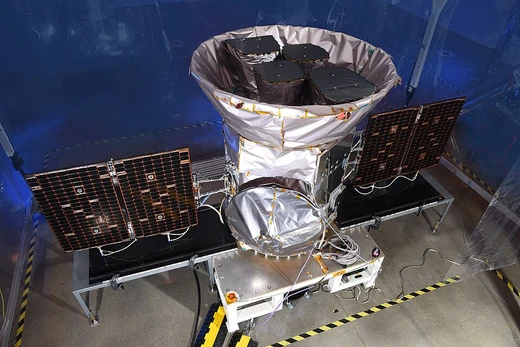
TRAPPIST-1c
A rocky exoplanet with a possible oxygen atmosphere around an ultracool dwarf.
TRAPPIST-1c is a mainly rocky exoplanet orbiting the ultra-cool red dwarf star TRAPPIST-1 in the constellation Aquarius, 40.7 light-years from Earth. It is the third most massive and third largest planet in its system, notable for its Earth-like density and the possibility of a thick abiotic oxygen-dominated atmosphere.
Quick Facts
- Discoverer
- Michaël Gillon et al.
- Discovery Site
- TRAPPIST
- Discovered
- 2 May 2016
- Discovery Method
- Transit
- Atmosphere Composition
- None or extremely thin / 99% O / 2 / , 1% CO / 2 / (uncertain)
- Apsis
- astron
- Eccentricity
- 0.00654 · 0.00188
- Star
- TRAPPIST-1
Facts from the source article.
Lore & Background
TRAPPIST-1c was discovered using the transit method, which allowed its radius to be calculated. Transit-timing variations and computer simulations determined its mass, density, and gravity. Initial estimates suggested a lower density and gravity consistent with a thick, Venus-like atmosphere, but refined density estimates show the planet's density is similar to Earth. The planet is likely tidally locked due to its close orbit, and it may be very geologically active from tidal squeezing, similar to Jupiter's moon Io, which has a similar orbital period and eccentricity.
Its orbit is very close to its host star, with a year lasting 2.42 days at a distance of 0.0158 AU. The planet receives about 2.1 times the sunlight Earth receives, similar to Venus. It is in 8:5 orbital resonance with TRAPPIST-1b and 5:3 resonance with TRAPPIST-1d. The host star TRAPPIST-1 is an ultracool dwarf with a temperature of 2566 K, an age of 7.6 billion years, and a luminosity of 0.05% of the Sun's.
Observations of the secondary eclipse by the James Webb Space Telescope, announced in 2023, suggest against a thick carbon dioxide atmosphere, but do not exclude a thick abiotic oxygen-dominated atmosphere, which is hypothesized to be common around red dwarf stars. Combined transmission spectra of TRAPPIST-1 b and c rule out a cloud-free hydrogen-dominated atmosphere for each planet, and later transmission spectra ruled out a hydrogen-dominated atmosphere with high confidence, as well as an atmosphere rich in water, ammonia, or carbon monoxide at 1 bar pressure when accounting for stellar contamination.
Reader's Guide
TRAPPIST-1c holds significance as one of the few rocky exoplanets where atmospheric characterization has been attempted with the James Webb Space Telescope. The ruling out of a thick carbon dioxide atmosphere, similar to Venus, was a key result announced in 2023, shifting focus toward the possibility of an abiotic oxygen-dominated atmosphere. This makes it a benchmark for studying terrestrial planets around ultracool dwarf stars, which are the most common type of star in the galaxy. Its Earth-like density and potential geological activity from tidal heating further enhance its importance for comparative planetology. The planet's orbital resonances with its neighbors also provide insights into the dynamical evolution of compact multi-planet systems. As one of the most accessible rocky exoplanets for atmospheric study, TRAPPIST-1c continues to inform models of planetary formation and habitability around low-mass stars.
Did You Know?
- TRAPPIST-1c has a measured surface temperature of 380 K.
- The planet may be geologically active due to tidal squeezing similar to Jupiter's moon Io.
- Observations rule out a thick carbon dioxide atmosphere but not a thick abiotic oxygen-dominated atmosphere.
Discovery Through a Global Telescope Network
The seven worlds circling TRAPPIST-1 were identified via the transit method, in which a planet crossing its star's face produces a measurable dip in brightness. The initial breakthrough arrived in 2016 when Michaël Gillon's group at the University of Liège re-examined light-curve anomalies first recorded in 2015 by the TRAPPIST-South instrument at La Silla Observatory in Chile. What was originally interpreted as three planets proved more complex; by 2017, a second pass over the same data revealed five additional terrestrial bodies. The campaign drew on a wide array of instruments, including the Spitzer Space Telescope, TRAPPIST-North at Oukaïmeden Observatory in Morocco, the South African Astronomical Observatory, and the Liverpool and William Herschel telescopes in Spain. Funding was split between NASA and the European Research Council, although some early news stories mistakenly credited NASA alone. The Spitzer data in particular are regarded as among that space telescope's most consequential scientific results.
Orbital Architecture and Permanent Day-Night Sides
Every planet in the system traces a nearly circular path, completing a full revolution in a window ranging from 1.5 to 19 days. Because all seven share a common orbital plane, each one transits the star as viewed from Earth—the very geometry that made their detection feasible. The star's gravitational grip at such close range has almost certainly tidally locked every world, so one hemisphere basks in unbroken daylight while the opposite side endures perpetual night. Despite their proximity, the planets' masses are broadly in the Earth-comparable range, firmly placing them in the terrestrial category. The tight, coplanar, low-eccentricity layout produces a compact and orderly architecture quite unlike the more scattered arrangement of our own Solar System. Tidal interactions over billions of years have likely erased any residual orbital eccentricity, leaving the smooth, circular tracks observed today.
Low Densities and the Atmospheric Question
Transit and spectroscopic data indicate that the TRAPPIST-1 planets possess notably low densities, suggesting their interiors may be enriched with volatile material rather than being composed purely of rock and metal. This compositional puzzle becomes especially significant alongside the atmospheric picture: no planet in the system shows confirmed evidence of an atmosphere, and dedicated observations of TRAPPIST-1b have specifically ruled one out. Whether the host star's radiation environment—emitting faint X-ray and ultraviolet output despite its cool surface—would even permit atmospheres to form and remain stable is still unresolved. The absence of detected air on the innermost confirmed world raises the possibility that the others share the same bare-sky condition, a finding that would profoundly reshape any habitability assessment. Researchers continue to probe these questions, aware that even a thin volatile-rich envelope could alter the surface conditions of these low-density, Earth-mass bodies.
An Ancient, Ultra-Cool Star with a Vast Future
TRAPPIST-1 is an ultra-cool red dwarf of spectral class M8, with a surface temperature near 2,566 kelvin—cold enough for condensates to form within its photosphere. At roughly nine percent of the Sun's mass and only slightly larger than Jupiter in radius, it sits at the very threshold where nuclear fusion can be sustained. Its estimated age of 7.6 billion years makes it older than our own Solar System, and its expected main-sequence lifetime stretches to approximately ten trillion years, about seven hundred times the current age of the universe. Four of the seven planets—designated d, e, f, and g—orbit within a temperature band where liquid water could theoretically persist, drawing sustained interest from astrobiologists and the public. The star's total luminosity is a mere 0.055 percent of the Sun's, radiated predominantly in the infrared, and James Webb Space Telescope observations suggest cold starspots may blanket up to a quarter of its visible surface.
Frequently Asked Questions
What is TRAPPIST-1c?
TRAPPIST-1c is a predominantly rocky planet that orbits the ultra-cool red dwarf TRAPPIST-1 in Aquarius, roughly 40.7 light-years from our solar system. It ranks as the third-heaviest and third-largest member of that seven-planet family.
What are TRAPPIST-1c's mass, radius, and density?
The world weighs in at about 131% of Earth's mass with a radius roughly 110% of Earth's, yielding a bulk density strikingly close to our home planet. It completes one full orbit around its host star in just 2.42 days.
Does TRAPPIST-1c have an atmosphere?
Current evidence points toward a possible thick, abiotic oxygen-dominated atmosphere rather than a thin or absent one. This makes it a standout case of a rocky exoplanet that might still hold onto a substantial gaseous envelope.
How hot is it on TRAPPIST-1c?
The planet's equilibrium temperature sits near 334.8 K, while a measured surface temperature of approximately 380 K places it in a warm range where liquid water could persist under the right atmospheric pressure.
Why do exoplanet fans care so much about TRAPPIST-1c?
Its near-Earth density paired with the prospect of a thick oxygen atmosphere makes it a key test case for how rocky worlds retain gases over geological time. It also anchors one of the most studied compact multi-planet systems known, giving astronomers a natural laboratory for comparative planet science.
More in Transiting Exoplanets, Part 2 1-24
Spotted an error? Know more?
Reader corrections go straight into our review queue. Suggest an edit · How this site is sourced