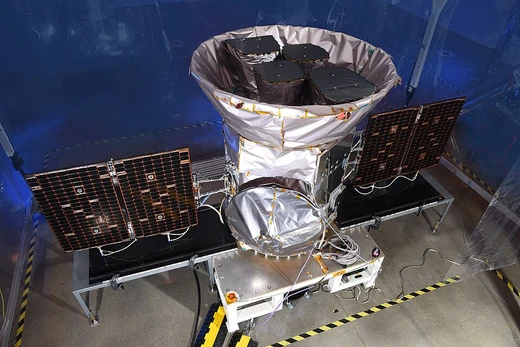
HAT-P-67b
An inflated hot Jupiter with an escaping atmosphere.
HAT-P-67b is a gas giant exoplanet orbiting the subgiant star HAT-P-67 in the constellation Hercules, approximately 1,200 light-years from Earth. It is notable as one of the largest and least dense exoplanets known, with a radius over double that of Jupiter and a density lower than that of marshmallows.
Quick Facts
- Discoverer
- Zhou et al. (2017)
- Discovery Site
- HATNet
- Discovered
- April 2017
- Discovery Method
- Transit
- Minorplanet
- no
- Apsis
- astron
- Semimajor
- 0.0615 · 0.0022 AU
- Eccentricity
- 0
- Period
- 4.81010827(59) · (58) days
- Inclination
- 85.01 · 0.35 · 0.32
- Semi-Amplitude
- 43 · 8 m/s
- Star
- HAT-P-67
Facts from the source article.
Lore & Background
HAT-P-67b was discovered via transits by the Hungarian Automated Telescope Network (HATNet) using small, wide-field telescopes at the Fred Lawrence Whipple Observatory in Arizona and the Mauna Kea Observatory in Hawaii. Observations were made in 2005 and 2008, and follow-up photometry was obtained with the 1.2 m telescope at the Fred Lawrence Whipple Observatory, including a full transit on 2012 May 28 and five partial transits in 2011, 2012, and 2013. Initial radial velocity confirmation was difficult due to the star's high rotational velocity, but data from 2009 to 2012 using the Keck telescope determined the planet's mass to be less than 0.59 Jupiter masses. Doppler tomography in 2016 confirmed the planet. An analysis of radial velocity data from the Galileo National Telescope detected the Rossiter–McLaughlin effect and measured a projected spin-orbit angle of 2.2 ± 0.4°, suggesting an aligned orbit likely resulting from migration through tidal interactions with a protoplanetary gas disk. The host star is expanding as it becomes a red giant, and HAT-P-67b is expected to be engulfed in 150 to 500 million years.
Reader's Guide
HAT-P-67b is significant as an extreme example of a hot Jupiter with one of the largest radii and lowest densities known, placing it on an unstable evolutionary path. Its equilibrium temperature of approximately 1,900 K and low mass cause it to be so inflated that it is expected to undergo Roche lobe overflow, leading to atmospheric evaporation and loss. Multiple studies have investigated its escaping atmosphere: a team using the CARMENES spectrograph at the Calar Alto Observatory detected sodium and ionized calcium, with the latter unusually prominent, and found absorption in hydrogen and helium lines before and after transit, suggesting a vast escaping gas cloud. Another team using the Habitable Zone Planet Finder on the Hobby–Eberly Telescope observed a prominent leading tail and a fainter trailing tail, interpreted as direct evidence of preferential mass loss on the dayside. A third team, averaging many post-transit spectra, estimated an effective planetary radius six times that of Jupiter, indicating ongoing evaporation. The planet's aligned orbit and impending engulfment by its expanding host star further highlight its role as a laboratory for studying planetary migration, atmospheric escape, and the ultimate fate of close-in giant planets.
Did You Know?
- HAT-P-67b has a density lower than that of marshmallows.
- Its atmosphere may be escaping at a rate of 10 million tons per second.
- The planet is expected to be engulfed by its expanding host star in 150 to 500 million years.
- Ionized calcium was detected prominently in its atmosphere, typically found in hotter planets.
Frequently Asked Questions
What is HAT-P-67b?
HAT-P-67b is a puffy gas giant that circles the subgiant star HAT-P-67 in the constellation Hercules, roughly 1,200 light-years from Earth. It ranks among the most voluminous and least dense worlds catalogued to date.
How does HAT-P-67b's size and density compare to familiar objects?
Its radius stretches past twice Jupiter's while its overall mass stays under 0.59 Jupiter masses, giving it a bulk density even lower than a marshmallow. This extreme puffiness is a hallmark of heavily inflated hot Jupiters.
How long does one orbit of HAT-P-67b take, and how hot is it?
The planet laps its host star every 4 days and 19 hours, an extremely tight period that drives its equilibrium temperature to around 1,900 kelvin.
Is HAT-P-67b actively losing its atmosphere?
Yes—observations indicate its upper atmosphere is escaping into space, a process accelerated by the star's intense irradiation combined with the planet's own weak gravity.
Why do exoplanet fans consider HAT-P-67b noteworthy?
It pushes the boundary of how large and how light a planet can be while still holding together, and its near-aligned spin-orbit angle of 2.2 ± 0.4° gives researchers a clean system for studying atmospheric escape in an inflated hot Jupiter.
More in Transiting Exoplanets, Part 2 1-24
Spotted an error? Know more?
Reader corrections go straight into our review queue. Suggest an edit · How this site is sourced