TOI-4616 b
A super-Earth transiting a nearby mid-M dwarf star.
TOI-4616 b (also known as LP 466-156 b) is a confirmed exoplanet orbiting the mid-M dwarf star TOI-4616, located approximately 91 light-years from Earth. Discovered via the transit method in March 2026, it is a super-Earth with an orbital period of 1.55 Earth days and an equilibrium surface temperature of 525 K (about 252 °C). The planet receives 8.5 times the stellar radiation flux that Earth receives from the Sun, placing it in an intermediate regime between Earth-sized planets around early M dwarfs and those around ultra-cool hosts.
Quick Facts
- Discoverer
- F. Zong Lang et al.
- Discovery Site
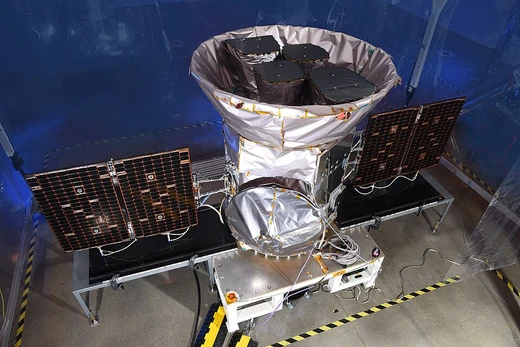
- Transiting Exoplanet Survey Satellite
- Discovered
- March 11, 2026 (Published)
- Discovery Method
- Transit
- Eccentricity
- 0 (fixed)
- Arg Peri
- 90
- Star
- TOI-4616
- Single Temperature
- 525 K
Facts from the source article.
Lore & Background
The TESS space telescope detected transit signals from the star TIC 258796169 during observations in sectors 17, 42, 43, and 70 between 2019 and 2021, cataloging the candidate as TOI-4616.01. To rule out false positives such as eclipsing binaries or instrumental noise, the TESS data were shared with international teams. From 2023 to 2025, ground-based observations using high-resolution photometry and adaptive optics confirmed that the transit signal originated from the target star. The final confirmation and characterization were carried out by an international team led by Francis Zong Lang, with results published on March 11, 2026, in The Astrophysical Journal Letters. Radial velocity measurements allowed estimation of the planet's mass and density, and statistical validation using TRICERATOPS software yielded a false positive rate of 0.0135, below the confirmation threshold of 0.015.
Reader's Guide
TOI-4616 b is notable as a benchmark Earth-sized planet transiting a nearby M4 dwarf, providing a rare opportunity to study a super-Earth in an intermediate radiation regime. Its Transmission Spectroscopy Metric of approximately 17, well above the threshold of 10 for James Webb Space Telescope priority targets, makes it one of the most favorable targets for atmospheric study of rocky bodies. Following its official confirmation, the planet is being considered for observation with the NIRISS instrument to search for spectral lines of water, carbon dioxide, and methane, while the MIRI instrument is planned to measure thermal emission from the day side. High heat transfer efficiency to the night side would indirectly indicate a dense atmosphere. The host star, TOI-4616, is a metal-poor red dwarf with an iron abundance only 32% of the Sun's, an estimated age between 0.3 and 0.8 billion years, and a rotation period of 1.2 days, factors that influence the planet's atmospheric retention under stellar wind and X-ray radiation.
Did You Know?
- TOI-4616 b was discovered in March 2026 by a team led by Francis Zong Lang.
- The planet's equilibrium surface temperature is about 252 °C.
- Its Transmission Spectroscopy Metric of ~17 exceeds the James Webb Space Telescope priority threshold of 10.
- The host star TOI-4616 has an iron abundance only 32% of the Sun's.
Frequently Asked Questions
What is TOI-4616 b?
TOI-4616 b (also catalogued as LP 466-156 b) is a confirmed super-Earth that circles the mid-M dwarf star TOI-4616 roughly 91 light-years from our solar system. It was identified in March 2026 using the transit method, making it one of the newer additions to the nearby exoplanet catalogue.
How does TOI-4616 b's orbit and climate compare to Earth's?
The planet laps its host star every 1.55 Earth days and bakes at an equilibrium temperature of about 252 °C (525 K), far too hot for liquid water as we know it. It soaks up roughly 8.5 times the stellar flux Earth gets from the Sun, which is a lot for a small rocky world.
What makes TOI-4616 b interesting to researchers studying M-dwarf planets?
It sits in a gap between super-Earths orbiting early M dwarfs and those around ultra-cool hosts, giving scientists a useful data point in a still-sparse region of parameter space. Its mid-M dwarf host and super-Earth size make it a handy bridge case for comparing atmospheric and thermal models across different stellar classes.
How was TOI-4616 b detected, and when?
The planet was confirmed in March 2026 through the transit method, meaning astronomers watched the star's brightness dip as the planet's silhouette passed in front of it. The short 1.55-day period means those transits repeat frequently, which helps pin down the orbital parameters quickly.
Why should fans of transiting exoplanets care about TOI-4616 b?
At only ~91 light-years away, it is close enough that future high-resolution instruments could realistically probe its atmosphere, and its super-Earth classification around a mid-M dwarf fills a niche that many fan-tracked lists have been waiting for. It rounds out the growing family of nearby transiting worlds that don't fit neatly into either the hot-Jupiter or ultra-cool-host categories.
More in Transiting Exoplanets, Part 2 1-24
Spotted an error? Know more?
Reader corrections go straight into our review queue. Suggest an edit · How this site is sourced