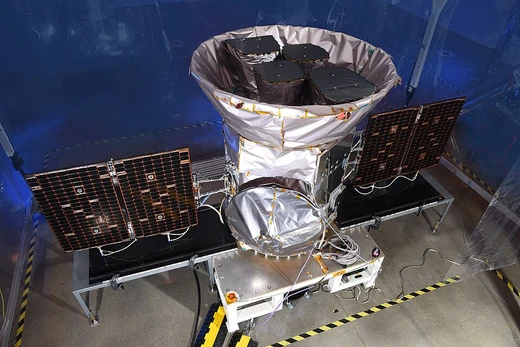
Kepler-438b
Earth-sized exoplanet on the inner edge of its star's habitable zone.
Kepler-438b (KOI-3284.01) is a confirmed near-Earth-sized exoplanet orbiting a red dwarf star in the constellation Lyra, approximately 460.2 light-years from Earth. Discovered by NASA's Kepler spacecraft using the transit method, it was announced on 6 January 2015. The planet is notable for being Earth-sized and located on the inner edge of its star's habitable zone, though it receives 1.4 times the solar flux of Earth and is subject to powerful stellar flares that may render it uninhabitable.
Quick Facts
- Discoverer
- Kepler spacecraft
- Discovered
- 2015
- Discovery Method
- Transit
- Apsis
- astron
- Semimajor
- 0.166 AU
- Eccentricity
- 0.03 · 0.01 · 0.03
- Period
- 35.23319 d
- Inclination
- 89.860
- Star
- Kepler-438
- Single Temperature
- 276 K
Facts from the source article.
Lore & Background
Kepler-438b was discovered by NASA's Kepler spacecraft, which measured the dimming of its host star as the planet transited. The preliminary light curves were analyzed between 13 May 2009 and 17 March 2012, and the periodic 35-day transits led to the conclusion that a planetary body was responsible. The discovery was announced alongside those of Kepler-442, Kepler-440, and Kepler-443 on 6 January 2015.
The planet is likely rocky and has a radius of 1.12 Earth radii, though its mass remains unknown. It orbits a red dwarf star with a mass of 0.54 solar masses and a radius of 0.52 solar radii, which is about 4.4 billion years old. The star's apparent magnitude is 14.467, making it too dim to be seen with the naked eye. Kepler-438b is likely tidally locked due to its close orbit, and a search for exomoons placed a maximum hypothetical moon mass at 29% of the planet's mass.
Although the planet orbits within the habitable zone, researchers at the University of Warwick have concluded it is not habitable due to powerful radiation activity from its parent star every 100 days, which includes stellar flares much more violent than those of the Sun. The planet is more likely to resemble a larger, cooler version of Venus. At nearly 140 parsecs distant, Kepler-438b is too far for current or next-generation telescopes to determine its mass or whether it has an atmosphere.
Reader's Guide
Kepler-438b's significance lies in its status as an Earth-sized planet within the habitable zone of a red dwarf, yet its example underscores the complexity of planetary habitability. The discovery highlighted that factors beyond orbital distance—such as stellar radiation, flares, and plasma environment—can critically affect a planet's potential to support life. The planet's exposure to violent flares every 100 days, capable of sterilizing life as known on Earth, led researchers to deem it uninhabitable and more akin to a cooler Venus. This case has informed the broader search for habitable exoplanets by demonstrating that a planet's location in the habitable zone is insufficient for habitability. The planet's distance from Earth (about 460 light-years) also illustrates the limitations of current observational capabilities; its mass and atmospheric properties remain unknown, and future missions like TESS, CHEOPS, the James Webb Space Telescope, and the Square Kilometer Array may study closer systems in greater detail. Kepler-438b thus serves as a cautionary example in exoplanet science, emphasizing the need for comprehensive characterization of stellar environments when assessing habitability.
Did You Know?
- The planet's host star, Kepler-438, has a surface temperature of 3748 K, much cooler than the Sun's 5778 K.
- A hypothetical exomoon around Kepler-438b could have a maximum mass of 29% of the planet's mass.
- The planet is likely tidally locked due to its close orbit around its red dwarf star.
Discovery and the Road to Confirmation
The Kepler space telescope identified this world through the transit method, measuring the subtle dimming of starlight as a planet passes across its host. Extracting the signal required three years of accumulated photometric data, and the detection came alongside four additional, smaller planets orbiting closer to the star. The findings were first shared at a scientific conference in mid-March 2014, with a formal announcement and a peer-reviewed paper in Science following on 17 April of that year. Under its working designation KOI-571.05, the planet was the first Earth-sized world found within another star's habitable zone. Yet the story does not end in confirmation. Follow-up statistical analyses have repeatedly flagged that the detection may still sit below the threshold for full planetary status. A 2019 study estimated a four percent false-positive probability, while a 2025 reassessment raised that figure to twenty percent. As a result, the scientific community continues to refer to it as a planet candidate rather than a confirmed world, a reminder that even a landmark discovery can remain provisional for over a decade.
A World of Uncertain Composition
The transit measurements yield a planetary radius of roughly 1.17 Earth radii, with an uncertainty band from about 4.5 percent smaller to 26.5 percent larger, giving a volume approximately 1.37 times that of our own planet. Beyond size, the picture grows hazy. Because mass cannot be directly measured from transit data alone, researchers must infer it by pairing the radius with assumed bulk compositions. The resulting range is enormous: as little as 0.32 Earth masses for a pure water-and-ice body, or as much as 3.77 Earth masses if entirely iron. A more plausible Earth-analog mix of one-third iron and two-thirds silicate rock yields about 1.44 Earth masses and a surface gravity roughly 17 percent stronger than our own. A thick hydrogen-helium envelope is considered unlikely, since planets below 1.5 Earth radii rarely retain such atmospheres, and the intense extreme-ultraviolet radiation from a young red dwarf would have stripped any primordial H/He through hydrodynamic escape. The estimated equilibrium temperature, around 188 kelvin, sits below even Mars, suggesting that without a greenhouse atmosphere the surface would be a frozen world.
Orbiting a Red Dwarf in the Habitable Zone
Kepler-186f circles its host star, an M-type red dwarf with a mass of 0.54 solar masses and a radius of 0.52 solar radii, at a distance of roughly 0.40 astronomical units. The orbital period is approximately 130 days. The star, about 4 billion years old and roughly 600 million years younger than the Sun, burns at a surface temperature of 3755 kelvin, far cooler than the Sun's 5778 kelvin. From Earth, the system sits about 580 light-years away in the constellation Cygnus, and the star's apparent magnitude of 14.62 makes it far too faint for unaided human eyes. The conservative habitable zone for this system spans from 0.23 to 0.46 astronomical units, and Kepler-186f receives about 32 percent of the illumination Earth gets from the Sun, placing it near the outer boundary in a position analogous to Mars in our own Solar System. Four smaller planets orbit much closer to the star and are considered too hot for liquid water; they are probably tidally locked. Kepler-186f, in its wider orbit, escapes the strongest tidal forces, though a roughly fifty-fifty chance of tidal locking still remains.
The Habitability Question and Its Limits
Being located within the habitable zone is a necessary but far from sufficient condition for a world to support life. For Kepler-186f, the critical unknown is its atmosphere. At a distance of 580 light-years, the planet is simply too remote for even the James Webb Space Telescope to resolve its atmospheric composition. In the absence of direct measurements, scientists rely on simplified climate models. One such model, restricted to nitrogen, carbon dioxide, and water with no cloud feedback, suggests that surface temperatures could exceed the freezing point of water if the atmosphere contains between 0.5 and 5 bars of carbon dioxide, depending on the assumed nitrogen partial pressure. The question of tidal locking adds another layer of uncertainty: while the four inner planets are almost certainly locked, Kepler-186f's wider orbit leaves its spin state genuinely ambiguous, with roughly a fifty percent probability of being tidally locked. Until an atmosphere is detected, its composition is characterized, and the possibility of stable liquid water is assessed, the planet remains a tantalizing but unresolved candidate rather than a confirmed abode for life.
Frequently Asked Questions
What is Kepler-438b?
Kepler-438b is a confirmed exoplanet roughly the size of Earth that circles a small red dwarf star. It was identified by NASA's Kepler space telescope through the transit method and officially announced in early January 2015.
Where does Kepler-438b sit in the sky?
The planet orbits a star in the constellation Lyra, roughly 460 light-years from our solar system. Its host star is an M-type red dwarf with about half the mass and radius of our Sun.
Could life exist on Kepler-438b?
The planet sits at the inner boundary of its star's habitable zone, so liquid water could theoretically persist on its surface. However, it receives about 40% more stellar energy than Earth does, and the frequent, intense flares from its red dwarf host make a stable, life-friendly environment unlikely.
What are Kepler-438b's basic orbital and physical stats?
The world is about 1.12 times Earth's radius, completes one orbit every 35 days and 5 hours, and has an equilibrium temperature of roughly 276 K. These figures place it as a near-Earth-sized world in a relatively tight orbit around a dim star.
Why do exoplanet fans keep talking about Kepler-438b?
It became one of the first confirmed Earth-sized planets found squarely within a habitable zone, which made it a headline-grabbing milestone for the search for potentially livable worlds. Its proximity to the inner habitable-zone edge and the flare activity of its host star also sparked lively debate about what 'habitable' really means for red-dwarf systems.
More in Transiting Exoplanets, Part 2 1-24
Spotted an error? Know more?
Reader corrections go straight into our review queue. Suggest an edit · How this site is sourced