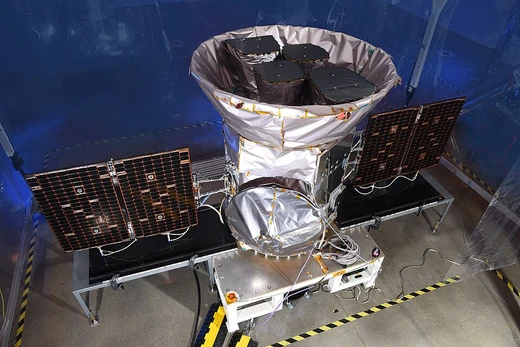
Kepler-61b
A super-Earth with an eccentric orbit in the habitable zone.
Kepler-61b, also cataloged as KOI-1361.01, is a super-Earth exoplanet that orbits a K-type main-sequence star called Kepler-61. The planet lies about 1,100 light-years away in the constellation Cygnus and was discovered in 2013 by NASA's Kepler spacecraft using the transit method, which detects the slight dimming of a star when a planet crosses in front of it.
This exoplanet is larger and more massive than Earth but smaller than Neptune or Uranus. It has a radius 2.15 times Earth’s and a mass 6.65 times Earth’s, giving it a density of about 3.6 grams per cubic centimeter—slightly lower than Mars’s density of 3.9 g/cm³. Its equilibrium temperature is 273 K, close to Earth’s average. The lower density suggests the planet may have a volatile composition or could be an ocean world.
The host star, Kepler-61, is a K-type star with a mass 0.63 times the Sun’s and a radius 0.62 times the Sun’s. It has a surface temperature of 4017 K and is about 1 billion years old—much younger than the Sun, which is 4.6 billion years old and burns at 5778 K. The star is too dim to see with the naked eye, with an apparent magnitude of 15.
Kepler-61b orbits its star every 59.877 days at an average distance of about 0.28 AU—closer than Mercury’s 0.38 AU from the Sun. Its orbit is mildly elliptical, with an eccentricity of about 0.25. The star emits only about 8% of the Sun’s luminosity, yet the planet receives 27% more sunlight than Earth does.
The planet lies in the inner part of the empirical habitable zone, where liquid water could exist under conditions of high albedo, low humidity, and higher atmospheric pressure. However, because of its close orbit, Kepler-61b is likely tidally locked, with one side always facing the star. Its equilibrium temperature of 273 K is promising, but its radius of 2.15 Earth radii suggests it is probably gaseous, lacking a solid surface. This does not rule out habitability entirely: a large, Earth-like moon—captured as a smaller planet rather than formed naturally—could have the right atmosphere and pressure to support liquid water and possibly life.
The planet’s elliptical orbit adds complexity. It swings from just beyond the inner edge of the habitable zone to the middle of it, causing temperatures to range from about 310 K at closest approach to 240 K at farthest.
Quick Facts
- Discoverer
- Kepler spacecraft
- Discovered
- 24 April 2013
- Discovery Method
- Transit
- Apsis
- astron
- Semimajor
- 0.26 AU
- Eccentricity
- <0.25
- Period
- 59.87756 d
- Inclination
- >89.80
- Star
- Kepler-61 (KOI-1361)
- Single Temperature
- 273 K
Facts from the source article.
Lore & Background
Kepler-61b is a super-Earth, with a radius of 2.15 Earth radii and a mass of 6.65 Earth masses, giving it a density of about 3.6 g/cm³, slightly below that of Mars. This lower density suggests the planet may have a volatile composition or be an ocean planet. Its equilibrium temperature is 273 K, close to Earth's, but its orbit is mildly elliptical with an eccentricity of 0.25, causing it to pass through the inner and middle parts of the habitable zone. At its closest approach, temperatures may reach up to 310 K, and at its farthest, as low as 240 K. The planet receives 27% more sunlight than Earth does.
The host star, Kepler-61, is a K-type main-sequence star with a mass of 0.63 solar masses and a radius of 0.62 solar radii. It has a temperature of 4017 K and is about 1 billion years old. The star is too dim to be seen with the naked eye, with an apparent magnitude of 15.
Kepler-61b was discovered in 2013 after NASA's Kepler spacecraft observed transits in the star's light curve. Radial velocity observations confirmed the planetary nature of the dips. The planet is likely tidally locked due to its close distance to its star.
Reader's Guide
Kepler-61b is notable as a super-Earth that orbits within the empirical habitable zone of its star, though its eccentric orbit takes it slightly beyond the inner edge and out to the middle of that zone. This results in significant temperature variations, from about 310 K at closest approach to 240 K at farthest. The planet's equilibrium temperature of 273 K is very close to Earth's, and if it has a rocky surface, it is considered a good candidate for life, given the system's age of about 1 billion years. However, its radius of 2.15 Earth radii suggests it is likely gaseous with no solid surface. The possibility of habitability in the system may instead rest on a hypothetical large, Earth-like moon orbiting Kepler-61b, provided such a moon has the proper atmospheric properties and pressure to support liquid water. Any such moon would have had to originate as a captured smaller planet, as such moons have never formed naturally. The planet's eccentricity and close distance to its star may also prevent habitability, and an intense greenhouse effect could make the planet too hot for liquid water altogether. Kepler-61b is compared to Pi Mensae b, another exoplanet with an eccentric orbit lying partially in the habitable zone.
Did You Know?
- Kepler-61b has an equilibrium temperature of 273 K, very close to that of Earth.
- Its orbit has an eccentricity of 0.25, causing temperatures to vary from 240 K to 310 K.
- Kepler-61b is about 1,100 light-years from Earth in the constellation Cygnus.
Discovery Through the Kepler Mission
Kepler-61b was identified during a final photometric test conducted in 2009 by NASA's Kepler space telescope. The spacecraft's photometer was scanning roughly 50,000 stars drawn from the Kepler Input Catalog when it recorded brief, periodic dimming events in the light curve of the star Kepler-61. These transit signatures—small, regular reductions in starlight caused by a body crossing the stellar disk—were flagged by the Kepler science team as promising candidates for ground-based follow-up. Radial velocity observations from terrestrial observatories subsequently confirmed that a planetary-mass object was responsible for the dips, ruling out alternative explanations such as stellar variability. The discovery was formally announced on April 24, 2013. Before receiving its official designation, the planet carried the provisional label KOI-1361.01, part of Kepler's broader catalog of Objects of Interest awaiting confirmation.
Physical Profile and Composition Questions
Kepler-61b is classified as a super-Earth, occupying a size and mass range above that of Earth yet well below the ice giants Uranus and Neptune. Its measured radius is 2.15 Earth radii, while its mass stands at approximately 6.65 Earth masses. Dividing mass by the implied volume yields a bulk density of roughly 3.6 grams per cubic centimeter, a figure slightly under Mars's 3.9 g/cm³. That comparatively low density has led astronomers to speculate that the planet may contain a substantial fraction of volatile material—water, ices, or other light compounds—or that it could be an ocean world enshrouded by a thick gaseous envelope. Its equilibrium temperature, derived from the stellar energy it absorbs, sits at 273 kelvin, essentially the freezing point of water. Whether a solid rocky surface even exists remains uncertain; the radius strongly suggests a predominantly gaseous or fluid composition, though a dense interior core cannot be entirely excluded.
The Host Star and Orbital Architecture
Kepler-61b circles a K-type main-sequence star that is noticeably smaller and cooler than our Sun. The host possesses a mass of 0.63 solar masses, a radius of 0.62 solar radii, and a surface temperature of 4,017 kelvin. At roughly one billion years of age, it is considerably younger than the Sun's 4.6 billion years. From Earth, the star's apparent magnitude is 15, far too faint for unaided human vision. The planet traces a mildly elliptical path with an eccentricity near 0.25, completing one orbit in about 59.9 days at a semi-major axis of roughly 0.28 astronomical units—closer to its star than Mercury is to the Sun. Despite the star's lower luminosity, at about 8 percent of the Sun's output, the planet receives roughly 27 percent more stellar flux than Earth does, a direct consequence of its tight orbital distance. The entire system resides some 1,100 light-years (338 parsecs) from Earth, in the direction of the constellation Cygnus.
Habitability Prospects and Complications
Kepler-61b occupies the inner portion of the empirical habitable zone, the band where liquid water could persist given adequate atmospheric pressure and a high albedo. Its equilibrium temperature of 273 kelvin is strikingly close to Earth's, and the system's billion-year age provides ample time for potential biological development. Yet several complications temper the optimism. The close orbital distance likely locks the planet's rotation to its orbit, producing a permanent dayside and nightside. The eccentric orbit carries the planet from just beyond the inner habitable-zone boundary out toward its middle, generating temperature swings from roughly 240 kelvin at apastron to 310 kelvin at periastron. A strong greenhouse effect could push temperatures even higher, eliminating liquid water altogether. Some researchers have suggested that a large, captured moon with its own atmosphere might offer a habitable niche, though the planet's orbital dynamics and proximity to its star pose serious challenges to that scenario as well.
Frequently Asked Questions
What is Kepler-61b?
Kepler-61b (catalog number KOI-1361.01) is a super-Earth exoplanet that circles the K-type main-sequence star Kepler-61, situated roughly 1,100 light-years from Earth in the constellation Cygnus.
How does Kepler-61b compare in size to Earth?
The planet measures about 2.15 Earth radii and packs roughly 6.65 Earth masses, yielding a bulk density near 3.6 g/cm³—less compact than our own world but well below gas-giant territory.
What is Kepler-61b's orbit like?
It completes one revolution around its host star every 59.877 days at a mean distance of 0.28 AU, and its path is notably eccentric rather than a near-perfect circle.
How was Kepler-61b detected?
In 2013, NASA's Kepler space telescope identified the planet through the transit method, registering the faint, repeating dimming of Kepler-61's light each time the planet slipped across the stellar disk.
Why do exoplanet fans care about Kepler-61b?
With an equilibrium temperature of about 273 K, it sits comfortably inside the habitable zone of its star, making it a compelling super-Earth case study for how temperate, potentially rocky-world conditions might look beyond our solar system.
More in Transiting Exoplanets, Part 2 1-24
Spotted an error? Know more?
Reader corrections go straight into our review queue. Suggest an edit · How this site is sourced