TOI-6692 b
An eccentric giant planet with a 131-day orbit around a yellow dwarf.
TOI-6692 b is a confirmed giant exoplanet orbiting the G1-class star TOI-6692, located approximately 1013 light-years from Earth. It is notable as one of the few giant planets with an orbital period exceeding 100 days for which both mass and radius have been measured, and as one of the few single-transit TESS targets whose period has been definitively confirmed through subsequent photometric follow-up.
Quick Facts
- Discoverer
- Allyson Bieryla et al.
- Discovered
- January 22, 2026
- Discovery Method
- Transit
- Eccentricity
- 0.537 · 0.061
- Arg Peri
- -16.6 · 7.9 · 7.7
- Inclination
- 89.483 · 0.083 · 0.074
- Star
- TOI-6692
- Single Temperature
- 467 +/-
Facts from the source article.
Lore & Background
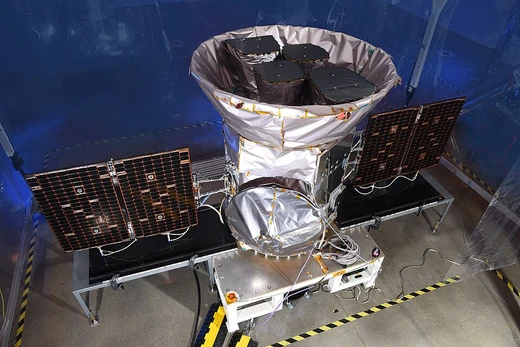
The planet was detected by the TESS space telescope in 2021, which recorded a single dip in the brightness of TOI-6692 in Sector 36. Because at least two transits are required for automatic confirmation, the signal was initially missed by algorithms and was later discovered manually by participants of the Visual Survey Group and Planet Hunters, who specialize in finding single transits. The object was subsequently designated a TESS Object of Interest (TOI). Ground-based radial velocity measurements, primarily from the Planet Finder spectrograph on the 6.5-meter Magellan II Telescope at Las Campanas Observatory in Chile, were conducted between 2022 and 2025 to determine the planet's mass and refine its orbital period. The discovery was announced in late January 2026 by an international team led by Allison Bieri.
Reader's Guide
TOI-6692 b occupies a distinctive place in exoplanet science as a giant planet with a long orbital period (131 days) and a highly eccentric orbit (eccentricity 0.537). Its high eccentricity suggests gravitational interaction with another object, likely through scattering, rather than peaceful migration through the protoplanetary disk. The radial velocity data also revealed a long-term linear drift, indicating the presence of an additional massive body in the system on a wide orbit, though its mass and orbital period remain undetermined. The planet's equilibrium temperature of 467 K (194 °C) reflects its moderate orbital distance of 0.512 AU from a star slightly larger and more luminous than the Sun. Its confirmation as a single-transit TESS target whose period was definitively established through follow-up observations underscores the value of manual inspection and coordinated ground-based campaigns in detecting planets that automated pipelines might overlook. The system's architecture, with evidence of a distant companion and a scattered giant planet, offers a case study in dynamical evolution.
Did You Know?
- TOI-6692 b was discovered manually by participants of the Visual Survey Group and Planet Hunters after TESS algorithms missed its single transit.
- The planet's orbit is highly eccentric, with an eccentricity of 0.537.
- Radial velocity data revealed a long-term linear drift, hinting at an additional massive body on a wide orbit.
- The host star TOI-6692 is about 7.8 billion years old and has twice the luminosity of the Sun.
More in Transiting Exoplanets, Part 2 1-24
Spotted an error? Know more?
Reader corrections go straight into our review queue. Suggest an edit · How this site is sourced