TOI-5734 b
A hot sub-Neptune at the upper boundary of the radius gap.
TOI-5734 b is a confirmed hot sub-Neptune exoplanet orbiting the young orange dwarf star TOI-5734, located approximately 106 light-years from the Sun. Its density of 0.98 ρ🜨, mass of 9.1 M🜨, and radius of about 2.1 R🜨 place it at the upper boundary of the radius gap, making it a priority target for studying the transition from gaseous sub-Neptunes to rocky super-Earths. The discovery of the object was officially announced by an international team of astronomers led by Simone Filomeno in late February 2026. The results were published on February 20, 2026, in The Astrophysical Journal Letters.
Quick Facts
- Discoverer
- S. Filomeno et al.
- Discovered
- February 20, 2026
- Discovery Method
- Transit
- Inclination
- 89.88 · 0.12 · 0.63
- Star
- TOI-5734
- Single Temperature
- 688 +/-
- Atmosphere Composition
- None or extremely thin
Facts from the source article.
Lore & Background
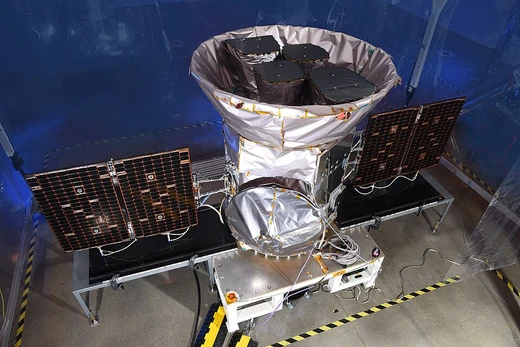
Primary signs of TOI-5734 b were recorded in 2022 using the TESS space telescope, which detected periodic dips in the brightness of the star TIC 9989136 in three observation sectors. The object was assigned the status of TESS Object of Interest (TOI) under number 5734.01. Final confirmation and characterization were carried out by an international team led by Simone Filomeno, with results published on February 20, 2026, in The Astrophysical Journal Letters. The host star TOI-5734 is a relatively young K3-K4 V dwarf with a radius of about 0.64 R☉, a mass of approximately 0.72 M☉, an effective temperature of 4750 K, and an age of 500 million years. Its rotation period of about 11 days is characteristic of young stars of this type. The planet completes an orbit every 6.18 Earth days at an average distance of about 0.06 AU, with an equilibrium surface temperature of 688 K (415 °C). Its density indicates a rocky composition, and it is hypothesized that the planet has almost entirely lost its primordial hydrogen-helium atmosphere due to intense irradiation from its host star.
Reader's Guide
TOI-5734 b is significant because its parameters place it at the upper boundary of the radius gap, a region in the mass-radius diagram where few exoplanets are found. This makes it a priority target for studying the evolutionary transition from gaseous sub-Neptunes to rocky super-Earths. The planet's high density suggests it is currently a predominantly rocky body with minimal or no gaseous envelope. Modeling of atmospheric evolution indicates that TOI-5734 b possesses an almost completely depleted primary envelope, likely lost through intense X-ray and ultraviolet radiation from its young host star. Astronomers estimate the planet will completely lose the remnants of its primary envelope within 300 million years. Despite the loss of primary gases, scientists do not rule out the scenario that the planet could be an ocean world with a secondary atmosphere rich in volatiles such as water vapor. The planet likely migrated from a region of larger radii on the mass-radius diagram to its current position near the radius gap over its lifetime. Its legacy lies in providing a rare observational anchor for understanding how sub-Neptunes lose their atmospheres and transform into denser super-Earths.
Did You Know?
- TOI-5734 b has a density of 0.98 ρ🜨, nearly identical to Earth's.
- The planet orbits its star every 6.18 days at a distance of about 0.06 AU.
- Its equilibrium surface temperature is estimated at 688 K (415 °C).
- The host star TOI-5734 is about 500 million years old.
More in Transiting Exoplanets, Part 2 1-24
Spotted an error? Know more?
Reader corrections go straight into our review queue. Suggest an edit · How this site is sourced