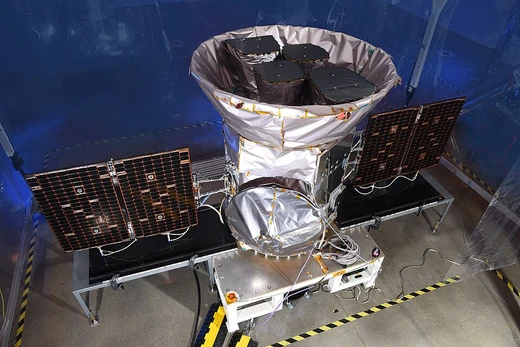
Kepler-9d
A hot Super-Earth orbiting its star every 1.56 days.
Kepler-9d is a transiting exoplanet orbiting the Sun-like star Kepler-9 in the constellation Lyra. It is notable as the third planet discovered in its system, despite being the closest planet to its star, because the two gas giants Kepler-9b and Kepler-9c were confirmed first. The planet was initially flagged as a transit event by the Kepler space telescope and later confirmed through follow-up observations.
Quick Facts
- Discovered
- 1 January 2011
- Discovery Method
- Transit (Kepler Mission)
- Apsis
- astron
- Semimajor
- 0.02730 AU
- Eccentricity
- 0
- Period
- 1.592851 d
- Star
- Kepler-9 (KOI-377)
- Single Temperature
- 2026
Facts from the source article.
Lore & Background
Kepler-9d was discovered by the Kepler space telescope, a NASA satellite designed to find terrestrial planets in transit. It was initially designated KOI-377.03 and recognized as a potential planet after the confirmation of Kepler-9b and Kepler-9c. Follow-up studies were required to verify that the transit signal was not caused by a background eclipsing binary star. The Kepler team exhaustively disproved alternative explanations, and the confirmation was published in the Astrophysical Journal on January 1, 2011. Observations were conducted using the High Resolution Echelle Spectrometer at the W.M. Keck Observatory in Hawaii, as well as the WIYN Observatory in Arizona and the Palomar Observatory in California.
The host star, Kepler-9, is a Sun-like star with a mass 7% greater than the Sun and a radius 2% larger. Its effective temperature is 5777 K, nearly identical to the Sun's 5778 K, and it is about 32% more metal-rich in iron. Kepler-9 is estimated to be one billion years old, younger than the Sun, and lies approximately 640 parsecs away in the constellation Lyra.
Kepler-9d is a Super-Earth with an inferred radius of 1.64 Earth radii, though its exact mass is unknown and presumed to be at least 1.5 Earth masses. It orbits at an average distance of 0.0273 AU from its star, completing one orbit every 1.592851 days. With an equilibrium temperature of 2026 K, it is hotter than all previously discovered planets by Kepler at the time of its announcement. Its density is not known.
Reader's Guide
Kepler-9d's significance lies in its role as an early example of a small, hot exoplanet discovered by the Kepler mission, demonstrating the ability to detect and confirm terrestrial-sized worlds in extremely close orbits. Its confirmation required careful elimination of false-positive scenarios, such as background eclipsing binaries, highlighting the rigorous validation process used by the Kepler team. The planet's naming convention—Kepler-9d rather than Kepler-9b—illustrates how discovery order can differ from orbital order when multiple planets are found in the same system. As a Super-Earth with a radius 64% larger than Earth's and an orbital period of just 1.56 days, Kepler-9d represents a class of planets that experience intense stellar irradiation, with equilibrium temperatures exceeding 2000 K. Its host star, Kepler-9, being nearly identical to the Sun but younger and more metal-rich, provides a useful comparison for understanding planetary system formation and evolution. The planet's legacy includes contributing to the statistical understanding of the frequency of small planets in close-in orbits, a key goal of the Kepler mission.
Did You Know?
- Kepler-9d orbits its star every 1.592851 days at a distance of 0.0273 AU, much closer than Mercury's 0.3871 AU from the Sun.
- Despite being the closest planet to its star, Kepler-9d is named 'd' because the gas giants Kepler-9b and Kepler-9c were confirmed first.
- The planet's equilibrium temperature of 2026 K made it hotter than all previously discovered planets by Kepler at the time of its announcement.
- Kepler-9d's radius is 1.64 Earth radii, making it a Super-Earth, though its exact mass is unknown.
More in Transiting Exoplanets, Part 2 1-24
Spotted an error? Know more?
Reader corrections go straight into our review queue. Suggest an edit · How this site is sourced