Kepler-8b
The hottest of Kepler's first five exoplanets, a diffuse hot Jupiter.
Kepler-8b is a hot Jupiter exoplanet orbiting the F-type star Kepler-8 in the constellation Lyra. It was the fifth of the first five exoplanets discovered by NASA's Kepler spacecraft and was the hottest of that initial group.
Quick Facts
- Discovered
- 2010-01-04
- Discovery Method
- Transit (Kepler Mission)
- Apsis
- astron
- Semimajor
- 0.0483 AU
- Eccentricity
- 0
- Period
- 3.5225 d
- Inclination
- 84.07
- Star
- Kepler-8 (KOI 10)
- Single Temperature
- 1859227 K.
Facts from the source article.
Lore & Background
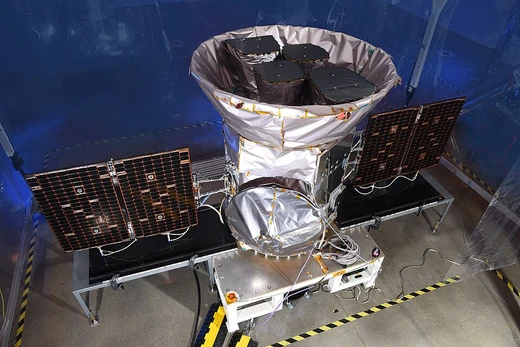
Kepler-8b was discovered by the Kepler spacecraft, which searches for transiting planets in a region of the sky between the constellations Lyra and Cygnus. The planet was first noted as a potential transit event and designated KOI 10.01. Follow-up radial velocity measurements at the W.M. Keck Observatory using the High Resolution Echelle Spectrometer confirmed the detection and provided mass and radius data. Kepler-8b was the last of the first five planets announced by Kepler, alongside Kepler-4b, Kepler-5b, Kepler-6b, and Kepler-7b, at the 215th meeting of the American Astronomical Society on January 4, 2010 in Washington, D.C.
The host star Kepler-8 is an F-type star about 1050 parsecs away, with a mass of 1.213 solar masses and a radius of 1.486 solar radii. It has an effective temperature of 6213 K, is about three-quarters of a billion years younger than the Sun, and is slightly less metal-rich. Kepler-8b orbits its star every 3.5 days at a distance of 0.0483 AU, making it a hot Jupiter. Its equilibrium temperature of 1760 K made it the hottest of the five planets announced at that conference. The planet has an eccentricity of nearly zero, indicating a very circular orbit.
Kepler-8b demonstrates the Rossiter–McLaughlin effect, where the host star's spectrum becomes redshifted and then blueshifted as the planet transits. This effect established that the planet orbits in prograde motion. A 2012 study determined the planetary orbit is probably well-aligned with the star's equatorial plane, deviating by about 5°. The planet is likely tidally locked to its parent star. In 2015, the planetary nightside temperature was estimated.
Reader's Guide
Kepler-8b holds significance as one of the first five exoplanets discovered by the Kepler spacecraft, helping to confirm the functionality of the mission. Its discovery, along with the other four planets, was announced at the 215th meeting of the American Astronomical Society in Washington, D.C. on January 4, 2010. As the hottest of that initial group, it provided early data on the diversity of hot Jupiters. The planet's low density—being 60.3% as massive as Jupiter but 41.9% wider—illustrates the inflated atmospheres common among close-in gas giants. The detection of the Rossiter–McLaughlin effect in its transit demonstrated that the planet orbits in prograde motion and is well-aligned with the star's equator, contributing to understanding of planetary migration and orbital dynamics. Kepler-8b was the only planet found in the Kepler-8 system, and its confirmation via radial velocity measurements at the W.M. Keck Observatory underscored the importance of ground-based follow-up for transit surveys. The planet's legacy lies in its role as a benchmark for early Kepler discoveries and as an example of the hot Jupiter class.
Did You Know?
- It was the only planet discovered in the orbit of Kepler-8.
- The planet demonstrates the Rossiter–McLaughlin effect, indicating prograde orbital motion.
More in Transiting Exoplanets, Part 2 1-24
Spotted an error? Know more?
Reader corrections go straight into our review queue. Suggest an edit · How this site is sourced