Kepler-432b
A dense, warm super-Jupiter on a decaying orbit toward its expanding giant star.
Kepler-432b is a hot super-Jupiter exoplanet orbiting the giant star Kepler-432 A, the innermost of two such planets discovered by NASA's Kepler spacecraft. It is notable for its high density and eccentric orbit, and for the ongoing tidal decay of its orbit as its host star expands toward engulfing it.
Quick Facts
- Discoverer
- Kepler spacecraft
- Discovered
- 24 January 2015
- Discovery Method
- Transit method
- Apsis
- astron
- Semimajor
- 0.301 (± 0.014) AU
- Eccentricity
- 0.5134 (± 0.01)
- Period
- 52.501 · 0.00007 · 0.00005 d
- Inclination
- 88.17 · 0.61 · 0.33
- Star
- Kepler-432 A (KOI-1299)
- Density
- 4.46 · 0.37 · 0.29 g cm / −3
- Single Temperature
- 809 K
Facts from the source article.
Lore & Background
Kepler-432b orbits the K-type giant star Kepler-432 A, which has exhausted its core hydrogen and is ascending the red giant branch. The star has a mass of 1.32 solar masses, a radius of 4.06 solar radii, a surface temperature of 4995 K, and an age of 4.2 billion years. The planet completes one orbit every 52 days at a distance of 0.30 AU, with a notably high eccentricity of 0.5134. Its mass is 5.41 Jupiter masses and its radius is 1.45 Jupiter radii, yielding a relatively high density of 4.46 g/cm³. The planet's equilibrium temperature is 809 K.
The host star's luminosity is 9.2 times that of the Sun. Observations indicate that tidal interactions with the expanding star are causing Kepler-432b's orbit to decay. As Kepler-432 A continues to expand past the planet's orbit, it will likely engulf the planet completely. The drag between the stellar photosphere and the gas giant will cause the orbit to spiral inward until the planet is vaporized by the star after ablation and vaporization.
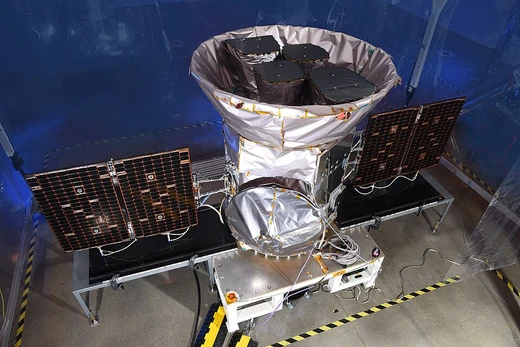
Kepler-432b was discovered via the transit method using NASA's Kepler spacecraft. Observations for potential exoplanet candidates took place between 13 May 2009 and 17 March 2012. After observing transits occurring every 50 days, it was concluded that a planetary companion was responsible. The discovery was announced on 24 January 2015.
Reader's Guide
Kepler-432b provides a valuable case study of planetary engulfment and tidal orbital decay in real time. Its host star, a K-type giant ascending the red giant branch, is gradually expanding and will eventually swallow the planet. This process offers insights into the fate of planets around aging stars, including the eventual engulfment of Earth by the Sun as a red giant some 7 billion years from now. The planet's high density for a gas giant and its eccentric orbit add to its scientific interest, as these characteristics may result from past dynamical interactions or the star's evolution. The system also helps astronomers understand how tidal forces between a star and a close-in giant planet can alter orbital parameters over time. Kepler-432b is one of the few known exoplanets observed in the process of being consumed by its host star, making it a benchmark for studying the final stages of planetary systems around evolved stars.
Did You Know?
- Kepler-432b has a density of 4.46 g/cm³, unusually high for a gas giant.
- Its host star, Kepler-432 A, is a K-type giant that has begun expanding into a red giant.
- The planet's orbit is decaying due to tidal interactions with its expanding star.
- Kepler-432b will eventually be engulfed and vaporized by its host star.
More in Transiting Exoplanets, Part 2 1-24
Spotted an error? Know more?
Reader corrections go straight into our review queue. Suggest an edit · How this site is sourced