IRAS 04125+2902 b
The youngest transiting exoplanet discovered, at three million years old.
IRAS 04125+2902 b, also called TIDYE-1b, is a very young exoplanet that orbits the protostar IRAS 04125+2902, located about 520 light-years away in the constellation Taurus. At just three million years old, it is the youngest transiting exoplanet found so far. As it continues to gather material, the planet will gradually shrink over time. It circles its host star very closely, at a distance of 0.07 AU, completing one orbit every 8.8 days.
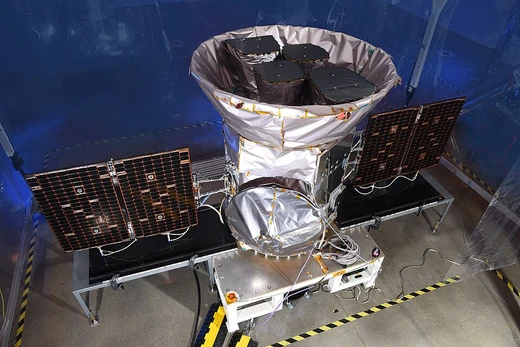
The planet was discovered using the transit method, which detects small, regular dips in a star’s brightness when a planet passes in front of it. Astronomer Madyson Barber and colleagues analyzed data from the Transiting Exoplanet Survey Satellite (TESS) to identify the signal. After ruling out other possible causes for the observed dips, the team confirmed the planet’s existence. The discovery was announced on November 20, 2024, in the journal *Nature*.
The planet is also nicknamed TIDYE-1b, after the TESS Investigation – Demographics of Young Exoplanets (TIDYE) project.
IRAS 04125+2902 b has a mass less than 0.3 times that of Jupiter (under 90 Earth masses) and a radius nearly equal to Jupiter’s—just 4% smaller, or about 10.7 Earth radii. It is still wrapped in a hydrogen envelope and will shed its outer layers as it evolves, possibly becoming a sub-Neptune, super-Earth, or sub-Saturn. If it becomes a super-Neptune, its radius will shrink to a certain size; if it becomes a sub-Saturn, it will shrink to another. Because of its large radius and relatively low mass, the planet likely has an extended atmosphere, making it a good candidate for follow-up observations with the James Webb Space Telescope.
The planet has a compact orbit, completing a lap every 8.8 days, with a mean distance from its star of just 8% of the Earth-Sun distance (0.07 AU). Its short orbit and high mass suggest it probably formed farther out and then migrated inward, since regions so close to the star don’t have enough material to form large planets.
At three million years old, IRAS 04125+2902 b is the youngest transiting exoplanet discovered and one of the youngest known exoplanets overall; only a few even younger objects are listed in the NASA Exoplanet Archive.
The host star, IRAS 04125+2902, is a T Tauri variable star 520 light-years away. It has a cool effective temperature and a spectral type of M1.25.
Quick Facts
- Discoverer
- Madyson Barber et al.
- Discovered
- November 20, 2024
- Discovery Method
- Transit
- Period
- 8.834978 · (28) days
- Star
- IRAS 04125+2902
- Mass
- J · ( / 🜨 / )
Facts from the source article.
Lore & Background
The planet was detected using the transit method from data collected by the Transiting Exoplanet Survey Satellite (TESS). Astronomer Madyson Barber and colleagues analyzed the data, ruling out alternative explanations to confirm the planet's existence. The discovery was announced on November 20, 2024, in the journal Nature.
IRAS 04125+2902 b has a mass less than 0.3 Jupiter masses and a radius nearly equal to Jupiter's. It is still enshrouded in a hydrogen envelope and will shed its outer layers during evolution, potentially becoming a sub-Neptune, super-Earth, or sub-Saturn. Its compact orbit of 8.8 days at 0.07 AU suggests it formed farther out and migrated inward.
The host star, IRAS 04125+2902, is a T Tauri variable with spectral type M1.25, larger than the Sun due to its youth. It has a transitional disk and forms a binary system with 2MASS J04154269+2909558 at a projected separation of 635 AU. The disk is misaligned with the stellar equator; possible causes include past planetary migration (requiring another undetected planet) or infalling material from the Taurus Molecular Cloud.
Reader's Guide
IRAS 04125+2902 b is significant as the youngest transiting exoplanet known, offering a rare window into planetary formation and early evolution. Its large radius and low mass suggest an extended atmosphere, making it a potential target for atmospheric analysis with the James Webb Space Telescope. The planet's youth means it will continue to shrink as it consolidates material, providing a natural laboratory for studying how planets change over millions of years. The misaligned disk of its host star raises questions about planetary migration and system dynamics, with implications for understanding how young planetary systems evolve. Its discovery via TESS data and publication in Nature underscore its importance in exoplanet science, particularly for probing the earliest stages of planetary development.
Did You Know?
- IRAS 04125+2902 b is only three million years old, making it the youngest transiting exoplanet discovered.
- The planet orbits its host star every 8.8 days at a distance of 0.07 AU.
- The planet likely formed farther from its star and then migrated inward.
Frequently Asked Questions
What is IRAS 04125+2902 b?
It is a very young, under-0.3-Jupiter-mass planet (roughly 90 Earth masses) circling the protostar IRAS 04125+2902 about 520 light-years out in Taurus. Fans and papers alike also refer to it by its nickname, TIDYE-1b.
What are IRAS 04125+2902 b's orbital stats?
The planet whips around its host in a mere 8.8 days at a tight semi-major axis of 0.07 AU. Its mass is estimated at under 0.3 Jupiter masses, placing it in the range of about 90 Earth masses.
How was IRAS 04125+2902 b discovered?
Astronomers identified it through the transit method, tracking the small, repeating dips in the star's brightness that occur each time the planet slides across its face. The regular cadence of those dimming events confirmed a bound companion.
Why is IRAS 04125+2902 b considered a big deal?
At roughly three million years old, it is the youngest transiting exoplanet known to date, giving scientists a rare snapshot of a world still in its earliest formation phase. That makes it a key data point for models of how young giant planets assemble and evolve.
What's the long-term future of IRAS 04125+2902 b?
Because it is still actively pulling in surrounding gas and dust, the planet is expected to gradually contract and shrink as it matures. Its story is very much a work in progress—what we see now is essentially the planet's infancy.
More in Transiting Exoplanets, Part 2 1-24
Spotted an error? Know more?
Reader corrections go straight into our review queue. Suggest an edit · How this site is sourced