HD 63433 c
A mini-Neptune losing its atmosphere to become a super-Earth.
HD 63433 c (TOI-1726 c) is a mini-Neptune exoplanet orbiting the Sun-like star HD 63433. It is the outermost planet in its system, yet it orbits extremely close to its star, at a distance of 0.1448 AU, completing one orbit every 21 days. The planet is notable for having its hydrogen atmosphere actively evaporated by stellar radiation, a process that is slowly transforming it into a super-Earth.
Quick Facts
- Discoverer
- Mann et al. (THYME)
- Period
- 20.54 days
- Discovered
- 30 April 2020
- Discovery Method
- Transit
- Eccentricity
- 0.21 · 0.33 · 0.14
- Star
- HD 63433
Facts from the source article.
Lore & Background
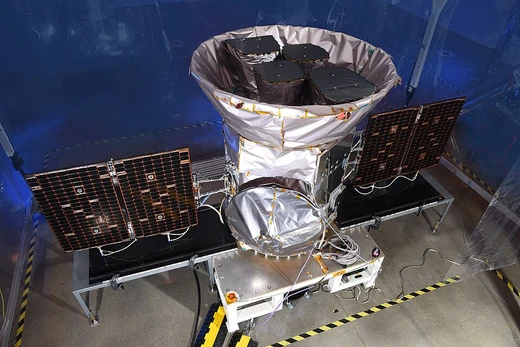
HD 63433 c was discovered in 2020 by Mann et al. using the Transiting Exoplanet Survey Satellite (TESS) as part of the TESS Hunt for Young and Maturing Exoplanets (THYME) project. It was found alongside HD 63433 b via the transit method. The planet orbits HD 63433, a G-type main-sequence star 73 light-years away in Gemini, which is a Solar analog with mass and radius very similar to the Sun. The star belongs to the Ursa Major moving group, giving the system an estimated age of 400 million years.
The planet is about 2.7 times larger than Earth and 15.5 times more massive, making it smaller and less massive than Neptune. Its composition is modeled as mainly silicate and water, surrounded by a gaseous envelope that constitutes about 2% of the planet. Despite being the outermost planet in its system, its orbital distance is only 37% of Mercury's distance from the Sun, resulting in a high estimated temperature between 267 and 406 °C.
In 2022, a study led by Michael Zhang using the Hubble Space Telescope observed that HD 63433 c's hydrogen atmosphere is evaporating due to strong radiation from its host star. The escaping gases travel at 50 km/s and form a gas cocoon 12 times larger than the planet itself. This process is gradually stripping the puffy atmosphere, turning the mini-Neptune into a super-Earth. The sibling planet HD 63433 b does not show the same effect, possibly because it has already lost its primordial atmosphere.
Reader's Guide
HD 63433 c is significant as one of the first mini-Neptunes observed in the act of losing its atmosphere, providing direct evidence for the evolutionary pathway from mini-Neptune to super-Earth. The 2022 study that detected hydrogen escaping at 50 km/s and forming a cocoon 12 times the planet's size demonstrates how stellar radiation can strip a planet's primordial envelope over time. This process helps explain the observed population of super-Earths, which may be the remnant cores of once-larger mini-Neptunes. The planet's youth—400 million years—makes it a valuable target for studying atmospheric escape in a relatively early stage of planetary evolution. Its host star, a Solar analog in the Ursa Major moving group, allows researchers to compare the system's evolution with that of our own Solar System. The fact that HD 63433 b does not show similar atmospheric loss suggests that different planets in the same system can experience divergent evolutionary paths. HD 63433 c thus serves as a natural laboratory for understanding how close-in planets lose their atmospheres and how the transition between planet types occurs.
Did You Know?
- HD 63433 c orbits its star at a distance of 0.1448 AU, about 37% of Mercury's distance from the Sun.
- Its hydrogen atmosphere is escaping at a speed of 50 km/s, forming a gas cocoon 12 times larger than the planet.
- The planet is 2.7 times larger than Earth but still one-third smaller than Neptune and Uranus.
More in Transiting Exoplanets, Part 2 1-24
Spotted an error? Know more?
Reader corrections go straight into our review queue. Suggest an edit · How this site is sourced