GJ 3929 b
Earth-sized exoplanet in the Venus zone of a red dwarf.
GJ 3929 b (also designated Gliese 3929 b and TOI-2013 b) is a confirmed Earth-sized exoplanet orbiting the red dwarf star GJ 3929, located 52 light-years away in the constellation Corona Borealis. It is notable for its high density, which is about 33% larger than Earth's, and for being located in the 'Venus zone' of its star, where runaway greenhouse conditions may occur.
Quick Facts
- Discoverer
- Kemmer et al.
- Discovered
- 2022
- Discovery Method
- Transit
- Eccentricity
- 0 (fixed)
- Star
- GJ 3929
- Atmosphere Composition
- None or oxygen-rich
Facts from the source article.
Lore & Background
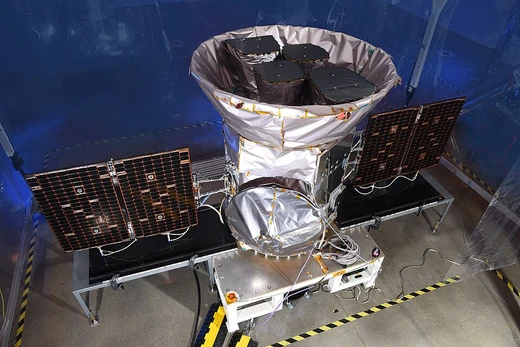
GJ 3929 b was discovered by a team led by Jonas Kermer from Heidelberg University, using transit signals from NASA's TESS mission. The planetary nature was confirmed with radial velocity observations from the CARMENES spectrograph and transit observations from SAINT-EX and LCOGT. The discovery was announced in 2022. The same radial velocity data also revealed a second planet in the system, GJ 3929 c, a sub-Neptune detected by radial velocity.
The planet orbits its star at a distance of 0.0252 AU, completing one orbit every 2.616 days. Its equilibrium temperature is around 300 °C, and it receives 17 times the insolation Earth gets from the Sun. Initial radius and mass estimates were later refined using the NEID spectrometer on the WIYN 3.5 m Telescope and the ARCTIC imager, along with photometry from TESS and LCOGT, yielding a density about 33% greater than Earth's.
Observations with the James Webb Space Telescope (JWST) searched for an atmosphere but detected no molecular features, ruling out a thick CO2-rich atmosphere. The dayside temperature is consistent with a zero-albedo planet with no heat distribution, suggesting a bare rock. A 2026 JWST study found the dayside temperature consistent with both airless and thin-atmosphere scenarios, such as an oxygen-rich, CO2-poor atmosphere. If airless, the surface is likely covered with crushed dunite rock or slab-form granite rock, based on secondary eclipse observations.
Reader's Guide
GJ 3929 b is significant as a benchmark for studying rocky planets in extreme insolation environments. Its high density, similar to Earth's, and lack of a detected thick atmosphere make it a key target for understanding atmospheric loss processes around red dwarfs. The planet's location in the 'Venus zone' provides a natural laboratory for investigating runaway greenhouse conditions and the transition from Earth-like to Venus-like worlds. The JWST observations, which ruled out a thick CO2 atmosphere and measured a dayside temperature consistent with a bare rock, have made GJ 3929 b one of the best-characterized small exoplanets in terms of surface properties. The 2026 study's finding that both airless and thin-atmosphere scenarios remain viable underscores the complexity of determining the true nature of such worlds. Its legacy lies in demonstrating how combined transit, radial velocity, and space-based infrared observations can constrain the composition and surface state of terrestrial exoplanets, informing future searches for atmospheres on similar planets.
Did You Know?
- GJ 3929 b has a density about 33% larger than Earth's.
- It orbits its star every 2 days, 14 hours and 47 minutes.
- JWST observations ruled out a thick CO2-rich atmosphere for this planet.
- The planet's surface may be covered with crushed dunite rock or slab-form granite rock if it is airless.
More in Transiting Exoplanets, Part 2 1-24
Spotted an error? Know more?
Reader corrections go straight into our review queue. Suggest an edit · How this site is sourced