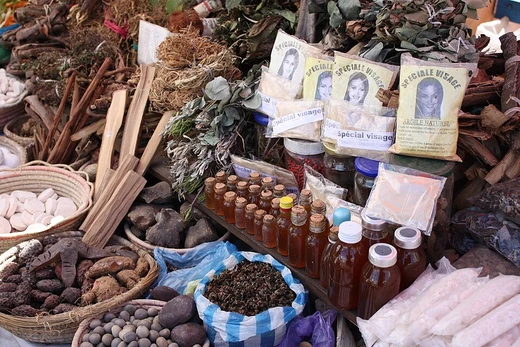
Chinese herbology
Last updated

Ellin Beltz · CC BY-SA 3.0
Chinese herbology uses plant, animal, human, and mineral substances, though plant elements are most common.[1] The practice stretches back millennia, with the earliest written prescription record from a manuscript sealed in 168 BCE.[2] A Nature editorial described traditional Chinese medicine as "fraught with pseudoscience".[3]
Quick Facts
- Field
- Traditional Chinese pharmacotherapy
Facts from the source article.
Key facts and history
The first major herbal classic, the Běn Cǎo Jīng, classifies 365 substances into superior, medium, and inferior categories.[4] Chinese herbs were traded through the Silk Road and were popular in medieval Islamic medicine.[5] Medieval Islamic scholars such as Rhazes, Haly Abbas, and Avicenna mentioned cinnamon, ginger, rhubarb, nutmeg, and cubeb as Chinese herbs.[5] The classic Bencao Gangmu describes 35 traditional Chinese medicines derived from the human body, though most are no longer in use.[6]
What the research sources say
The National Center for Complementary and Integrative Health reports that studies of Chinese herbal products have had mixed results.[7] Some Chinese herbal products have been contaminated with toxic compounds, heavy metals, pesticides, and microorganisms.[7]
References
- Wikipedia, "Chinese herbology" (CC BY-SA 4.0), which cites: Unschuld, "Medicine in China: A History of Pharmaceutics", University of California Press, 1986; "Introduction to English Terminology of Chinese Medicine", Paradigm Publications, 2002-08-01 (original not read by us) en.wikipedia.org
- Wikipedia, "Chinese herbology" (CC BY-SA 4.0), which cites: Harper, "Early Chinese Medical Literature: The Mawangdui Medical Manuscripts", Kegan Paul International, 1998, p. 39–41 (original not read by us) en.wikipedia.org
- Wikipedia, "Chinese herbology" (CC BY-SA 4.0), which cites: "Hard to swallow", Nature, 2007, p. 105–6; Shang, "Placebo-controlled trials of Chinese herbal medicine and conventional medicine comparative study", International Journal of Epidemiology, 2007, p. 1086–92; Siegfried, "Herbal medicine, randomised controlled trials and global core competencies", South African Medical Journal, 2012, p. 912–3; Shaw D, "Toxicological risks of Chinese herbs", Planta Medica, 2012, p. 2012–8; Krell, "Aristolochia: the malignant truth", The Lancet Oncology, 2013-01-01, p. 25–26 (original not read by us) en.wikipedia.org
- Wikipedia, "Chinese herbology" (CC BY-SA 4.0), which cites: Unschuld, "Medicine in China: A History of Pharmaceutics", University of California Press, 1986, p. 13; Unschuld, "Medicine in China: A History of Pharmaceutics", University of California Press, 1986, p. 13; Goldschmidt, "The Evolution of Chinese Medicine: Song dynasty, 960-1200", Routledge, 2009, p. 13; Unschuld, "Medicine in China: A History of Pharmaceutics", University of California Press, 1986, p. 13 (we also read that source) en.wikipedia.org
- Wikipedia, "Chinese herbology" (CC BY-SA 4.0), which cites: Heyadri, "The use of Chinese herbal drugs in Islamic medicine", Journal of Integrative Medicine, 2015, p. 363–367 (original not read by us) en.wikipedia.org
- Wikipedia, "Chinese herbology" (CC BY-SA 4.0), which cites: Nie, "Confucian Bioethics", Springer, 2002, p. 167–206; Awaya, "The Human Body as a New Commodity", The Review of Tokuyama University, June 1999; "Commodifying Bodies", Sage, October 2011 (original not read by us) en.wikipedia.org
- "Traditional Chinese Medicine: In Depth", National Center for Complementary and Integrative Health, April 2009. facts only, no text reused. nccih.nih.gov
Each numbered sentence above was checked against the source it cites before publication. Sentences citing Wikipedia adapt text from the English Wikipedia article Chinese herbology (contributors), used under CC BY-SA 4.0; this entry is available under the same licence. Other sources were used for facts only; no text or images are copied from them.
More in Traditional & Alternative Medicine
Sources
Compiled from Wikipedia and the sources listed below. Text from Wikipedia is available under CC BY-SA 4.0; this entry is adapted from it.
- Wikipedia: Chinese herbology (CC BY-SA 4.0).
- Word definitions: the Codexery glossary, each quoted from its Wikipedia article.
Spotted an error? Know more?
Reader corrections go straight into our review queue. Suggest an edit · How this site is sourced