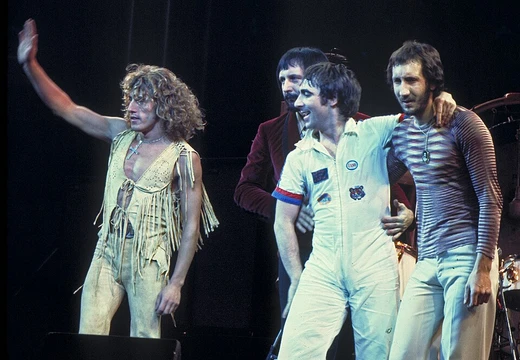
Roger Daltrey
The voice that turned a London pub band into a global thunderclump of sound and fury.

via Wikipedia: Roger Daltrey · see source
Roger Daltrey is the co-founder and lead vocalist of the rock band the Who, known for his powerful voice and charismatic stage presence. His stage persona earned him a position as one of the "gods of rock and roll". Born on 1 March 1944 in London, Daltrey's career spans decades as both a member of the Who and a solo artist, with hit songs including "My Generation", "Pinball Wizard", "Won't Get Fooled Again", "Baba O'Riley", "Who Are You" and "You Better You Bet". He has released ten solo studio albums, five compilation albums and one live album, with solo hits such as "Giving It All Away", "Free Me", "Without Your Love", "Walking in My Sleep", "After the Fire" and "Under a Raging Moon". The Who are considered one of the most influential rock bands of the 20th century and have sold over 100 million records worldwide.
Quick Facts
- Birth name
- Roger Harry Daltrey
- Born
- 1 March 1944
- Birthplace
- East Acton, London, England
- Genre
- Rock
- art rock
- hard rock
- soft rock
- power pop
- Occupation
- Singer
- musician
- songwriter
- actor
- film producer
- Instrument
- Vocals
- guitar
- harmonica
- Discography
- Solo, with the Who
- Years active
- 1959–present
Lore & Background
Roger Daltrey arrived in the Who's orbit as the lead vocalist of a skiffle group called the Detours, which he joined after making his first guitar from a block of wood in 1957. When the band needed a new name after discovering another band performing as the Detours in 1964, Daltrey made the decision for the band, saying "It's the Who, innit?" He became the band's leader, gaining a reputation for using his fists to impose discipline. According to Pete Townshend, Daltrey "ran things the way he wanted. If you argued with him, you usually got a bunch of fives." Daltrey explained this harsh approach came from the tough neighbourhood where arguments were resolved by fighting. He was expelled from school, though Townshend wrote that "until he was expelled, Roger had been a good pupil." After the band's first hit single and recording contract in early 1965, Daltrey's dominance diminished. The other members fired him in January 1966 after he beat up drummer Keith Moon for supplying illegal drugs to Townshend and Entwistle, but he was re-admitted a week later on probation after promising not to do it again. He recalled, "I thought if I lost the band, I was dead. If I didn't stick with the Who, I would be a sheet metal worker for the rest of my life."
Reader's Guide
In the fan community, Roger Daltrey is less a musician than a force of nature given a microphone. The story fans tell is one of pure, undiluted vocal commitment: the idea that every note he sings is a small act of self-sacrifice, that he doesn't perform a song so much as he bleeds it out. This narrative carries enormous cultural weight because it positions him as the antithesis of the polished, studio-perfect vocalist. His voice is rough, nasal, occasionally strained—and that imperfection is precisely what makes it feel real, urgent, alive. Within rock music's broader narrative, Daltrey's career helped establish the template for the frontman-as-emotional-conduit archetype. Before him, rock vocalists tended toward either cool detachment or theatrical showmanship. Daltrey offered something rarer: unguarded, almost painful sincerity delivered at full volume. That model influenced generations of vocalists who valued emotional rawness over technical polish. His longevity also shapes how fans think about rock's legacy. In an era where bands fracture, rebrand, or fade, Daltrey's six-decade presence with the Who makes him a living bridge between the 1960s counterculture and the present. When he steps to the mic, fans aren't just hearing a song; they're hearing a thread that stretches back to a smoky London pub, unbroken.
More in Band Members & Collaborators
Elsewhere in The Who
Spotted an error? Know more?
Reader corrections go straight into our review queue. Suggest an edit · How this site is sourced