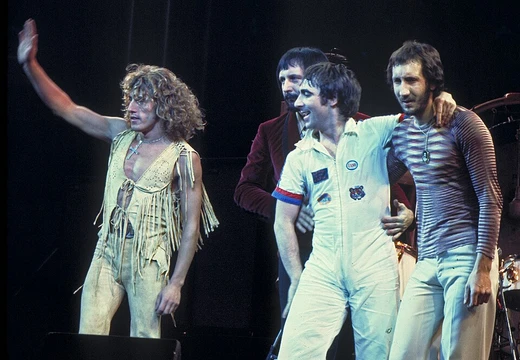
Keith Moon
The man who turned a drum kit into a controlled demolition and made the audience cheer for the wreckage.

via Wikipedia: Keith Moon · see source
Where other drummers kept time, Moon treated the kit as a weapon, a stage prop, and a personal extension of his boundless, bombastic energy. His playing was a thunderous, almost violent engine that drove The Who's wall-of-sound aesthetic and gave the band its signature physicality. Beyond the music, Moon became a cultural figure in his own right—a larger-than-life personality whose hotel-room disasters, kit explosions, and irreverent showmanship made him one of rock's most memorable characters. His death in 1978 at just 32 cut short a career that had already left an indelible mark on how drumming was performed, perceived, and celebrated in popular music.
Quick Facts
- Birth name
- Keith John Moon
- Born
- 23 August 1946
- Birthplace
- Wembley, Middlesex, England
- Died
- 7 September 1978
- Place of death
- Mayfair, London, England
- Resting place
- Golders Green Crematorium, London, England
- Spouse
- Kim Kerrigan, 1966, 1975, 1998
- Partner
- Annette Walter-Lax (1975–1978)
Facts from the source article.
Lore & Background
Keith Moon arrived at The Who in 1964 as a young, restless drummer with a taste for chaos that the band quickly recognized as a gift. His style was unlike anything in the British pop scene of the early sixties: instead of a steady backbeat, Moon played with a rolling, cascading energy, his sticks and hands blurring across cymbals, toms, and snare in a continuous storm. He treated fills not as transitions but as set-pieces, and his sense of rhythm was looser, more physical, more felt than calculated. This gave The Who's songs a driving, almost reckless momentum that no other band of the era quite matched. Offstage, Moon's personality was equally volcanic. Hotel managers across Europe and America learned to dread his name. He was known for detonating small fireworks in his kit, setting fire to curtains, and generally treating every room he occupied as a temporary laboratory for mayhem. Yet those who worked with him—Pete Townshend, Roger Daltrey, John Entwistle, and a revolving door of roadies and engineers—consistently described him as generous, fiercely loyal, and possessed of a dry, self-aware humor that undercut his own legend. He knew he was a spectacle, and he leaned into it with a grin. In an era when drummers were expected to stay in their seats and keep four-four, he demonstrated that the kit could be a visual and physical performance instrument. His approach opened the door for the theatrical, high-energy drumming that would define arena rock for decades. When he died in London in 1978, the rock world lost not just a musician but a philosophy: that playing loud, playing hard, and playing alive was its own form of art.
Reader's Guide
Instrument and Role: Keith Moon was the drummer of The Who, the rhythmic and sonic engine of the band. His kit—often a Ludwig set he affectionately called his 'bomb'—was the center of gravity in every performance. He didn't just keep time; he was the time, a rolling, cascading force that gave The Who's compositions their relentless forward drive. Personality in the Group Dynamic: In a band of four strong egos, Moon occupied a unique space. He was the physical, the visceral, the one who made the music happen in the body before the mind. Townshend composed, Daltrey sang, Entwistle anchored the low end, and Moon detonated the whole structure into motion. He was the band's comic relief, its wildest card, and—when the lights dimmed and the first downbeat hit—its most disciplined force. He could be the biggest fool in the room and the tightest drummer in the business within the same hour. Key Musical Contributions: Moon's drumming defined the sound of The Who's early and mid-period work. His rolling fills, his use of the snare as a percussive lead voice, his willingness to let a fill run for eight, twelve, sixteen bars—these were the textures that made songs like 'My Generation,' 'Baba O'Riley,' and 'Won't Get Fooled Again' feel like they were being built in real time, brick by brick, in front of the audience. His approach to dynamics—building from a whisper to a roar within a single bar—gave the band's arrangements a dramatic arc that pure composition alone couldn't achieve. What Made Him Irreplaceable: It wasn't just speed or volume. It was intent. Every hit, every crash, every stick-slip had a purpose and a personality. You could hear him in the kit, not just a drummer. That sense of a specific, irreplaceable human being driving the music was the thing no session player, no later replacement, could replicate. The Who's sound was, in a very real sense, Keith Moon's sound.
Did You Know?
- Moon's drumming style was a deliberate rejection of the tidy, seated drumming conventions of early-1960s British pop.
- Keith Moon was the first of The Who's four original members to die, passing away in 1978 at the age of 32 in London, England.
More in Band Members & Collaborators
Elsewhere in The Who
Spotted an error? Know more?
Reader corrections go straight into our review queue. Suggest an edit · How this site is sourced