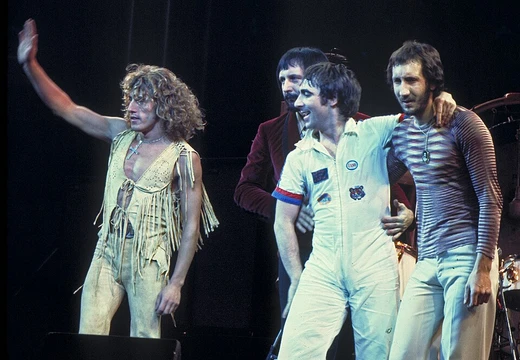
Baba O'Riley
The moment a rock band pointed a synthesizer at the sky and changed everything.
Baba O'Riley is the title track of The Who's 1971 album Who's Next, written by Pete Townshend. It stands as one of the most consequential songs in rock history, marking the moment the band decisively crossed from guitar-driven rock into a new electronic frontier. Its pulsing Minimoog synthesizer lines, driving bass, and Townshend's urgent vocal delivery created a sound that felt simultaneously futuristic and anthemic, redefining what a rock band could sound like. For fans, the song is more than a hit single; it is the sound of a generation's anxiety channeled into pure, shimmering energy. It sits at the crossroads of The Who's rock-opera era and their later, more experimental work, embodying Townshend's restless urge to push the band beyond the stadium-rock formula that had made them famous.
Quick Facts
- Artist
- the Who
- Album
- Who's Next
- B-side
- My Wife
- Recorded
- May 1971
- Studio
- Olympic (London)
- Genre
- Hard rock; art rock
- Label
- Polydor
- Writer
- Pete Townshend
Facts from the source article.
Lore & Background
The name itself carries a small, human story. Townshend has explained that the title was inspired by the parents of a young student he was teaching at the time. The student carried the surname O'Riley, and 'Baba'—a term of spiritual respect in several traditions—was added to honor the parents. What began as a nod to a family in a classroom became the banner for one of the most ambitious pop-rock statements of the early seventies. Musically, the song was a declaration of independence from The Who's own past. After the massive production of Tommy, Townshend wanted something leaner, sharper, and stranger. The Minimoog synthesizer, still a novelty in 1971, was given the lead melodic role rather than buried in the mix. The result was a track that sounded like no other rock record of its era: a machine-driven pulse under a human, almost desperate vocal performance. The lyrics paint a picture of a lost generation—children of a 'teenage wasteland'—searching for meaning in a world that had lost its spiritual center. The song's legacy is enormous. It helped normalize synthesizers in rock music years before the new wave fully took hold, and it demonstrated that a band built on volume and power could pivot toward electronic texture without losing its identity. For The Who, it was a bridge between the rock-opera spectacle and the more introspective, experimental direction they would explore in the years that followed.
Reader's Guide
In fan mythology, Baba O'Riley is the song where The Who stopped being a band and became a statement. The story the community tells is one of controlled revolution: here was a group that had already conquered the stadium, the rock opera, the cultural conversation—and they chose to walk away from all of it and build something that sounded like a machine dreaming. The Minimoog wasn't a garnish; it was the voice. That decision rippled outward for decades, proving that electronic texture and human urgency could coexist in a single, unbroken phrase. Culturally, the song carries the weight of a turning point. It arrived in the wake of Tommy's grandeur and pointed toward a future where rock would absorb synth, where the guitar would share the throne rather than rule it. Fans still cite it as the moment they realized The Who were not just a 'power trio with a drummer' but genuine architects of sound. In the broader rock narrative, Baba O'Riley sits alongside a handful of records that redefined the instrument palette. It is the rock equivalent of a door swinging open into a room you didn't know was there. And for the fan community, pressing play on it is still an act of small pilgrimage—three minutes of cold, electric certainty that the future was already here, humming in a London studio, waiting for someone to press record.
More in Songs & Singles
Elsewhere in The Who
Spotted an error? Know more?
Reader corrections go straight into our review queue. Suggest an edit · How this site is sourced