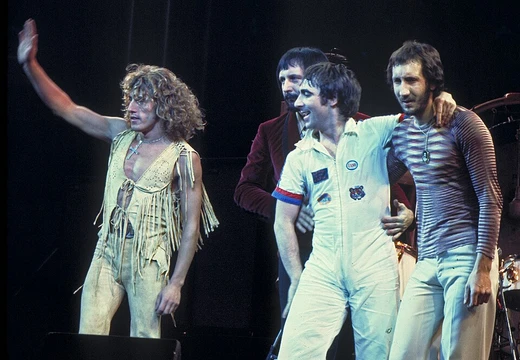
Simon Phillips
The thunderous successor to a drumming throne he never sat, yet always echoed.

via Wikipedia: Simon Phillips (drummer) · see source
Simon Phillips is a celebrated British drummer whose powerful, technically commanding style places him in the same lineage of rock percussion as The Who's legendary drummers, though he was never a member of the band himself. In the broader context of The Who's drumming legacy—defined by Keith Moon's explosive chaos and Kenney Jones's tight propulsive drive—Phillips represents the next wave of drummers who carried the torch of volume, showmanship, and sheer kinetic energy into the 1980s and beyond.
Quick Facts
- Born
- 6 February 1957
- Birthplace
- London, England
- Genre
- Jazz fusion
- rock
- heavy metal
- Occupation
- Musician, record producer
- Instrument
- Drums, percussion
- Years active
- 1969–present
- Past member of
- Toto, Judas Priest, The Who, 801, Ph.D., RMS
Facts from the source article.
Lore & Background
In the pantheon of rock drummers, The Who set a standard that few could match: a drum kit treated less as a timekeeping device and more as a full percussive orchestra, played with a physicality that bordered on the theatrical. Simon Phillips, arriving on the scene in the late 1970s, inherited that expectation. His tenure with Chicago brought him to arenas where audiences had grown up on The Who's stadium shows, and his playing—massive fills, relentless double-stroke patterns, a cymbal work that rang like a gong section—spoke the same visual and aural language. He did not imitate Moon's pyrotechnic destruction or Jones's metronomic lock, but he channeled the same underlying principle: the drummer as a front-and-center performer whose kit is a stage unto itself. His move to Toto in the early 1980s placed him in a band that blended rock power with studio polish, and his drumming on their recordings demonstrated a range that went from thunderous open back-kick grooves to intricate, almost jazz-inflected passages. Between band commitments, Phillips became one of the most in-demand session drummers of his era, laying down tracks for a staggering array of artists across rock, pop, and fusion. His reputation in the studio was built on reliability and power: he could lock into a pocket with the precision of a click track while still making the performance feel alive and dangerous. Beyond performance, Phillips became a prominent figure in drum education, writing instructional books and conducting clinics that influenced a generation of young players. His teaching philosophy emphasized musicality over mere speed, a corrective to the era's obsession with technical flash. In the context of The Who's influence, this made him a kind of philosophical heir: the idea that a drummer's job is to serve the song first, then to make the audience feel the ground shake second.
Reader's Guide
Instrument & Role: Phillips plays a full drum kit—kick, snare, toms, cymbals, and often a second snare or percussion accents. His role in any ensemble is that of the rhythmic engine and, in live settings, a visual anchor. He does not merely keep time; he drives the dynamic arc of a song, building tension through fills and releasing it with crashes that fill the room. Personality & Group Dynamic: In a band setting, Phillips is the disciplined force. Where a frontman might chase a wild riff, he is the one who says, in the quiet of the rehearsal room, 'Let's count it in one more time.' He is patient, methodical, and quietly authoritative. He does not compete for attention; he makes the attention feel inevitable because the groove is so solid that everything else has to build on top of it. In the group dynamic, he is the floor—the thing everyone stands on without thinking about it. Key Musical Contributions: His playing is defined by a combination of power and precision. Open back-kick patterns give his grooves a ringing, resonant quality. His cymbal work is deliberate and loud, each crash placed to mark a structural change. His fills are not gratuitous; they serve the transition. In studio work, his timing is essentially quantized by ear, and his dynamics are controlled so that a quiet verse and a loud chorus feel like two different rooms. What Made Him Irreplaceable: In the shadow of The Who's drumming legacy, Phillips represents the idea that power drumming does not require destruction. You can play with the same volume, the same physical commitment, the same 'the stage is a percussion pit' energy, and still be musical. He proved that the throne The Who built for the drummer could be occupied by someone who was as much a musician as a showman, and that the two roles are not mutually exclusive.
Did You Know?
- Simon Phillips was a member of both Chicago and Toto during the 1980s, making him one of the few drummers to front two major rock acts in the same decade.
- He is a prolific drum educator and author, having written instructional books that influenced a generation of young players to prioritize musicality over raw speed.
- His playing style is often discussed in the context of the 'power drumming' tradition that The Who helped define, positioning him as a philosophical heir to that lineage even without a formal connection to the band.
More in Band Members & Collaborators
Elsewhere in The Who
Spotted an error? Know more?
Reader corrections go straight into our review queue. Suggest an edit · How this site is sourced