Tommy (1975 film)
Pinball wizard meets fever dream: a Technicolor hallucination directed by a man who couldn't tell the difference between a church and a circus.

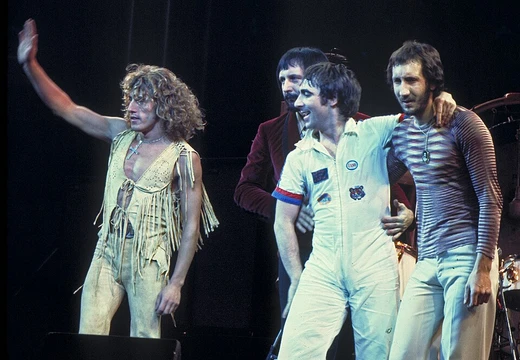
Heritage Auctions · via Wikipedia: Tommy (1975 film) · Fair use
Ken Russell pointed his camera at Oliver Reed — gaunt, 41, playing the grown-up Tommy Walker — and decided The Who's 1969 rock opera didn't need a stage. The 1975 result is less a concert film than a running fever dream: circus rings, halos, pinball flippers, tableaux pulled straight out of religious painting, all while The Who play the entire score live on set, mics catching every breath. No overdubs, no audience in the frame.
It slots into the band's output in a way that's genuinely hard to categorize — part recording, part live performance, part Russell going feral with his own visual obsessions. Box-office numbers said "no thanks" at release. Over time it became the one fan film you reach for when you want a rock narrative pushed through full-blown Technicolor hallucination, where the camera does things a theater director would never greenlight.
Quick Facts
- Director
- Ken Russell
- Based on
- Tommy (1969 album), the Who
- Producer
- Robert Stigwood; Ken Russell
- Cinematography
- Dick Bush; Ronnie Taylor
- Editing
- Stuart Baird
- Music
- The Who
- Studio
- Robert Stigwood Organization Ltd.
- Hemdale Film Corporation (International)
- Columbia Pictures (United States)
- Distributor
- Hemdale Film Corporation (International); Sony Pictures Releasing (United States)
Facts from the source article.
Lore & Background
In the world of The Who's rock opera, Tommy Walker is a boy struck by a car who loses his sight, hearing, and speech. The 1975 film expands this origin into a sequence of increasingly bizarre sensory episodes: a circus ring where clowns perform grotesque acts, a pinball machine that becomes a cathedral of neon and chrome, and a courtroom that dissolves into a religious trial. Ken Russell treats each song as a discrete visual poem, leaping between 1950s suburban Britain, a deranged asylum, and a cosmic arena where Tommy is anointed as a messianic figure.
The Who themselves appear throughout, performing the music in period-appropriate outfits while the camera swirls around them in Russell's signature long takes. Their presence grounds the film's wild imagery in the physical reality of rock performance—sweat, amplifiers, the thump of a bass drum—while the narrative around them remains deliberately fragmented and symbolic. Oliver Reed, in his final major film role, delivers a Tommy who is part rock star, part prophet, part tragic everyman, and his physical intensity anchors the spectacle.
For fans, the film represents The Who at their most ambitious as visual storytellers. It is not a faithful stage adaptation; it is a reinterpretation that trusts the audience to follow an emotional and symbolic arc rather than a literal plot. The result is a work that rewards repeated viewings, where new images and connections surface with each pass, much like the layered compositions of the original album.
Reader's Guide
The 1975 film Tommy is a cinematic rock-opera adaptation of The Who's 1969 album of the same name. Directed by Ken Russell, it stars Oliver Reed as the adult Tommy Walker, with The Who performing the entire score live on set. Production took place in the UK and was driven by the band's own creative vision, giving them unusual control over the final cut. What sets it apart from a typical concert film or stage recording is Russell's commitment to pure visual surrealism. Each track is reimagined as a distinct set-piece: a grotesque circus, a chrome-and-neon pinball cathedral, a religious trial, a suburban nightmare. The Who are embedded within these worlds rather than simply playing to a camera, and the editing jumps between reality and hallucination without explanation, trusting the audience to follow the emotional logic. The project revealed a different facet of the band's artistry. While their studio albums were driven by Pete Townshend's songwriting and narrative structure, the film exposed the group's willingness to be performers in someone else's visual language. It also showed that their rock-opera ambitions extended beyond the recording studio into a fully cinematic medium, even if the result was polarising at the time.
Did You Know?
- The film was a commercial disappointment on release but has since developed a strong cult following, often screened at festivals and rock-cinema retrospectives where its audacity is celebrated rather than mocked.
- The Who performed the music live during filming rather than lip-syncing to a studio track, meaning the on-screen performances are genuine, unedited takes that capture the physicality of a live rock show.
More in Films, TV & Media
Elsewhere in The Who
Spotted an error? Know more?
Reader corrections go straight into our review queue. Suggest an edit · How this site is sourced