
Hyperalgesia
Abnormally increased sensitivity to pain from nerve damage or opioids.
Last updated

Jmarchn · CC BY-SA 3.0
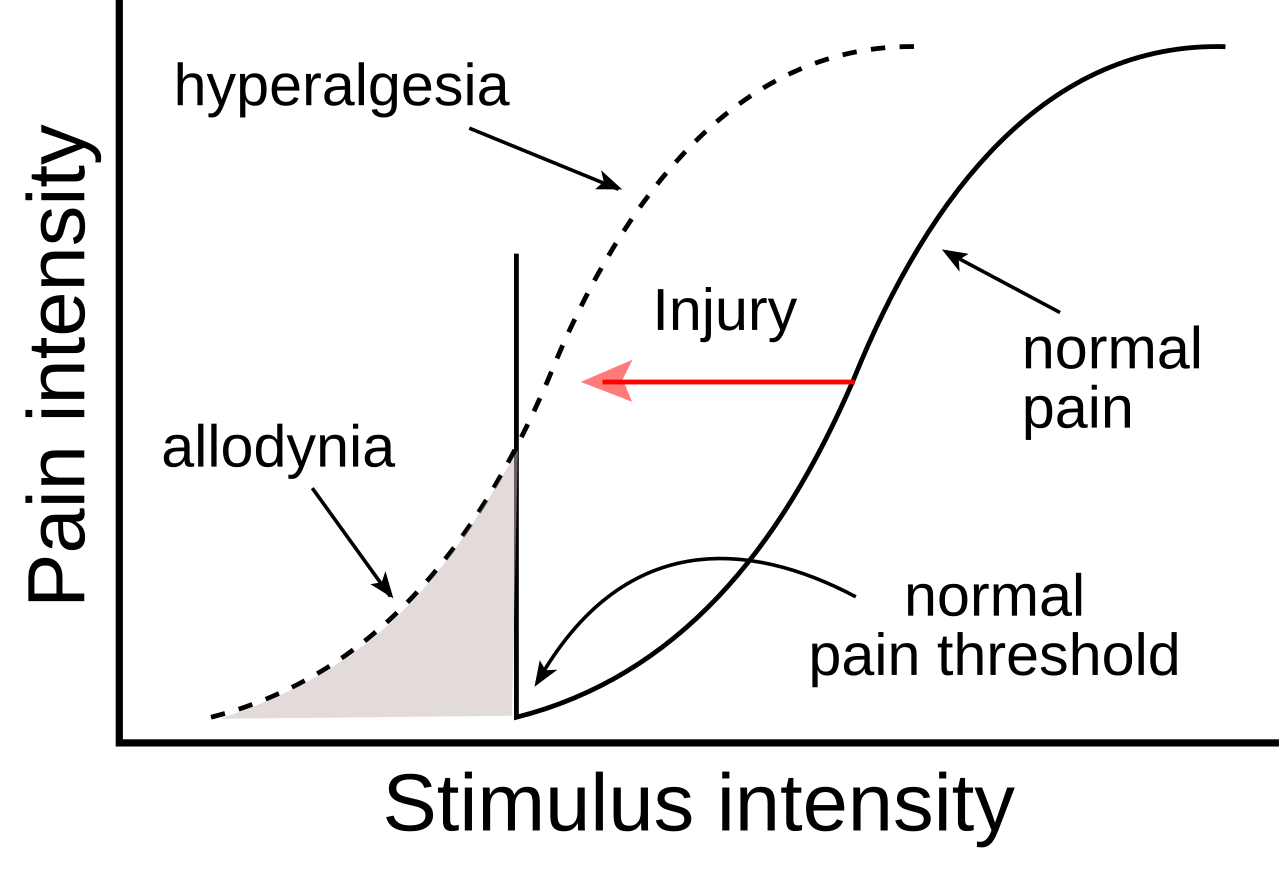
Hyperalgesia is an abnormally increased sensitivity to pain that can result from damage to nociceptors or peripheral nerves.[1] The sensitization of nociceptors that leads to this condition is mainly driven by prostaglandins E and F.[1]
Quick Facts
- Known for
- Abnormally increased sensitivity to pain
- Types
- Focal (primary, secondary) and diffuse (functional, opioid-induced)
- Causes
- Damage to nociceptors
- platelet-activating factor
- opioid use
- infection
- Treatment
- SSRIs
- tricyclic antidepressants
- NSAIDs
- glucocorticoids
- gabapentin
- pregabalin
- NMDA antagonists
- tramadol
- TENS
- Primary hyperalgesia
- Pain sensitivity directly in damaged tissues
- Secondary hyperalgesia
- Pain sensitivity in surrounding undamaged tissues
- Associated conditions
- Fibromyalgia, opioid-induced hyperalgesia
- Common cause
- Platelet-activating factor (PAF) from inflammatory or allergic response
Facts from the source article.
Key facts and history
The term hyperalgesia combines the Greek hyper ('over') and -algesia from algos ('pain').[1] Chronic hyperstimulation of opioid receptors alters homeostasis of pain signalling pathways, with one major pathway through stimulation of the nociceptin receptor.[2] The release of proinflammatory cytokines such as interleukin-1 by activated leukocytes also increases pain sensitivity as part of sickness behavior.[3] Sickness behavior, an evolved response to infection, includes a temporary heightened sensitivity to pain.[1]
Platelet-activating factor (PAF), produced during inflammatory or allergic responses, serves as an inducer of hyperalgesia.[4] Pain-producing chemicals called cytokines and chemokines are released when immune cells interact with the peripheral nervous system, which appears to be the mechanism behind this effect.[4] Platypus venom is a rare trigger for focal hyperalgesia.[5] Individuals who use opioids long-term or take high doses for chronic pain may develop hyperalgesia, where their pain is more severe than what physical exam findings would suggest.[6]
When opioid-induced hyperalgesia occurs, clinicians often respond by raising the opioid dose, which can make the problem worse.[6] Long term potentiation, a form of spinal cord amplification, is activated when nociceptive fibers are stimulated in a pattern that mimics inflammation.[7]
What the cited sources add
Hyperalgesia may respond to standard treatments such as SSRI or tricyclic antidepressants, NSAIDs, glucocorticoids, gabapentin, pregabalin, NMDA antagonists, and atypical opioids like tramadol.[8] To tell allodynia from hyperalgesia, quantitative sensory testing measures pain thresholds and stimulus/response functions.[9] A cotton swab or a brush is the tool used to evaluate dynamic mechanical allodynia.[9] Pressure and punctate allodynia and hyperalgesia are evaluated using a pressure algometer, standardized monofilaments, or weighted pinprick stimuli.[9]
References
- Wikipedia, "Hyperalgesia" (CC BY-SA 4.0), which cites: "Clinical Pharmacology", www.clinicalpharmacology-ip.com; Hart BL, "Biological basis of the behavior of sick animals", Neurosci Biobehav Rev, 1988, p. 123–37 (original not read by us) en.wikipedia.org
- Wikipedia, "Hyperalgesia" (CC BY-SA 4.0), which cites: "The opioid peptide nociceptin/orphanin FQ mediates prostaglandin E2-induced allodynia, tactile pain associated with nerve injury", Eur. J. Neurosci., February 2006, p. 995–1004; "Regulation of proinflammatory cytokines gene expression by nociceptin/orphanin FQ in the spinal cord and the cultured astrocytes", Neuroscience, January 2007, p. 275–85; "Activation of the nociceptin opioid system in rats. Sensory neurons produce antinociceptive effects in inflammatory pain: involvement of inflammatory mediators", J. Neurosci. Res., August 2024, en.wikipedia.org
- Wikipedia, "Hyperalgesia" (CC BY-SA 4.0), which cites: Hart BL, "Biological basis of the behavior of sick animals", Neurosci Biobehav Rev, 1988, p. 123–37; "Cytokine-induced sickness behavior", Brain Behav., February 2003, p. S112–18; "Interleukin-1 mediates the behavioral hyperalgesia produced by lithium chloride and endotoxin", Brain Res., October 1993, p. 321–24 (original not read by us) en.wikipedia.org
- Wikipedia, "Hyperalgesia" (CC BY-SA 4.0), which cites: "Role of the immune system in chronic pain", Nat. Rev. Neurosci., July 2005, p. 521–32 (original not read by us) en.wikipedia.org
- Wikipedia, "Hyperalgesia" (CC BY-SA 4.0), which cites: "Venom from the platypus, Ornithorhynchus anatinus, induces a calcium-dependent current in cultured dorsal root ganglion cells", J. Neurophysiol., March 2001, p. 1340–45 (original not read by us) en.wikipedia.org
- Wikipedia, "Hyperalgesia" (CC BY-SA 4.0), which cites: "Opioid-induced hyperalgesia in humans: molecular mechanisms and clinical considerations", Clin J Pain, 2008, p. 479–96; "Mechanisms of opioid-induced tolerance and hyperalgesia", Pain Manag Nurs, September 2007, p. 113–21; Mitra S, "Opioid-induced hyperalgesia: pathophysiology and clinical implications", J Opioid Manag, 2018, p. 123–30 (original not read by us) en.wikipedia.org
- Wikipedia, "Hyperalgesia" (CC BY-SA 4.0), which cites: "Synaptic amplifier of inflammatory pain in the spinal dorsal horn", Science, June 2006, p. 1659–62 (original not read by us) en.wikipedia.org
- Wikipedia, "Hyperalgesia" (CC BY-SA 4.0), which cites: "Antidepressants in the treatment of neuropathic pain", Basic & Clinical Pharmacology & Toxicology, June 2005, p. 399–409; "Usefulness of antidepressants for improving the neuropathic pain-like state and pain-induced anxiety through actions at different brain sites", Neuropsychopharmacology, July 2008, p. 1952–65; "The cyclooxygenase isozyme inhibitors parecoxib and paracetamol reduce central hyperalgesia in humans", Pain, March 2004, p. 148–53; "Methylprednisolone and Ketorolac rapidly reduce hyperalgesia around a skin burn injury and inc en.wikipedia.org
- Wikipedia, "Hyperalgesia" (CC BY-SA 4.0), which cites: "NeuPSIG guidelines on neuropathic pain assessment", Pain, Jan 2001, p. 14–27; "Allodynia and hyperalgesia in neuropathic pain: clinical manifestations and mechanisms.", Lancet Neurol, Sep 2014, p. 924–35 (original not read by us) en.wikipedia.org
Each numbered sentence above was checked against the source it cites before publication. Sentences citing Wikipedia adapt text from the English Wikipedia article Hyperalgesia (contributors), used under CC BY-SA 4.0; this entry is available under the same licence. Other sources were used for facts only; no text or images are copied from them.
More in Symptoms and signs: Skin and subcutaneous tissue
Sources
Compiled from Wikipedia and the sources listed below. Text from Wikipedia is available under CC BY-SA 4.0; this entry is adapted from it.
- Wikipedia: Hyperalgesia (CC BY-SA 4.0).
- Word definitions: the , each quoted from its Wikipedia article.
Spotted an error? Know more?
Reader corrections go straight into our review queue. Suggest an edit · How this site is sourced