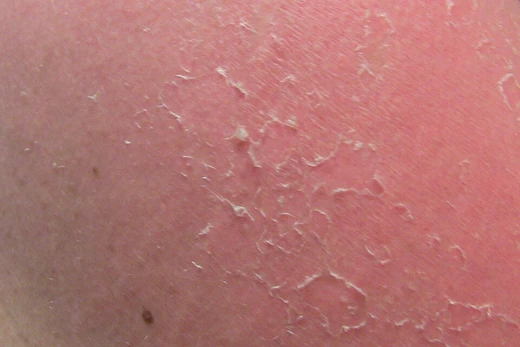
Cyanosis
A bluish discoloration of tissue indicating low oxygen.
Last updated

Pots Syndrome · CC BY 2.0
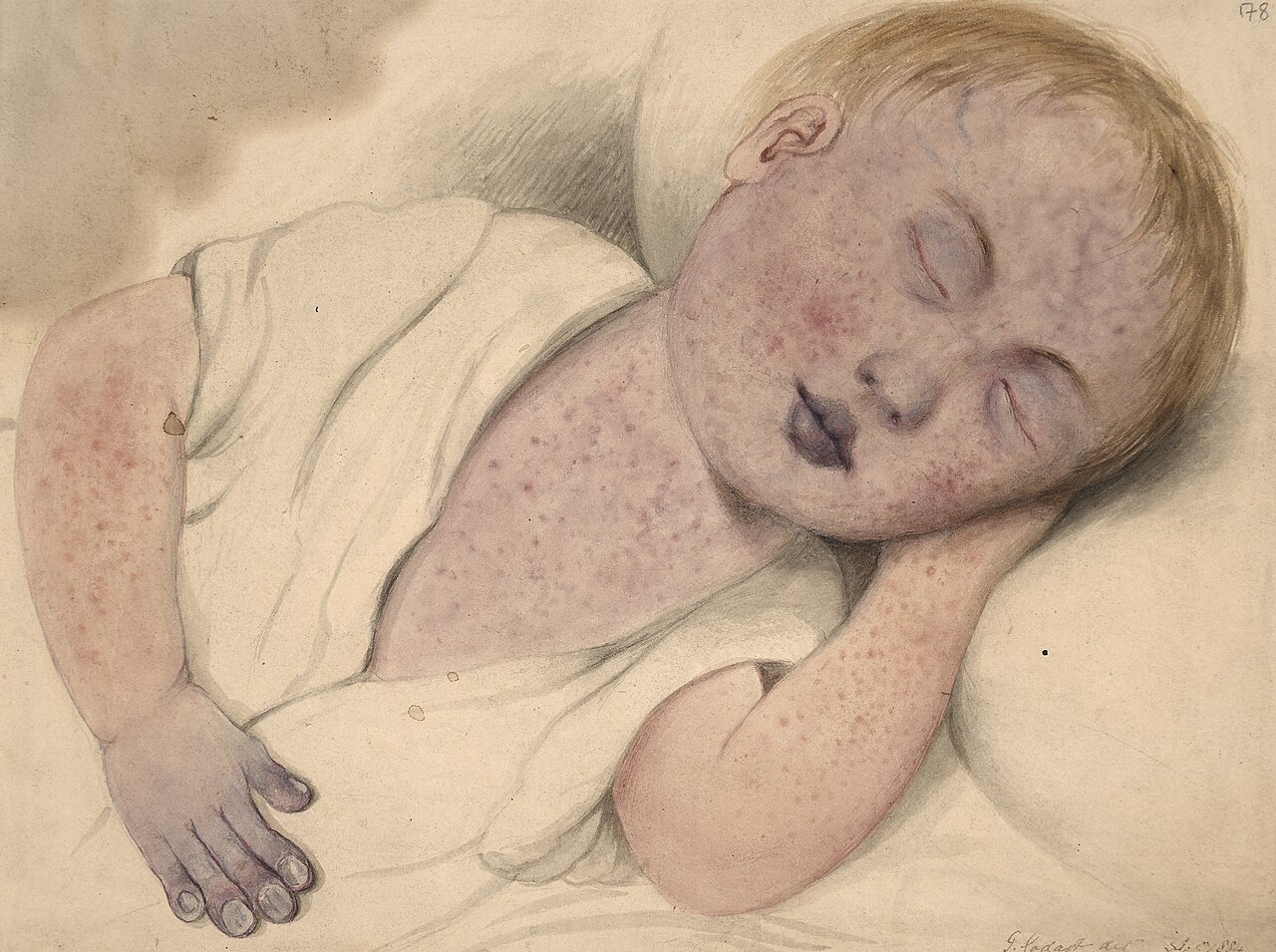
Cyanosis is a bluish-purple discoloration of tissues caused by decreased oxygen bound to hemoglobin in capillary blood.[1] The term literally means "blue disease" and comes from the Greek word for blue.[2] In body areas where the skin is thin, such as the mucous membranes, lips, nail beds, and ear lobes, the bluish-purple discoloration of cyanosis is most apparent.[1]
Key facts and history
Central cyanosis results from low arterial oxygen saturation, typically appearing when deoxyhemoglobin reaches 5.0 g/dL or oxygen saturation falls to 85% or below.[3][4] Differential cyanosis affects only the lower body and is seen with patent ductus arteriosus.[5] Jean-Baptiste de Sénac first described cyanosis in 1749, attributing it to a heart defect mixing arterial and venous blood.[6] Because cyanosis is a symptom rather than a disease, treatment is directed at the root cause.[7]
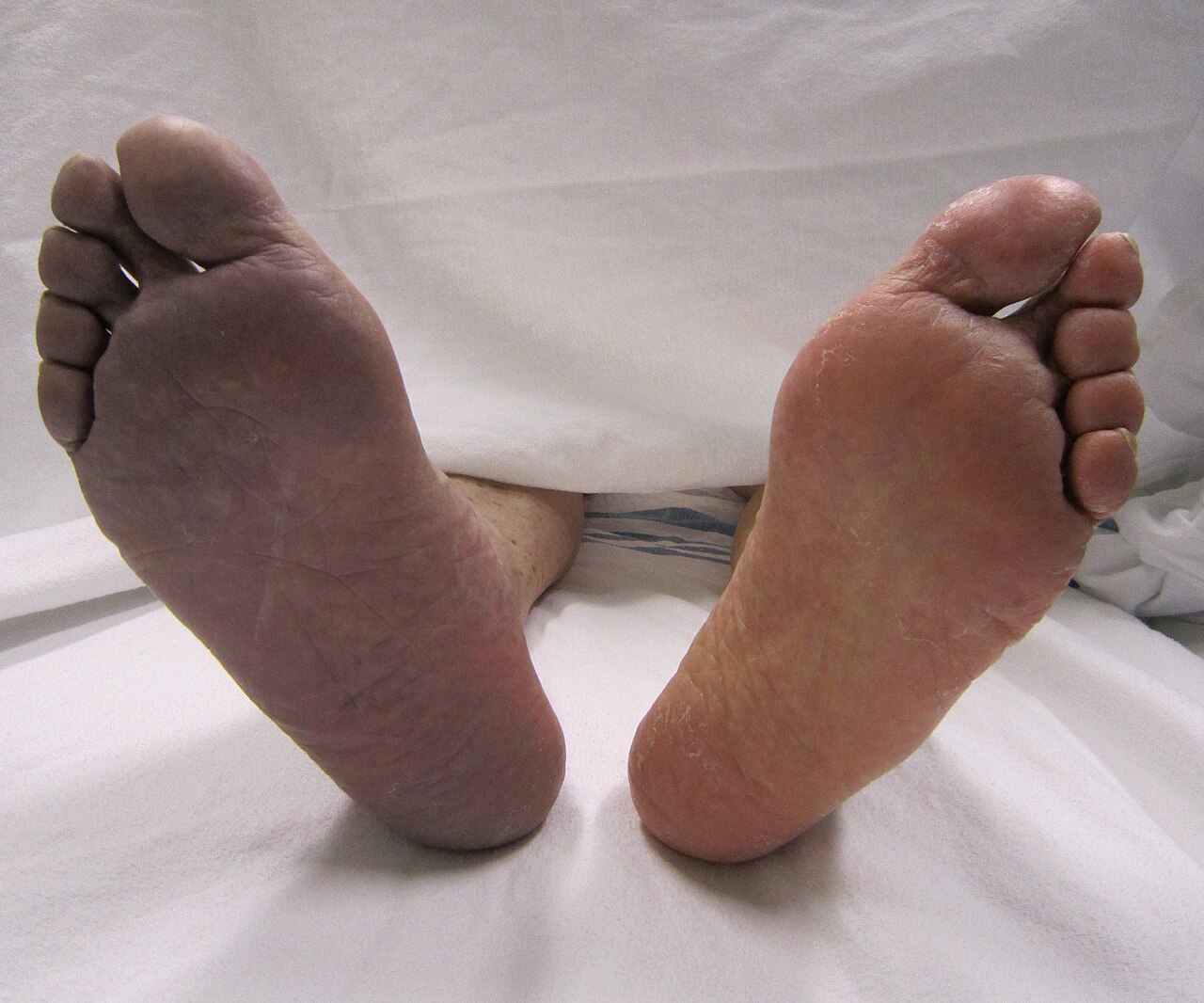
Peripheral cyanosis is characterized by a higher level of deoxyhemoglobin in the venous part of the peripheral circulation, frequently resulting from blood flow that is insufficient or blocked to the limbs.[8][4] While any condition that triggers central cyanosis can also lead to peripheral signs, peripheral cyanosis may appear even when heart and lung function are normal.[9] In newborn infants with peripheral cyanosis, the discoloration is seen in the distal extremities, around the mouth, and around the eyes, yet the mucous membranes stay pink.[10]
What the cited sources add
The StatPearls 2021 source states that medications containing amiodarone or silver can cause discoloration mistaken for cyanosis.[1] The same source notes that mongolian spots, birthmarks, and blue or purple food dyes may also mimic cyanosis.[11] A 2001 American Journal of Clinical Dermatology article and a 2004 Pediatric Clinics of North America article support that careful history and physical examination are crucial for diagnosis.[11] The 1970 Journal of Pediatrics article by Lees specifies that in peripheral cyanosis, mucous membranes stay pink, unlike in central cyanosis where they become cyanotic.[10]
The same article recommends immediate supplemental oxygen for patients with significant respiratory distress.[12] According to a 2004 article in Pediatric Clinics of North America by Sasidharan, the initial step in emergency management is to secure the airway, breathing, and circulation.[12]
References
- Wikipedia, "Cyanosis" (CC BY-SA 4.0), which cites: Adeyinka, "Cyanosis", StatPearls, 2021; Adeyinka, "Cyanosis", StatPearls, 2021 (original not read by us) en.wikipedia.org
- Wikipedia, "Cyanosis" (CC BY-SA 4.0), which cites: "Mosby's Medical, Nursing & Allied Health Dictionary", 1994, p. 425 (original not read by us) en.wikipedia.org
- Wikipedia, "Cyanosis" (CC BY-SA 4.0), which cites: "Mini Oxford Handbook of Clinical Medicine", p. 56; Adeyinka, "Cyanosis", StatPearls, 2021 (original not read by us) en.wikipedia.org
- Wikipedia, "Cyanosis" (CC BY-SA 4.0), which cites: "Central and Peripheral Cyanosis", StatPearls, July 2020 (original not read by us) en.wikipedia.org
- Wikipedia, "Cyanosis" (CC BY-SA 4.0), which cites: "Central and Peripheral Cyanosis", StatPearls, July 2020; "Central and Peripheral Cyanosis", StatPearls, July 2020; Gillam-Krakauer, "Patent Ductus Arteriosus", StatPearls, 2021; Gillam-Krakauer, "Patent Ductus Arteriosus", StatPearls, 2021 (original not read by us) en.wikipedia.org
- Wikipedia, "Cyanosis" (CC BY-SA 4.0), which cites: Lundsgaard, "Studies on Cyanosis", The Journal of Experimental Medicine, 1919-09-01, p. 259–269 (original not read by us) en.wikipedia.org
- Wikipedia, "Cyanosis" (CC BY-SA 4.0), which cites: Adeyinka, "Cyanosis", StatPearls, 2021 (original not read by us) en.wikipedia.org
- Wikipedia, "Cyanosis" (CC BY-SA 4.0), which cites: "Central and Peripheral Cyanosis", StatPearls, July 2020; McMullen, "Cyanosis", The American Journal of Medicine, 2013-03-01, p. 210–212 (original not read by us) en.wikipedia.org
- Wikipedia, "Cyanosis" (CC BY-SA 4.0), which cites: "Central and Peripheral Cyanosis", StatPearls, July 2020; "Central and Peripheral Cyanosis", StatPearls, July 2020 (original not read by us) en.wikipedia.org
- Wikipedia, "Cyanosis" (CC BY-SA 4.0), which cites: Lees, "Cyanosis of the newborn infant", The Journal of Pediatrics, 1970, p. 484–498; Lees, "Cyanosis of the newborn infant", The Journal of Pediatrics, 1970, p. 484–498 (original not read by us) en.wikipedia.org
- Wikipedia, "Cyanosis" (CC BY-SA 4.0), which cites: Dereure, "Drug-Induced Skin Pigmentation: Epidemiology, Diagnosis and Treatment", American Journal of Clinical Dermatology, 2001, p. 253–262; Conlon, "Skin lesions in the neonate", Pediatric Clinics of North America, 2004, p. 863–888 (original not read by us) en.wikipedia.org
- Wikipedia, "Cyanosis" (CC BY-SA 4.0), which cites: Sasidharan, "An approach to diagnosis and management of cyanosis and tachypnea in term infants", Pediatric Clinics of North America, 2004, p. 999–1021 (original not read by us) en.wikipedia.org
Each numbered sentence above was checked against the source it cites before publication. Sentences citing Wikipedia adapt text from the English Wikipedia article Cyanosis (contributors), used under CC BY-SA 4.0; this entry is available under the same licence. Other sources were used for facts only; no text or images are copied from them.
More in Symptoms and signs: Skin and subcutaneous tissue
Sources
Compiled from Wikipedia and the sources listed below. Text from Wikipedia is available under CC BY-SA 4.0; this entry is adapted from it.
- Wikipedia: Cyanosis (CC BY-SA 4.0).
Spotted an error? Know more?
Reader corrections go straight into our review queue. Suggest an edit · How this site is sourced