
Hyperalgesia
Abnormally increased sensitivity to pain from nerve damage or opioids.

Jmarchn · CC BY-SA 3.0
Hyperalgesia is an abnormally increased sensitivity to pain, which may be caused by damage to nociceptors or peripheral nerves and can cause hypersensitivity to stimulus. It is a condition that can arise from injury, inflammation, infection, or long-term opioid use, and is associated with disorders such as fibromyalgia.
- Field
- Pain medicine, neurology
- Known for
- Abnormally increased sensitivity to pain
- Types
- Focal (primary, secondary) and diffuse (functional, opioid-induced)
- Causes
- Damage to nociceptors, platelet-activating factor, opioid use, infection
- Treatment
- SSRIs, tricyclic antidepressants, NSAIDs, glucocorticoids, gabapentin, pregabalin, NMDA antagonists, tramadol, TENS
Lore & Background
Hyperalgesia can be experienced in focal, discrete areas or as a more diffuse, body-wide form. The focal form is typically associated with injury and is divided into primary hyperalgesia, which occurs directly in damaged tissues, and secondary hyperalgesia, which occurs in surrounding undamaged tissues. Conditioning studies have established that it is possible to experience a learned hyperalgesia of the diffuse form.
Reader's Guide
Hyperalgesia is a clinically significant condition because it represents a pathological amplification of pain sensitivity, often complicating the management of chronic pain. It is induced by platelet-activating factor during inflammatory or allergic responses, and can also result from long-term opioid use, where it may be mistaken for tolerance and lead to dose escalation that worsens the problem. The condition is associated with fibromyalgia and can be assessed through bedside tests and quantitative sensory testing. Treatment is similar to that for neuropathic pain and may include antidepressants, NSAIDs, gabapentinoids, NMDA antagonists, or transcutaneous electrical nerve stimulation. Reducing opioid dose may improve pain management when hyperalgesia is opioid-induced. The condition underscores the complexity of pain pathways and the need for careful differential diagnosis.
Did You Know?
- Prostaglandins E and F are largely responsible for sensitizing the nociceptors in hyperalgesia.
- One unusual cause of focal hyperalgesia is platypus venom.
- Opioid-induced hyperalgesia can develop from both chronic and acute exposure to opioids.
- Stimulation of nociceptive fibers in a pattern consistent with inflammation can cause long-term potentiation in the spinal cord, producing hyperalgesia.
Biology & Classification of the Condition
Hyperalgesia represents an abnormal amplification of pain sensitivity, a term drawn from the Greek roots meaning "over" and "pain." The condition manifests in two broad patterns: focal, confined to a specific region, or diffuse, spreading across the body. The focal form further divides into primary hyperalgesia, where heightened sensitivity is limited to the injured tissue itself, and secondary hyperalgesia, in which the surrounding, undamaged tissue also becomes overly reactive. A more widespread, functional form appears in conditions such as fibromyalgia. At the cellular level, prostaglandins E and F play a central role in sensitizing nociceptors, while platelet-activating factor, released during inflammatory or allergic responses, drives the process through immune cells that interact with peripheral nerves and discharge cytokines and chemokines. In the spinal cord, stimulation of nociceptive fibers in patterns typical of inflammation triggers long-term potentiation at the synapse with the periaqueductal grey, effectively switching on an amplification circuit. Even the evolved sickness response to infection, mediated by proinflammatory cytokines like interleukin-1 released by activated leukocytes, temporarily raises pain sensitivity.
The Paradox of Opioid-Induced Hyperalgesia
One of the most clinically troubling dimensions of hyperalgesia is its paradoxical emergence from the very drugs designed to relieve pain. Both acute and chronic exposure to opioids—whether heroin, morphine, or high-dose prescription regimens for chronic pain—can produce a state in which patients feel pain far out of proportion to any physical finding. This opioid-induced hyperalgesia is particularly insidious because it closely mimics tolerance, leading clinicians to escalate doses, which in turn worsens the underlying hypersensitivity. The mechanism involves chronic overstimulation of opioid receptors, which disrupts the normal homeostasis of pain-signalling pathways. A key pathway runs through the nociceptin receptor, and blocking this receptor has been proposed as a strategy to prevent the condition from developing. When hyperalgesia is clearly opioid-driven, reducing the dose can paradoxically improve pain control. In severe cases, the side effect is significant enough to necessitate complete discontinuation of opioid therapy.
Clinical Diagnosis & Sensory Assessment
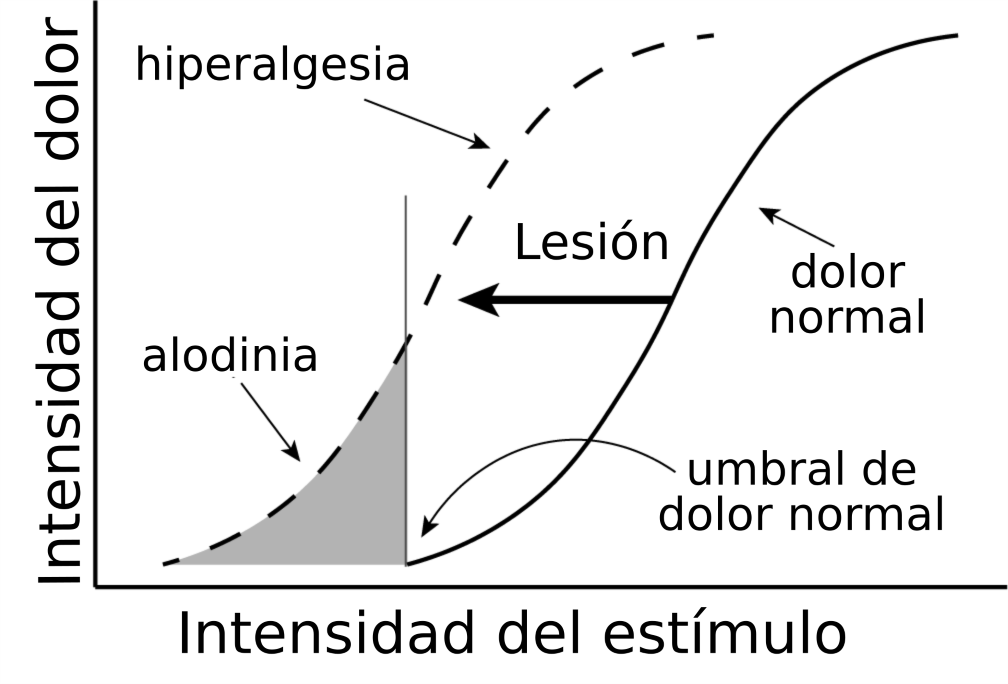
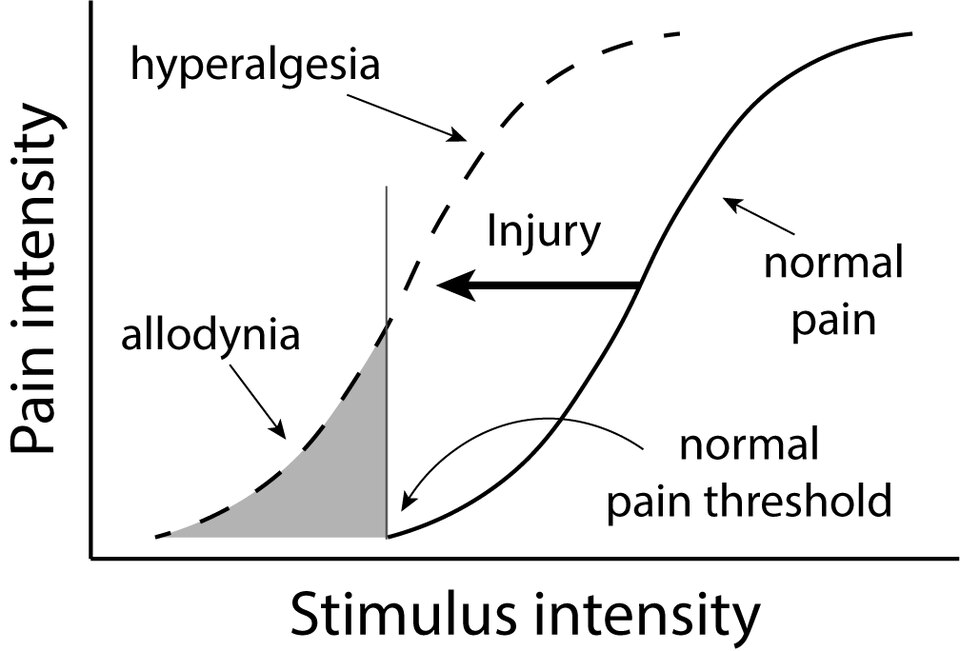
Identifying hyperalgesia in clinical practice relies on a combination of simple bedside observations and more sophisticated quantitative tools. At the most basic level, a clinician applies a cotton swab, gentle finger pressure, a pinprick, or thermal stimuli—such as metal thermo rollers set at 20 °C and 40 °C—and observes the patient's pain intensity and character while mapping the exact area of abnormality. Quantitative sensory testing adds precision: a decreased pain threshold points toward allodynia, whereas an increased pain response to a given stimulus is the hallmark of hyperalgesia. Dynamic mechanical allodynia can be gauged with a cotton swab or a soft brush, while a pressure algometer, standardized monofilaments, or weighted pinprick stimuli evaluate pressure and punctate responses. A dedicated thermal tester handles temperature-based assessment. These layered approaches help clinicians separate hyperalgesia from the closely related condition of allodynia and from hypoalgesia, ensuring that the treatment pathway chosen matches the true underlying mechanism.
Therapeutic Strategies & Management Challenges
Because hyperalgesia shares its biological underpinnings with other nerve-irritation and nerve-damage pain syndromes—such as allodynia and neuropathic pain—its pharmacological toolkit overlaps considerably with those conditions. Clinicians may turn to SSRIs or tricyclic antidepressants, NSAIDs, glucocorticoids, gabapentin or pregabalin, NMDA antagonists, and atypical opioids like tramadol. When the hyperalgesia is opioid-induced, the counterintuitive step of lowering the opioid dose can actually improve the patient's overall pain management. Beyond medication, transcutaneous electrical nerve stimulation has demonstrated the ability to alleviate hyperalgesic symptoms. Despite this range of options, finding the right drug or combination for a given individual often demands a period of trial and error, making the condition clinically challenging to manage. The therapeutic landscape is further complicated by the need to distinguish true hyperalgesia from tolerance or other pain phenomena before committing to a specific regimen.
Gallery




Frequently Asked Questions
Who is Hyperalgesia?
Hyperalgesia is a clinical condition in which a person experiences an exaggerated pain response to stimuli that would normally cause only mild discomfort. It falls under the domains of pain medicine and neurology and reflects a malfunctioning of the body's nociceptive signaling pathways.
What are Hyperalgesia's types and how does it present?
It can appear as a focal form—split into primary (at the site of injury) and secondary (spreading to nearby tissue)—or as a diffuse form linked to functional disorders or chronic opioid exposure. In either presentation, even light touch or routine pressure registers as intensely painful.
What causes Hyperalgesia to show up?
Common triggers include direct damage to nociceptors or peripheral nerves, inflammatory or infectious processes, the release of platelet-activating factor, and prolonged use of opioid analgesics. It is also a recognized feature of fibromyalgia and other chronic pain syndromes.
Why is Hyperalgesia important in the broader pain landscape?
It signals that the nervous system has become sensitized, meaning ordinary injuries or medications can spiral into chronic, debilitating pain. Recognizing and treating it early helps prevent the cycle of central sensitization that complicates recovery from trauma, surgery, or long-term opioid therapy.
More in Symptoms and signs: Skin and subcutaneous tissue 1-23
Spotted an error? Know more?
Reader corrections go straight into our review queue. Suggest an edit · How this site is sourced