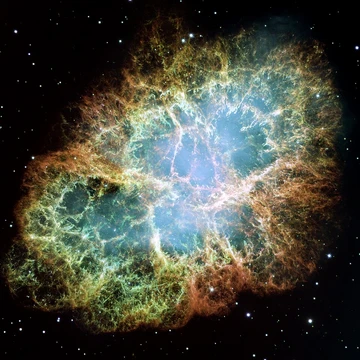
Supernova remnant
Expanding structures from stellar explosions, key sources of cosmic rays.
Last updated
When a star explodes as a supernova, it leaves behind a supernova remnant (SNR). This structure is defined by an expanding shock wave that pushes outward, carrying both the material blasted off the star and the interstellar gas it plows into and heats along the way.
Two main events can trigger a supernova: a massive star exhausts its nuclear fuel, collapses under its own gravity, and forms either a neutron star or a black hole; or a white dwarf pulls matter from a companion star until it reaches a critical mass and ignites a carbon explosion. In either case, the explosion hurls stellar material outward at speeds up to 10% the speed of light—roughly 30,000 kilometers per second—while a powerful shock wave forms ahead of the ejecta, heating the surrounding plasma to millions of degrees Kelvin. This shock gradually slows as it sweeps up more material, but it can continue expanding for hundreds or thousands of years, covering tens of parsecs, until its speed drops below the local speed of sound.
One of the most well-studied young remnants came from SN 1987A, a supernova spotted in February 1987 in the Large Magellanic Cloud. Other famous remnants include the Crab Nebula; Tycho, the remnant of SN 1572, named after Tycho Brahe who recorded its brightness; and Kepler, the remnant of SN 1604, named after Johannes Kepler. The youngest known remnant in the Milky Way is G1.9+0.3, found in the Galactic Center.
An SNR evolves through several stages. First comes free expansion of the ejecta, lasting tens to a few hundred years, until the ejected material has swept up its own weight in circumstellar or interstellar gas. Next, a shell of shocked gas forms, marking the Sedov-Taylor phase, which can be modeled with a self-similar analytic solution; strong X-ray emission reveals the hot, shocked gas and powerful shock waves.
Then the shell cools into a thin, dense layer—less than one parsec thick, with 1 to 100 million atoms per cubic meter—surrounding a hot interior of a few million Kelvin. This is the pressure-driven snowplow phase, visible in optical light from recombining ionized hydrogen and oxygen. Later, the interior cools, and the dense shell continues expanding on its own momentum, best seen in radio emissions from neutral hydrogen.
Quick Facts
- Expansion velocity
- up to 30,000 km/s (10% the speed of light)
- Temperature
- well above millions of K
- Notable examples
- Crab Nebula (SN 1054)
- SN 1987A
- Tycho (SN 1572)
- Kepler (SN 1604)
Facts from the source article.
Lore & Background
A supernova remnant passes through several stages as it expands. Initially, the ejecta expand freely until they sweep up their own weight in circumstellar or interstellar medium, lasting tens to a few hundred years.
This is followed by the Sedov-Taylor phase, where a shell of shocked gas forms and strong X-ray emission traces the hot shocked gas. The shell then cools into a thin, dense structure surrounding a hot interior, visible in optical emission from recombining hydrogen and oxygen. Finally, the interior cools and the remnant merges with the surrounding interstellar medium after roughly 30,000 years.
There are three types of supernova remnants: shell-like (e.g., Cassiopeia A), composite (a shell containing a central pulsar wind nebula, e.g., G11.2-0.3), and mixed-morphology (thermal composite) remnants, which show central thermal X-ray emission enclosed by a radio shell (e.g., W28 and W44). Remnants requiring significantly higher ejection energies than a standard supernova are called hypernova remnants.
The connection between cosmic rays and supernovas was first suggested by Walter Baade and Fritz Zwicky in 1934. Vitaly Ginzburg and Sergei Syrovatskii in 1964 noted that if the efficiency of cosmic ray acceleration in supernova remnants is about 10 percent, the cosmic ray losses of the Milky Way are compensated. This hypothesis is supported by shock wave acceleration, based on Enrico Fermi's ideas. Fermi proposed a model in 1949 for cosmic ray acceleration through particle collisions with magnetic clouds (second order Fermi mechanism), and a later model involved a powerful shock front (first order Fermi mechanism).
Reader's Guide
Supernova remnants are significant as the primary suspected source of galactic cosmic rays, a connection first proposed by Baade and Zwicky in 1934. The hypothesis that remnants accelerate cosmic rays with about 10 percent efficiency, compensating the Milky Way's cosmic ray losses, was advanced by Ginzburg and Syrovatskii in 1964. This is supported by the mechanism of shock wave acceleration, building on Fermi's ideas from 1949. Observations of the SN 1006 remnant in X-rays have shown synchrotron emission consistent with it being a source of cosmic rays.
However, for energies higher than about 10^18 eV, a different mechanism is required, as supernova remnants cannot provide sufficient energy. It remains unclear whether supernova remnants accelerate cosmic rays up to PeV energies; the future Cherenkov Telescope Array (CTA) will help answer this question. The study of supernova remnants also provides insight into stellar evolution, nucleosynthesis, and the dynamics of interstellar medium.
Frequently Asked Questions
How fast do supernova remnants expand, and how hot do they get?
The leading shock front can reach velocities as high as 30,000 km/s, roughly one-tenth the speed of light. The material caught in that shock is compressed to temperatures well above several million kelvin, making these structures brilliant X-ray sources.
Which supernova remnants are the most well-known among fans?
The Crab Nebula (from the 1054 event), the Tycho and Kepler remnants (from 1572 and 1604), and the still-studying SN 1987A shell are the go-to examples most enthusiasts reference. Each one offers a different window into how an explosion's aftermath evolves over centuries.
More in Supernova Remnants
Sources
Compiled from Wikipedia and the sources listed below. Text from Wikipedia is available under CC BY-SA 4.0; this entry is adapted from it.
- Wikipedia: Supernova remnant (CC BY-SA 4.0).
- Word definitions: the Codexery glossary, each quoted from its Wikipedia article.
Spotted an error? Know more?
Reader corrections go straight into our review queue. Suggest an edit · How this site is sourced