Crab Nebula
Supernova remnant and pulsar wind nebula in Taurus.

via Wikipedia: Crab Nebula · see source
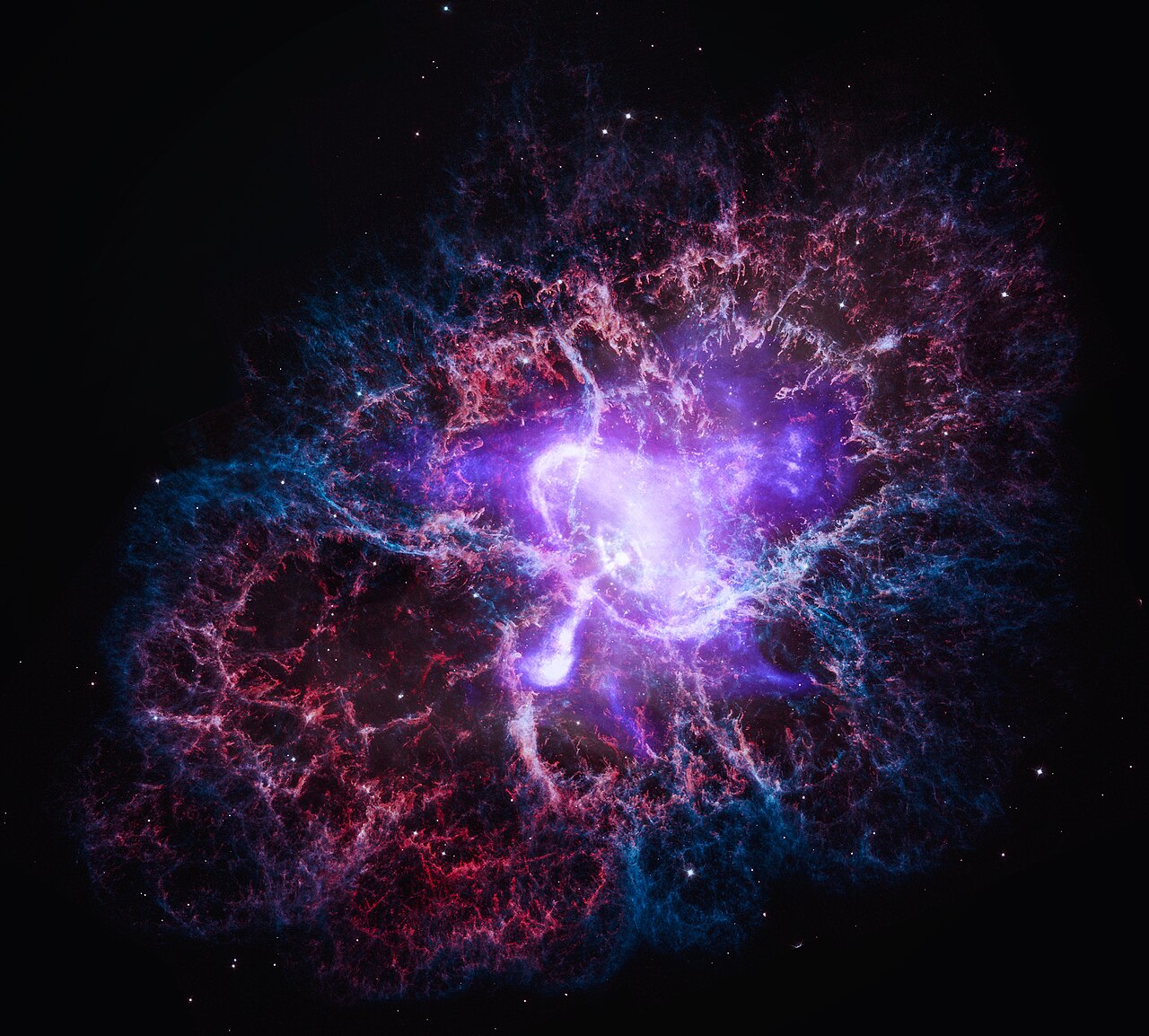
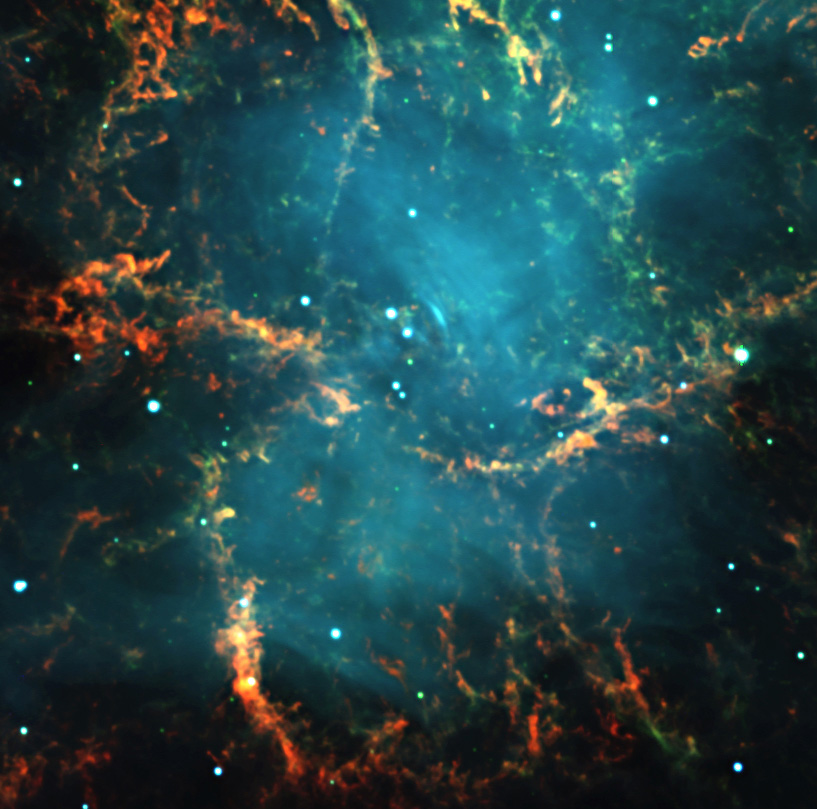
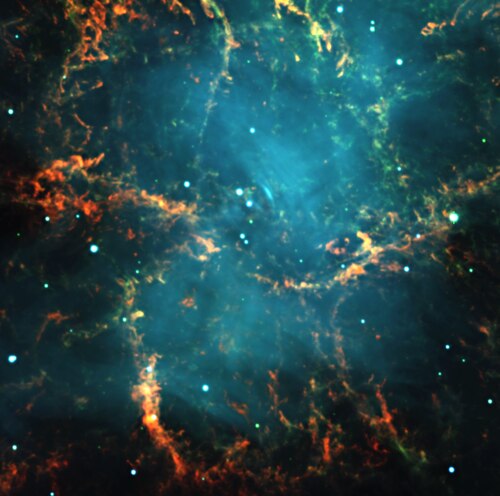
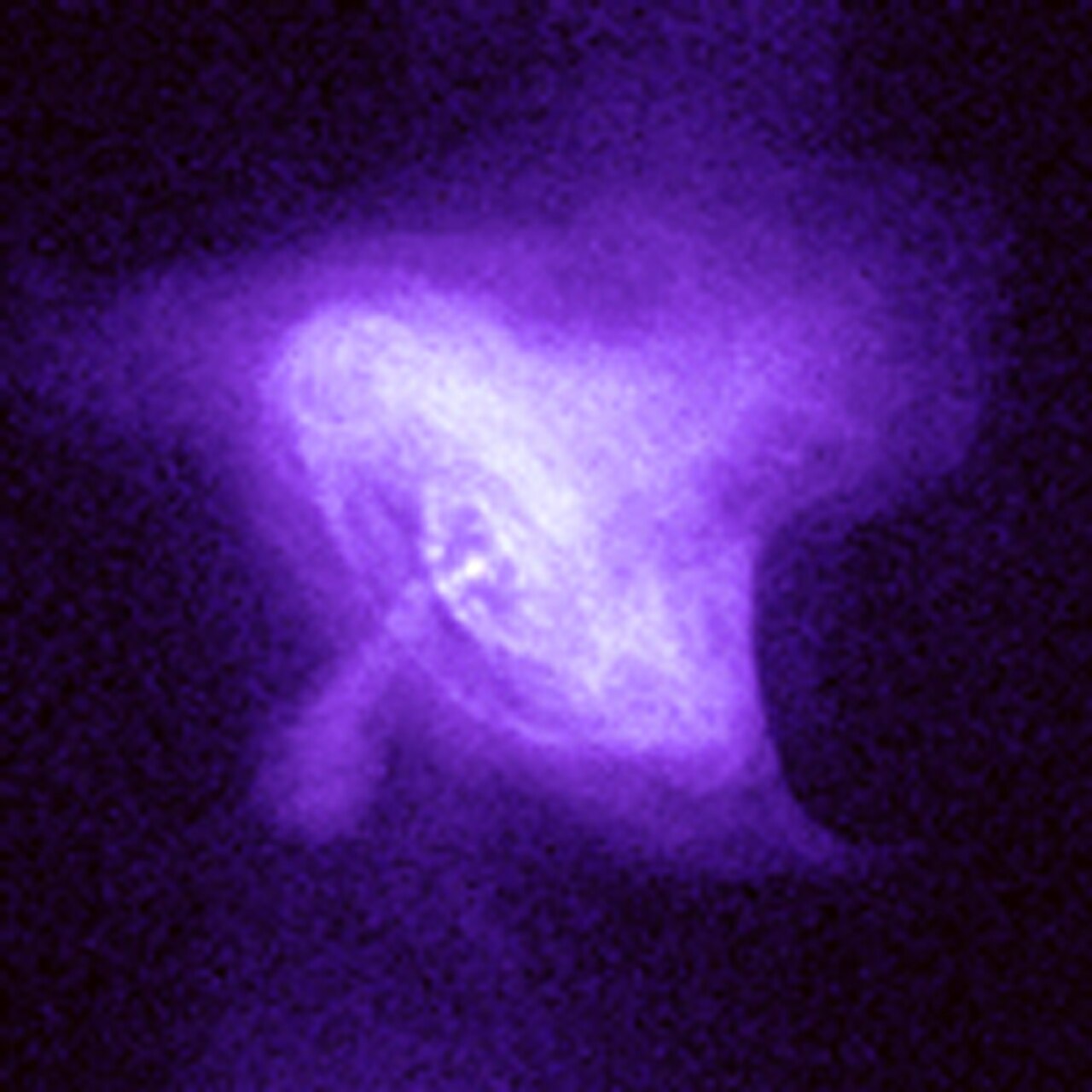
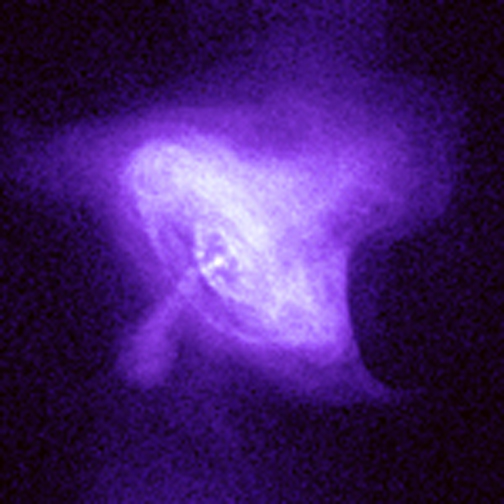
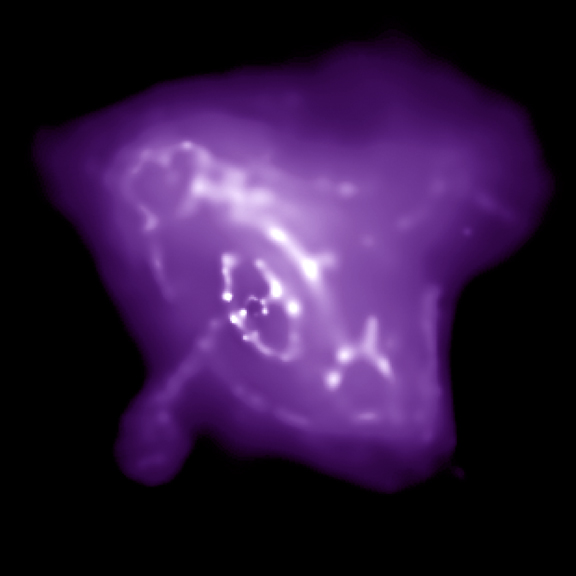
The Crab Nebula, also known as M1, NGC 1952, or Taurus A, is a supernova remnant and pulsar wind nebula located in the constellation Taurus. Its name comes from a sketch made by William Parsons, the 3rd Earl of Rosse, in 1842 or 1843 using a 36-inch telescope; the drawing showed a shape with arms that reminded him of a crab. English astronomer John Bevis first spotted the nebula in 1731. It matches a brilliant supernova witnessed in AD 1054 by Mayan, Japanese, and Arab observers, and recorded by Chinese astronomers as a "guest star." This was the first time astronomers linked a known nebula to a supernova seen in history.
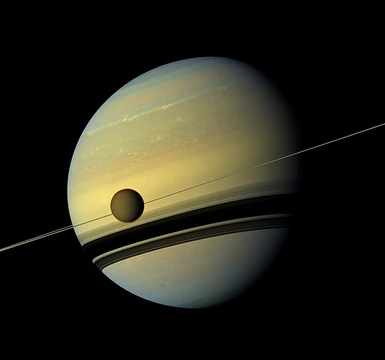
With an apparent magnitude of 8.4—similar to Saturn's moon Titan—the Crab Nebula is too dim for the naked eye but can be seen through binoculars under good conditions. It sits in the Perseus Arm of the Milky Way, roughly 2.0 kiloparsecs (6,500 light-years) from Earth. Its diameter is about 3.4 parsecs (11 light-years), which appears as roughly 7 arcminutes across, and it expands at around 1,500 kilometers per second (930 miles per second), or 0.5% of the speed of light.
At the nebula's center lies the Crab Pulsar, a neutron star 28–30 kilometers (17–19 miles) across that spins 30.2 times per second. This star emits pulses of radiation from gamma rays to radio waves. Above 30 keV in X-ray and gamma-ray energies, the Crab Nebula is usually the brightest persistent gamma-ray source in the sky, with measured flux extending beyond 10 TeV. Its radiation allows detailed study of objects that pass in front of it. In the 1950s and 1960s, astronomers mapped the Sun's corona by observing how the nebula's radio waves traveled through it, and in 2003, the thickness of Titan's atmosphere was measured as it blocked X-rays from the nebula.
The earliest records of the supernova itself come from Chinese and Japanese observers in 1054. Modern understanding that the Crab Nebula resulted from that supernova began in 1921, when Carl Otto Lampland noticed changes in the nebula's structure. This eventually led to the conclusion that the nebula's creation matched the bright SN 1054 event.
John Bevis first identified the nebula in 1731. It was rediscovered independently in 1758 by Charles Messier while he was searching for a bright comet. Messier catalogued it as the first entry in his list of comet-like objects. In 1757, Alexis Clairaut had recalculated Halley's Comet's orbit, predicting its return in late 1758. While searching for that comet, Messier found the Crab Nebula, initially mistaking it for Halley's Comet. After noticing the object didn't move across the sky, he realized it wasn't a comet, which inspired him to compile a catalogue of fixed, cloudy objects to avoid future confusion. William Herschel observed the nebula many times between 1783 and 1809, though it's unclear if he discovered it independently or knew of it earlier; he concluded it was made of a group of stars. William Parsons, using a 36-inch telescope at Birr Castle in the early 1840s, drew the nebula with crab-like arms. When he observed it again in 1848 with a 72-inch telescope, he couldn't confirm the resemblance, but the name had already stuck.
The Crab Nebula was the first astronomical object recognized as connected to a supernova. In the early 20th century, comparing photographs taken years apart showed the nebula was expanding. Tracing that expansion backward suggested it became visible on Earth about 900 years earlier. Historical records then revealed that a new star bright enough to see in daylight had been recorded in the same part of the sky by Chinese astronomers on July 4, 1054, and likely by Japanese observers as well. In 1913, Vesto Slipher studied the nebula's spectrum. Carl Lampland found changes in the cloud in 1921, and that same year John Charles Duncan proved the remnant was expanding, while Knut Lundmark noted its proximity to the 1054 guest star. In 1928, Edwin Hubble proposed linking the cloud to that star, an idea that remained debated until supernovae were better understood. Nicholas Mayall later confirmed that the 1054 star was indeed the supernova that created the Crab Nebula. This sparked a search for other historical supernovae, leading to seven more matches between modern remnants and ancient records. In 1934, connections were also made to a 13th-century Japanese reference to a "guest star" in the Meigetsuki.
- discovered_by
- John Bevis (1731)
- constellation
- Taurus
- distance_from_earth
- about 2.0 kiloparsecs (6,500 ly)
- diameter
- 3.4 parsecs (11 ly)
- apparent_magnitude
- 8.4
- central_object
- Crab Pulsar (neutron star, 28–30 km across, spin rate 30.2 times per second)
- associated_supernova
- SN 1054 (observed in AD 1054)
Verified Timeline
Lore & Background
The Crab Nebula was first identified in 1731 by John Bevis. It was independently rediscovered in 1758 by Charles Messier as he was observing a bright comet; Messier catalogued it as the first entry in his catalogue of comet-like objects. William Parsons, 3rd Earl of Rosse, observed the nebula at Birr Castle in the early 1840s using a 36-inch telescope and made a drawing that showed it with arms like those of a crab. He observed it again later, in 1848, using a 72-inch telescope but could not confirm the supposed resemblance, though the name stuck. In the early twentieth century, analysis of early photographs taken several years apart revealed that the nebula was expanding. Tracing the expansion back revealed that the nebula must have become visible on Earth about 900 years before. Historical records revealed that a new star bright enough to be seen in the daytime had been recorded in the same part of the sky by Chinese astronomers on 4 July 1054, and probably also by Japanese observers. In 1928, Edwin Hubble proposed associating the cloud with the star of 1054, an idea that remained controversial until the nature of supernovae was understood. Nicholas Mayall indicated that the star of 1054 was undoubtedly the supernova whose explosion produced the Crab Nebula.
Reader's Guide
The Crab Nebula holds a central place in astronomy as the first astronomical object recognized as being connected to a supernova explosion. Its identification with the supernova of 1054, recorded by Chinese, Japanese, Arab, and Mayan observers, provided a crucial link between historical records and modern astrophysical phenomena. The discovery of the Crab Pulsar in 1968, with its precise age known almost to the day, allowed verification of basic physical properties of neutron stars, such as characteristic age and spin-down luminosity. The nebula's radiation allows detailed study of celestial bodies that occult it; for example, in the 1950s and 1960s the Sun's corona was mapped from observations of the Crab Nebula's radio waves passing through it, and in 2003 the thickness of the atmosphere of Saturn's moon Titan was measured as it blocked out X-rays from the nebula. At X-ray and gamma ray energies above 30 keV, the Crab Nebula is generally the brightest persistent gamma-ray source in the sky. The role of this supernova to the scientific understanding of supernova remnants was crucial, as no other historical supernova created a pulsar whose precise age is known for certain.
Did You Know?
- The Crab Nebula was the first astronomical object identified that corresponds with a historically-observed supernova explosion.
- The Crab Pulsar spins at 30.2 times per second and is 28–30 kilometres across.
- In 2003, the thickness of the atmosphere of Saturn's moon Titan was measured as it blocked out X-rays from the Crab Nebula.
- The supernova that created the Crab Nebula was visible to the naked eye for about two years after its first observation.
- The Crab Nebula was the first astrophysical object confirmed to emit gamma rays in the very-high-energy band above 100 GeV, detected in 1989 by the Whipple Observatory.
From Comet-Hunter to Crab: The Long Road to a Name
The nebula first entered Western astronomical records in 1731, when English observer John Bevis noted its presence in the sky. Two decades later, Charles Messier stumbled upon it by accident while scanning the constellation Taurus for the long-awaited return of Halley's Comet. Initially mistaking the faint smudge for the comet itself, Messier grew suspicious when the object refused to shift position against the background stars. That moment of confusion proved productive: it inspired him to compile a catalogue of fixed, cloud-like objects that comet hunters might otherwise misidentify, and the nebula became the very first entry in that list. William Herschel returned to the target repeatedly between 1783 and 1809, ultimately concluding it was a cluster of stars. The name, however, arrived in the early 1840s. At Birr Castle, William Parsons, the 3rd Earl of Rosse, peered through his 36-inch telescope and sketched the nebula with what he perceived as crab-like arms. A follow-up observation in 1848 with a larger 72-inch instrument failed to confirm the resemblance, yet the evocative label endured and remains in use today.
The Guest Star of 1054: Linking Ancient Sky-Watching to Modern Physics
On 4 July 1054, Chinese astronomers recorded a brilliant new star visible even in daytime, an event also noted by Japanese observers in the Meigetsuki and later traced to a 13th-century Baghdad manuscript by the Nestorian physician Ibn Butlan. For nearly nine centuries, that guest star remained a curiosity in historical texts. The scientific breakthrough came in the early 1900s, when analysis of photographs taken years apart revealed the nebula was steadily growing. Carl Otto Lampland spotted structural changes in 1921, John Charles Duncan demonstrated the expansion quantitatively, and Knut Lundmark pointed out the remnant's proximity to the recorded 1054 event. Edwin Hubble formally proposed the link in 1928, though the idea stayed contested until the physics of supernovae was better understood. Nicholas Mayall ultimately settled the matter, declaring the 1054 star to be the exploding progenitor. This identification made the Crab Nebula the first object ever confirmed as the aftermath of a witnessed supernova, and it launched a broader search that has since uncovered seven additional historical supernova remnants.
A Racing Neutron Star at the Heart of an Expanding Shell
At the precise center of the Crab Nebula spins the Crab Pulsar, a neutron star barely 28 to 30 kilometres across that completes a full rotation 30.2 times every second. This compact remnant blasts out rhythmic pulses of electromagnetic radiation spanning the entire spectrum, from the longest radio waves all the way up to the most energetic gamma rays. The surrounding nebula itself spans roughly 3.4 parsecs, or about 11 light-years, and is still flinging material outward at approximately 1,500 kilometres per second—half a percent of the speed of light. Situated in the Perseus Arm of the Milky Way at a distance of roughly 2.0 kiloparsecs (6,500 light-years), the object presents an apparent size of about seven arcminutes. Its apparent magnitude of 8.4, roughly matching that of Saturn's moon Titan, places it just beyond naked-eye visibility, though a pair of binoculars under favourable dark skies can reveal its faint glow. In the high-energy regime the nebula earns special distinction: above 30 keV in X-ray and gamma-ray energies it is generally the brightest persistent source in the entire sky, with detected flux stretching past 10 TeV.
A Natural Beacon for Probing Distant Atmospheres
Because the Crab Nebula radiates steadily across so many wavelengths, it has served as an invaluable natural beacon for testing how intervening matter absorbs or distorts its light. In the 1950s and 1960s, radio astronomers exploited the nebula's persistent radio emissions to map the structure of the Sun's corona: as the radio waves passed through the solar atmosphere on their way to Earth, the resulting distortions revealed details about the corona that were otherwise extremely difficult to measure. Decades later, in 2003, the same principle was applied to a much more distant target. When Saturn's moon Titan drifted in front of the nebula, it blocked a portion of the X-ray flux, and by measuring exactly how much radiation was absorbed, researchers determined the thickness of Titan's atmosphere. The nebula's steady, well-known output also makes it a practical reference for instruments across the spectrum, a role it has played since Vesto Slipher included it in his 1913 spectroscopic survey of the sky.
Gallery
Frequently Asked Questions
What is the Crab Nebula?
The Crab Nebula is a glowing shell of gas and dust left behind by a massive star that exploded roughly 970 years ago. It sits in the constellation Taurus and carries several catalogue numbers, including M1 and NGC 1952.
Who first spotted the Crab Nebula?
English astronomer John Bevis was the first to record the nebula in 1731, though Charles Messier independently found it again two decades later in 1758. It is the very first entry in Messier's famous catalogue.
What's spinning at the heart of the Crab Nebula?
A neutron star called the Crab Pulsar sits at the center, only about 28–30 kilometres wide yet rotating more than thirty times every second. Its rapid spin and intense magnetic field power the glowing wind nebula that surrounds it.
How big and how far away is the Crab Nebula?
The nebula spans roughly 3.4 parsecs (about 11 light-years) in diameter and lies approximately 6,500 light-years from Earth. To the naked eye it appears as a faint smudge with an apparent magnitude of 8.4.
Why does the Crab Nebula matter to astronomy?
It was the first object ever linked to a supernova recorded in human history—the brilliant outburst seen by Chinese and Japanese observers in 1054 AD. Because of that connection, it became a cornerstone for understanding how massive stars die and what remains after the explosion.
More in Astronomy 1-24
Spotted an error? Know more?
This is a living reference — every entry is fact-audited, and reader corrections feed straight into our audit queue. Suggest an edit · See this site's audit record