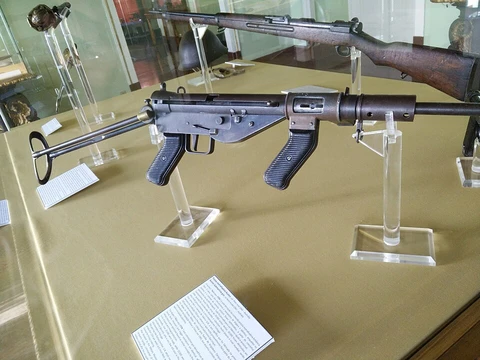
Franchi LF-57
Italian pressed-metal submachine gun with a folding stock.

The Franchi LF-57 is a 9×19mm Parabellum submachine gun made by the Italian firm Luigi Franchi. Its construction relies heavily on pressed metal, and it shares several design features with the Beretta Model 12, a competing Italian design.
Development began in 1956, and production started the following year. The Italian Army received 13,500 units, including deliveries to the 13th "Aquileia" Target Acquisition Group of the 3rd Missile Brigade in Portogruaro. In 1962, the weapon was issued to the Italian Navy's COMSUBIN but was soon replaced by the Beretta PM 12. The Heckler & Koch MP5 later replaced it in Italian Army service. The Portuguese Army bought 10,000 copies, using them in conflicts in Angola, Guinea-Bissau, Mozambique, and the Democratic Republic of Congo shortly after that country's independence from Belgium. Production continued until 1980, with 30,000 examples built for foreign markets, as the design saw little success within Italy’s own military and law enforcement.
The LF-57 uses a recessed bolt head similar to the Beretta Model 12’s to shorten the weapon, but the bolt’s mass sits above the barrel rather than wrapping around it, simplifying manufacture. Most parts are stampings and pressings; the two sides of the receiver are each a single piece joined by a long seam. The barrel is held by a single nut, making removal straightforward. The tubular butt folds to the right side of the receiver, and the pistol grip is all steel. Sights are simple fixtures atop the barrel.
Users included Angola, Congo-Brazzaville, the Democratic Republic of Congo (formerly Zaire), Katanga, the Front for Congolese National Liberation, Italy, Portugal, Mozambique, and Nigeria. The non-state group Anyanya also used it.
Quick Facts
- Origin
- Italy
- Is Ranged
- yes
- Service
- 1962–present
- Wars
- Congo Crisis / Portuguese Colonial War / Nigerian Civil War
- Designer
- Luigi Franchi
- Manufacturer
- Franchi
- Production Date
- 1956 or 1957-c.1980
- Variants
- LF-62
- Weight
- 3,17 kg (7 lb)
- Length
- 419 mm (16.50 in) butt folded, 686 mm (27 in.) butt extended
- Part Length
- 203 mm (8 in.)
- Caliber
- 9×19mm Parabellum
Facts from the source article.
Lore & Background
Development of the LF-57 began at Franchi in 1956, and production started the following year. The weapon shares many design features with the Beretta Model 12, which was considered a rival design. The LF-57 is mainly constructed of pressed metal, with most parts made from stampings and pressings; the two sides of the receiver are each one piece joined by a long seam. The bolt uses a recessed bolt head similar to the Beretta Model 12 to reduce overall length, but the bolt's mass is carried above the barrel rather than around it, simplifying manufacture. The barrel is held by a single barrel nut, making removal straightforward. The tubular butt folds to the right side of the receiver, and the pistol grip is entirely steel. Sights are simple fixtures on top of the barrel.
A total of 13,500 units were delivered to the Italian Army, including the 13th "Aquileia" Target Acquisition Group of the 3rd Missile Brigade "Aquileia" of Portogruaro. In 1962, the weapon was supplied to the COMSUBIN of the Italian Navy, but was shortly afterwards replaced by the Beretta PM 12. The Heckler & Koch MP5 later replaced the LF-57 in the Italian Army. The Portuguese Army purchased 10,000 copies, using them in wars in Angola, Guinea-Bissau, Mozambique, and the Democratic Republic of Congo in the years immediately following independence from Belgium. Production continued until 1980, with a total of 30,000 examples built for the foreign market, as the weapon was unsuccessful within domestic Italian military and law-enforcement markets.
Reader's Guide
The Franchi LF-57 occupies a modest but distinct place in submachine gun history as an Italian design that saw more success abroad than at home. Its pressed-metal construction and simplified manufacturing—using stampings and a one-piece receiver side—reflected mid-20th-century trends toward cost-effective mass production. The recessed bolt head, borrowed conceptually from the Beretta Model 12, allowed a compact package, though the LF-57 positioned the bolt mass above the barrel rather than around it, a unique arrangement that eased fabrication. Despite these innovations, the LF-57 failed to gain lasting domestic acceptance; it was quickly replaced in Italian service by the Beretta PM 12 and later the Heckler & Koch MP5. Its primary legacy lies in foreign sales: 10,000 units to Portugal saw extensive use in colonial and post-colonial conflicts in Africa, and the weapon was also fielded by various African states and non-state actors such as the Anyanya. With 30,000 examples produced for export by 1980, the LF-57 remains a footnote in Italian arms development, remembered more for its export role than for any domestic impact.
More in Submachine Guns, Part 3 1-16
Spotted an error? Know more?
Reader corrections go straight into our review queue. Suggest an edit · How this site is sourced