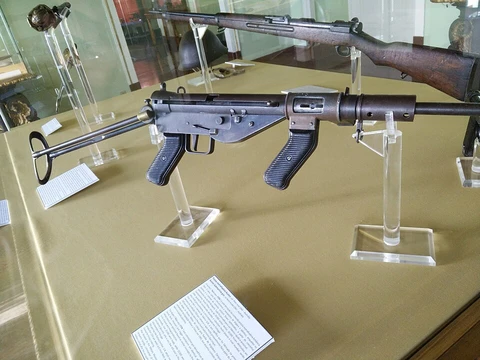
Floro MK-9
A low-cost Philippine submachine gun with Uzi magazine compatibility.

The Floro MK-9 is a submachine gun that was designed and previously built by Floro International Corporation (FIC). It was aimed at local security forces as an inexpensive option compared to foreign-made submachine guns.
In March 1996, Gregory Floro approached the Philippine Army to test FIC’s small arms under the Self-Reliance Defense Posture program. Two MK-9s were tested and reportedly met the requirements for a 9mm submachine gun. The first 75 units were delivered in two batches on October 6 and 7, 1997. In April 1998, the Armed Forces of the Philippines’ Research and Development Center asked FIC to modify the MK-9s with a heavier buffer assembly. Sixty-five of them were returned to FIC for reworking and resubmitted in September 1998. In August 2000, the AFP told FIC those 65 MK-9s did not meet requirements, but FIC offered to rework them again, and they were redelivered in January 2001. Ten additional MK-9s were provided at no extra cost to replace units given to the AFP Office of the Chief of Staff Security Group in 1997. A memo from the Department of the Interior and Local Government noted the MK-9 as a weapon that could be recovered from ex-rebels and militiamen under a firearms amnesty.
In 1997, the MK-9 was reportedly sold to the AFP under a contract worth P1,500,000 for 75 units, which were later found allegedly defective. A case was filed in the Sandiganbayan under the Anti-Graft and Corrupt Practices Act on September 27, 2004. The court cleared Major Jose L. Barao Jr., Captain Henry G. Valeroso, and FIC president Victorino R. Floro on April 27, 2018. Colonel Artemio C. Cacal was cleared after his death. The Sandiganbayan ruled that prosecutors failed to prove the contract caused undue injury or gave Victorino improper benefits.
The MK-9 is a blowback-operated weapon made from steel, chambered for the 9×19mm Parabellum cartridge. It has a black phosphate reflective finish, while the pistol grip is molded black matte polymer. FIC dropped plans for a wooden buttstock. The gun fires from a closed bolt and has a selector switch for semi-automatic or full-automatic fire. The upper receiver is a steel tube, and the barrel is held by a perforated barrel jacket. A suppressor can be attached. The lower receiver and magazine housing are sheet metal. The extended magazine well includes a plastic hand guard that also serves as a forward grip.
Quick Facts
- Origin
- Philippines
- Is Ranged
- yes
- Service
- 1997–Present
- Wars
- Civil conflict in the Philippines
- Designer
- Floro International Corporation
- Production Date
- Estimated to be 1990s
- Weight
- 3.18 kg (Empty, MK-9) / 2.55 kg (Empty, MP-9) / 3.2 kg (With Magazine)
- Length
- 64.5 cmThe official MK-9 webpage erroneously reported the measurement as 64.5mm. (Stock extended, MK-9) / 65 cm (Stock extended, MP-9)
- Part Length
- 46 cm (Stock folded, MK-9) / 46.5 cm (Stock folded, MP-9)
- Cartridge
- 9×19mm Parabellum
- Action
- blowback, closed bolt
- Rate
- 800-850 rounds/min
Facts from the source article.
Lore & Background
The MK-9 was developed by Floro International Corporation (FIC) and tested by the Philippine Army in March 1996 as part of the Self-Reliance Defense Posture program. Two MK-9s reportedly passed the requirement for a 9mm submachine gun. Seventy-five units were delivered in two batches on October 6 and 7, 1997. In April 1998, the Armed Forces of the Philippines' Research and Development Center requested a rework with a heavy buffer assembly; 65 MK-9s were returned to FIC for this modification and resubmitted in September 1998. In August 2000, the AFP informed FIC that the 65 MK-9s failed requirements, but FIC offered to rework them, and they were redelivered in January 2001. Ten additional MK-9s were provided at no extra charge to replace units supplied to the AFP Office of the Chief of Staff Security Group in 1997.
The MK-9 is a blowback-operated weapon made from steel. The upper receiver is a steel tube, and the barrel is held in place by a perforated barrel jacket. The lower receiver and magazine housing are sheet metal, with an extended magazine well that doubles as a forward grip. It uses the firing mechanism of the M16. The cocking handle is on the left side of the upper receiver and incorporates a dust cover. A Picatinny rail on the upper receiver allows mounting of telescopic and red dot sights. A suppressor can be used when needed. The basic version has a collapsible stock; a shortened variant, the MP-9, has a skeletal folding stock and no barrel jacket.
The MK-9 was reportedly sold to the AFP in 1997 under a P1,500,000.00 contract. A corruption case was filed under the Anti-Graft and Corrupt Practices Act on September 27, 2004, alleging the 75 MK-9s were defective. The Sandiganbayan cleared Major Jose L. Barao Jr., Captain Henry G. Valeroso, and Victorino R. Floro on April 27, 2018, ruling that prosecutors did not prove undue injuries or benefits. Colonel Artemio C. Cacal was cleared posthumously.
Reader's Guide
The Floro MK-9 represents an attempt by a Philippine manufacturer to provide a domestically produced, low-cost submachine gun for local security forces. Its design borrows the Uzi magazine interface and the M16 firing mechanism, reflecting a pragmatic approach to using proven components. The weapon's history is marked by a protracted evaluation and rework process with the Armed Forces of the Philippines, spanning from 1996 to 2001, and a subsequent corruption case that ultimately resulted in acquittals. The MK-9 saw limited adoption: the Philippine Navy ordered around 100 units for the Naval Special Operations Command, and the Philippine Marine Corps tested it for military police, armored vehicle crews, and counter-terrorist units. It was formerly used by the Anti-Crime Task Force and the Armed Forces of the Philippines. The Department of the Interior and Local Government documented the MK-9 as a potential recovery item from ex-rebels and militiamen under firearms amnesty. The weapon's significance lies in its role as a locally made alternative in a market dominated by imports, though its troubled procurement and legal issues highlight the challenges of domestic small-arms production in the Philippines.
Did You Know?
- The MK-9 uses the firing mechanism of the M16.
- It accepts 25- or 30-round Uzi magazines.
- The Sandiganbayan cleared all accused in a 2004 graft case related to the MK-9 contract in 2018.
More in Submachine Guns, Part 3 1-16
Spotted an error? Know more?
Reader corrections go straight into our review queue. Suggest an edit · How this site is sourced