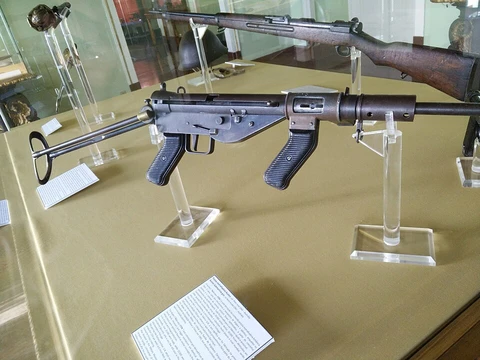
FBP submachine gun
Portuguese submachine gun combining MP40 and M3 features.

The FBP is a 9 mm submachine gun whose design originated in 1940 with Gonçalves Cardoso, a Portuguese Army artillery officer. Development stopped due to World War II, but the weapon was later revised and entered production in 1948. It was manufactured at the Fábrica de Braço de Prata in Lisbon, and its initials gave the gun its name; the Portuguese military adopted it as the m/948 that same year. The design borrowed the large bolt and telescoping operating spring from the German MP40, and the collapsible wire stock from the American M3. An unusual feature was a barrel sleeve with a mount for the standard Portuguese Mauser bayonet. The original m/948 fired only on full automatic. An upgraded m/963 version, introduced in 1961, added a semi-automatic fire mode. The weapon was mainly issued to officers and non-commissioned officers in Portugal’s armed forces and security forces, alongside stocks of ex-German MP34s. It saw combat in Angola, Portuguese Guinea, Mozambique, Portuguese India, and Portuguese Timor. It was eventually replaced by the 9 mm Uzi and a collapsible-stock variant of the standard m/961 G3 rifle. In 1976, Major Engenheiro Mário Tavares led a team at Fábrica Militar de Braço de Prata in developing a modernized version with a barrel cooling sleeve, but it never reached production. Users included Portugal, Angola, and East Timor (where FALINTIL used it, and some were later inherited by the Timor-Leste Defence Force).
Quick Facts
- Origin
- Portugal
- Is Ranged
- yes
- Service
- 1948-1980s
- Wars
- Portuguese Colonial War / East Timorese civil war / Indonesian occupation of East Timor
- Designer
- Major Francisco Gonçalves Cardoso
- Design Date
- 1948 (production model)
- Manufacturer
- Fábrica de Braço de Prata (FBP)
- Production Date
- 1948-1955 (FBP m/948) / 1961-1980 (later models)
- Variants
- m/948, m/963 and m/976
- Weight
- 3.77 kg
- Length
- 807 mm
- Cartridge
- 9×19mm Parabellum
Facts from the source article.
Lore & Background
The FBP submachine gun utilized the large bolt and telescoping operating spring of the German MP40 submachine gun, and the collapsible wire stock of the American M3 submachine gun. Unusual for submachine guns, the m/948 was fitted with a barrel sleeve with a mount to accept the standard Portuguese Mauser bayonet. The original version only allowed for fully automatic fire; an upgraded version designated FBP m/963, introduced in 1961, also allowed for semi-automatic fire.
The weapon was primarily issued to officers and NCOs in the Portuguese Armed Forces and security forces, along with quantities of ex-German MP 34 submachine guns. In Portuguese service it was used in combat in Angola, Portuguese Guinea, Mozambique, Portuguese India and Portuguese Timor. It was eventually replaced in service by the 9 mm Uzi and the collapsible-stock version of the standard m/961 G3 rifle.
In 1976 Fábrica Militar de Braço de Prata, led by Major Engenheiro Mário Tavares, developed a modernized version of the FBP with a barrel cooling sleeve, but it never entered production. Users included Portugal, Angola, and East Timor, where it was used by the FALINTIL and some were inherited by the Timor-Leste Defence Force.
Reader's Guide
The FBP submachine gun represents a notable example of mid-20th-century Portuguese small arms design, blending features from two prominent World War II-era weapons: the German MP40 and the American M3. Its adoption in 1948 as the m/948 provided Portuguese forces with a domestically produced submachine gun that saw extensive service across Portugal's colonial territories, including Angola, Mozambique, and Portuguese India. The weapon's unusual bayonet mount, accepting the standard Portuguese Mauser bayonet, reflected a design philosophy that valued versatility in close-quarters combat. The introduction of the m/963 variant in 1961 added semi-automatic fire capability, adapting the weapon to evolving tactical needs. Despite its eventual replacement by the Uzi and the collapsible-stock G3 rifle, the FBP remained in use with Portuguese security forces and saw continued service in East Timor with the FALINTIL and later the Timor-Leste Defence Force. The 1976 modernization attempt, though never produced, indicates ongoing interest in the platform. The FBP's legacy is tied to the Portuguese Colonial Wars and the broader history of Portuguese military procurement.
Did You Know?
- The FBP's design was first conceived in 1940 by Gonçalves Cardoso, an artillery officer in the Portuguese Army.
- It combined the bolt and spring of the German MP40 with the collapsible wire stock of the American M3.
- The m/948 variant had a barrel sleeve mount for a standard Portuguese Mauser bayonet.
- A modernized version with a barrel cooling sleeve was developed in 1976 but never entered production.
More in Submachine Guns, Part 3 1-16
Spotted an error? Know more?
Reader corrections go straight into our review queue. Suggest an edit · How this site is sourced