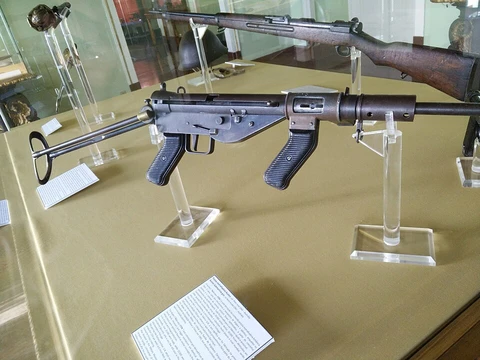
F1 submachine gun
Australian 9mm submachine gun with top-mounted magazine.

The F1 submachine gun, chambered in 9×19mm, was built by Australia’s Lithgow Small Arms Factory. It entered service with Australian soldiers in July 1963, taking over from the Owen machine carbine. Though its construction was straightforward and sturdy, featuring a magazine mounted on top like the Owen, it “never gained popularity with those using it.” During the Vietnam War, it was increasingly swapped out for the American M16A1 rifle. Australia retired the F1 in the early 1990s, replacing it with the F88C Austeyr, a local version of the Steyr AUG. Lithgow produced roughly 25,000 units between 1962 and 1973. While no longer in Australian service, a number of F1s were given to the Royal Papua New Guinea Constabulary.
The weapon operates on a simple blowback system, firing from an open bolt with a fixed firing pin. While under development, it was called the X3. Many of its features come from the British Sterling submachine gun. Unlike the Sterling or the Owen, the F1 has a removable wooden butt and a separate pistol grip. Its detachable, curved 34-round box magazine slots into a housing on top of the barrel—the same magazine used by the Sterling. This top-mounted design makes the gun easier to carry and use while lying prone, and it is less prone to jamming than a bottom-mounted magazine. The ejection port sits directly beneath the magazine, creating a hazard: if a user’s hand drifts back over the port, the forward-moving bolt can pinch the web of the hand. The butt-plate and pistol grip are identical to those on the L1A1 SLR, and the F1 can accept SLR bayonets, though it was usually fitted with a detachable bayonet mounted on the right side of the barrel jacket.
The trigger offers a two-stage pull: a half-pull gives semi-automatic fire, while pulling and holding it back produces full automatic. A safety catch, easily worked by the thumb, is included. A small guard sits forward of the ejection port to protect the forward hand. The cocking handle, located on the left side, lacks a tab and latches into the bolt, allowing it to be moved back and forth to clear fouling. The pistol grip and its internal parts came from the SLR L1A1 production line at Lithgow, as did the wooden butt, reducing the need for new tooling. Because the magazine is vertical, the sights are offset to the right, requiring the user to tilt their head slightly.
Quick Facts
- Origin
- Australia
- Is Ranged
- YES
- Service
- 1963–1991
- Wars
- Vietnam War / Sino-Vietnamese War
- Design Date
- 1962
- Manufacturer
- Lithgow Small Arms Factory
- Production Date
- 1963–1973
- Number
- 25,136
- Weight
- 3.7 kg (Empty) / 4.30 kg (Loaded)
- Length
- 714 mm
- Part Length
- 198 mm
- Cartridge
- 9×19mm Parabellum
Facts from the source article.
Lore & Background
The F1 was developed as the X3 and shares many design features with the British Sterling submachine gun. Unlike both the Sterling and its predecessor the Owen, the F1 has a removable wooden butt and pistol grip. A curved, detachable 34-round box magazine is inserted in a magazine housing on top of the barrel, similar to the earlier Owen gun. It used the same magazine as the Sterling. The top-mounted magazine is unobtrusive for carrying and when lying prone; it also benefits from being less likely to jam than a bottom-mounted magazine. The ejection port is directly under the magazine and provides a trap for the unwary user; should the user's hand stray back to the port, the bolt moving forwards will 'bite' the web of the hand. The butt-plate and pistol-grip are identical to those on the L1A1 SLR, as well as the capability of adapting SLR bayonets. However, it was mostly used with a detachable bayonet fitted on the right side of the barrel jacket.
The trigger is a two-stage pull, half back semi auto, pull and hold back gives full auto requiring a safety catch only easily operated by the thumb. There is a small guard fitted forward of the ejection port to protect the forward hand. The left-mounted cocking handle does not have a 'tab' on it. The cocking handle latches into the bolt that allows it to be worked forwards and backwards to clear fouling. The pistol grip with internal parts came from the production line of the SLR L1A1 rifle, at the Lithgow factory. The wooden butt also was from the SLR production line, reducing the amount of tooling. Because of the vertical magazine the sights of the F1 were offset to the right of the weapon requiring a slight head tilt to the right, the rear sight being a roughly triangular asymmetrical metal flap with a round aperture, the front sight being a blade mounted on the right side of the weapon's magazine well.
Although the F1 retained many of the Owen's features it did not continue to have a separate compartment inside the receiver, isolating the small-diameter bolt from its retracting handle, so it was no longer as resistant to jamming if dropped in mud. This is considered a major disadvantage in comparison to the Owen gun it replaced. That being said, the non-reciprocating charging handle blocks off the slot in the side of the receiver to prevent the ingress of dirt.
Reader's Guide
The F1 was produced in numbers of about 25,000 from 1962 to 1973 and served as the standard Australian submachine gun from its introduction in July 1963 until the early 1990s. In Vietnam it was later largely replaced by the US-made M16A1 rifle. The F1 was retired in the early 1990s and replaced by the F88C Austeyr, an Australian-built version of the Steyr AUG rifle. While no longer used by Australia, a shipment of F1s was donated to the Royal Papua New Guinea Constabulary. The weapon was also formerly used by the Royal Malaysian Police, and examples are now on display at the Police Museum. Its design, while robust and simple, never gained popularity with those using it. The F1's top-mounted magazine and shared components with the L1A1 SLR reduced tooling costs, but the loss of the Owen's mud-resistant bolt compartment was a noted drawback. The F1 remains a distinctive example of Australian small arms development, bridging the Owen gun and the later adoption of the bullpup F88C Austeyr.
Did You Know?
- The F1 was designated the X3 while under development.
- The F1 used the same magazine as the British Sterling submachine gun.
More in Submachine Guns, Part 3 1-16
Spotted an error? Know more?
Reader corrections go straight into our review queue. Suggest an edit · How this site is sourced