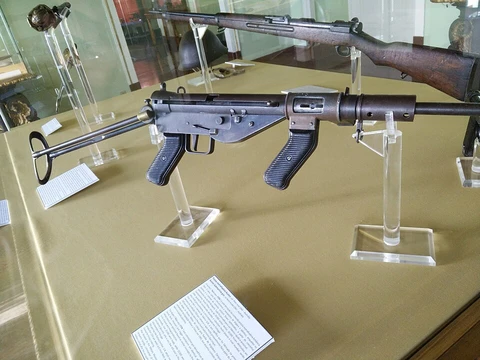
FNAB-43
Italian lever-delayed blowback submachine gun, 1943–1945.

The FNAB-43 is an Italian submachine gun designed and developed during World War II, manufactured from 1943 to 1945. It is notable for its complex lever-delayed blowback system and extensive use of milling and precision engineering, which made it an expensive weapon to produce. Approximately 1,000 were built by the Fabbrica Nazionale d'Armi di Brescia (FNA-B) and issued to German and Italian RSI units fighting in Northern Italy.
Quick Facts
- Origin
- Italian Social Republic
- Is Ranged
- yes
- Service
- 1943-1960s
- Used By
- Italian Social Republic / Italian Resistance / Nazi Germany / France / Algeria
- Wars
- World War II / Algerian War / Years of Lead
- Designer
- Francesco Scalori
- Design Date
- 1942
- Manufacturer
- Fabbrica Nazionale d'Armi di Brescia
- Production Date
- 1943–1945
- Number
- ~1,000
- Variants
- Tipo 1 (standard), Tipo 2 (made for German troops with some German markings on the side)
- Weight
- 3.9 kg (8 lbs. 12 oz.)
Facts from the source article.
Lore & Background
The FNAB-43 was designed and developed in Italy, with the first prototype built in 1942. Production ran from 1943 to 1945, yielding approximately 1,000 units. The weapon was issued to German and Italian RSI (Repubblica Sociale Italiana) units operating in Northern Italy. Its manufacture was expensive due to extensive milling and precision engineering.
The FNAB-43 employs a lever-delayed blowback system firing from a closed bolt. The bolt consists of two pieces with a pivoted lever between the bolt head and body. Upon firing, the bolt head retracts and rotates the lever, whose base rests against a lug in the receiver. This lever delays the opening movement until the bullet leaves the barrel and breech pressure drops. The lever then accelerates the bolt body rearward, and the entire bolt unit recoils as one piece. On return, the lever re-engages the lug and pivots forward, removing a coupling that allows the firing pin to move only when the bolt is fully forward. Although claims suggest a slow cyclic rate of 400 rounds per minute, testing with modern 9×19mm Parabellum ammunition produced a rate of 837 rounds per minute; the World War II rate was likely slightly lower.
The weapon features a muzzle brake and compensator built into the barrel shroud. The magazine well is hinged, allowing the magazine to lie beneath the barrel similarly to the French MAT-49. A single metal bar stock can be folded upward, making the weapon more compact.
Reader's Guide
The FNAB-43 represents a notable but limited Italian contribution to submachine gun design during World War II. Its lever-delayed blowback system was an advanced feature for its time, intended to allow a closed-bolt firing position while controlling recoil and rate of fire. However, the complexity and cost of its precision-milled construction meant only about 1,000 were produced, restricting its impact to the Northern Italian theater where German and RSI forces used it. The weapon's hinged magazine well and folding stock show design influences that would appear in later post-war designs like the MAT-49. Despite claims of a slow cyclic rate, testing with modern ammunition revealed a much higher rate of 837 rounds per minute, suggesting the original ammunition may have produced a lower figure. The FNAB-43 remains a rare and technically interesting example of wartime Italian small arms engineering, valued by collectors for its distinctive mechanism and limited production.
Did You Know?
- The magazine well is hinged so the magazine can lie beneath the barrel, similar to the French MAT-49.
- Testing with modern 9×19mm ammunition gave a cyclic rate of 837 rounds per minute, despite claims of 400.
More in Submachine Guns, Part 3 1-16
Spotted an error? Know more?
Reader corrections go straight into our review queue. Suggest an edit · How this site is sourced