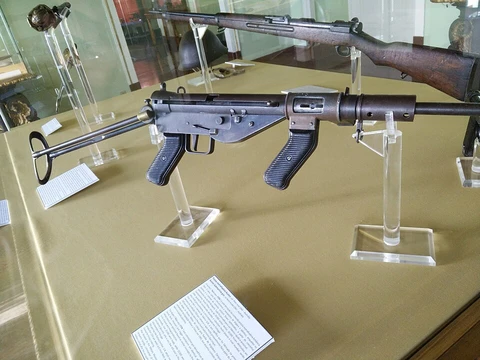
FMK-3 submachine gun
Argentine blowback submachine gun with telescoping bolt and grip safety.

The FMK-3 is an Argentine submachine gun that uses blowback operation and selective fire. It was designed by Fabricaciones Militares in 1974. By 1991, roughly 30,000 had been made for the Argentine military.
The weapon’s development traces back to the 1950s, when the Fábrica Militar de Armas Portables Domingo Matheu obtained rights to produce a copy of the U.S. M3 A1, or "Grease Gun." That Argentine version was chambered in 9×19mm instead of .45 ACP, and came in two models: the PAM 1 and PAM 2, differing by the presence of a handle latch. In the early 1970s, the factory shifted to a telescoping bolt design, which shortens the weapon and allows the magazine to sit inside the pistol grip. This concept, first developed by Jaroslav Holecek in 1946, was later used in the Sa 23, Uzi, MAC-10, and Star Z-84. The resulting Argentine model was the PA-3 DM, later renamed the FMK-3.
At first glance, the FMK-3 resembles the Uzi. It fires 9×19mm Parabellum rounds and feeds from a magazine in the pistol grip. A fire selector and a grip safety are located at the rear of the grip; the grip safety must be squeezed to fire. Above the grip, the upper receiver holds the barrel, bolt, and recoil spring. Early versions came with three stock options: a one-piece plastic fixed stock, a wooden fixed stock, or a retractable wire stock. The charging handle sits on the left side of the upper receiver, with a sliding dust cover to keep out debris. A sling holder is at the rear on the same side. The front sight is a hooded post, and the rear is an L-shaped flip sight adjustable for windage, with settings for 50 and 100 meters, all protected by side ears. The ejection port is small and located on the right side of the upper receiver.
The FMK-3 has a rate of fire of 650 rounds per minute. Available magazines hold 20, 32, or 40 rounds. It can also accept a silencer and has grenade-firing capability. Unlike many similar submachine guns, the safety, disconnect, and auto sear are positioned behind the grip, leaving only the shot selector and manual safety ahead of the trigger. The safety selector is a wing-type lever on the left, with three positions: "S" (safe), "R" (repeat), and "A" (automatic fire). An additional grip safety locks the bolt if the weapon is not held correctly, preventing firing even if the gun is ready.
Quick Facts
- Origin
- Argentina
- Is Ranged
- yes
- Service
- 1974–present
- Wars
- Argentine Dirty War / Croatian War of Independence / Falklands War / Guatemalan Civil War / Salvadoran Civil War
- Manufacturer
- Fabricaciones Militares
- Production Date
- 1974–1993
- Number
- 85,000
- Weight
- 3.4 kg (7.5 lb) empty
- Length
- 523 mm (20.6 in), stock folded / 693 mm (27.3 in), stock extended
- Part Length
- 290 mm (11.4 in)
- Cartridge
- 9×19mm Parabellum
- Action
- Blowback, open bolt
Facts from the source article.
Lore & Background
In the 1950s, the FMAP DM (Fábrica Militar de Armas Portables Domingo Matheu), part of the Dirección General de Fabricaciones Militares, acquired production rights for a copy of the U.S. M3 A1 submachine gun, chambered in 9×19mm rather than .45 ACP. Two versions, the PAM 1 and PAM 2, were released. In the early 1970s, FMAP DM redesigned the weapon to use a telescoping bolt, a concept designed by Jaroslav Holecek in mid-1946 that reduced the size of the weapon and was later popularized in the Sa 23, UZI, Ingram MAC-10, and Star Z-84. This design became the PA-3 DM, later known as the FMK-3.
The FMK-3 hosts its magazine in the pistol grip and includes a fire selector and grip safety on the rear of the grip, which must be squeezed to fire. The upper receiver houses the barrel, bolt, and recoil spring. The charging handle is on the left side of the upper receiver and has a sliding dust cover. The ejection window is small and located on the right. Sights consist of a hooded front post and a rear L-shaped flip sight adjustable for windage with 50- and 100-meter positions. The first series offered three stock versions: one-piece plastic fixed, fixed wood, and retractable wire.
The safety, disconnect, and auto sear are located behind the handle; ahead of the trigger is only the selector mechanism and manual safety. The safety selector has a wing-type lever with three positions: upper intermediate, 'S' (safe), 'R' (repeat), and 'A' (automatic fire). The grip safety locks the bolt if the weapon is not correctly grasped, preventing firing even if the gun is ready. With the bolt at rest, an empty chamber, and a full magazine, the grip safety prevents accidental discharge.
Reader's Guide
The FMK-3 represents Argentina's adaptation of the telescoping bolt concept to a domestically produced submachine gun, following earlier licensed production of the M3 A1. Its design shares the compact layout of the UZI and similar weapons, with the magazine in the pistol grip and a grip safety that enhances carrying safety. The weapon was produced in three main variants: the FMK-3 with retractable wire stock, the FMK-4 with a fixed polymer stock similar to the H&K G3, and the FMK-5 semi-automatic-only version for the civilian market. The FMK-3 was used by Argentine law enforcement and the Argentine Army, as well as the armies of Bolivia, Croatia, Guatemala, El Salvador, and Uruguay. El Salvador received more than 600 FMK-3s during the 1980s, used during the Salvadoran Civil War, and later put into storage; some were used in the 2010s by private security guards. The weapon's safety features, including the grip safety and the positioning of the sear behind the handle, were noted as making it safe to carry in any condition. Its production of around 30,000 units by 1991 indicates a moderate but significant role in Argentine and regional military and law enforcement inventories.
Did You Know?
- The FMK-3 uses a telescoping bolt concept designed by Jaroslav Holecek in mid-1946, also used in the UZI and Ingram MAC-10.
- The FMK-3 has a grip safety that locks the bolt if the weapon is not correctly grasped.
- The FMK-5 is a semi-automatic-only version of the FMK-3 produced for the civilian market.
More in Submachine Guns, Part 3 1-16
Spotted an error? Know more?
Reader corrections go straight into our review queue. Suggest an edit · How this site is sourced